Prep Tools
Cajun Marinade Injector
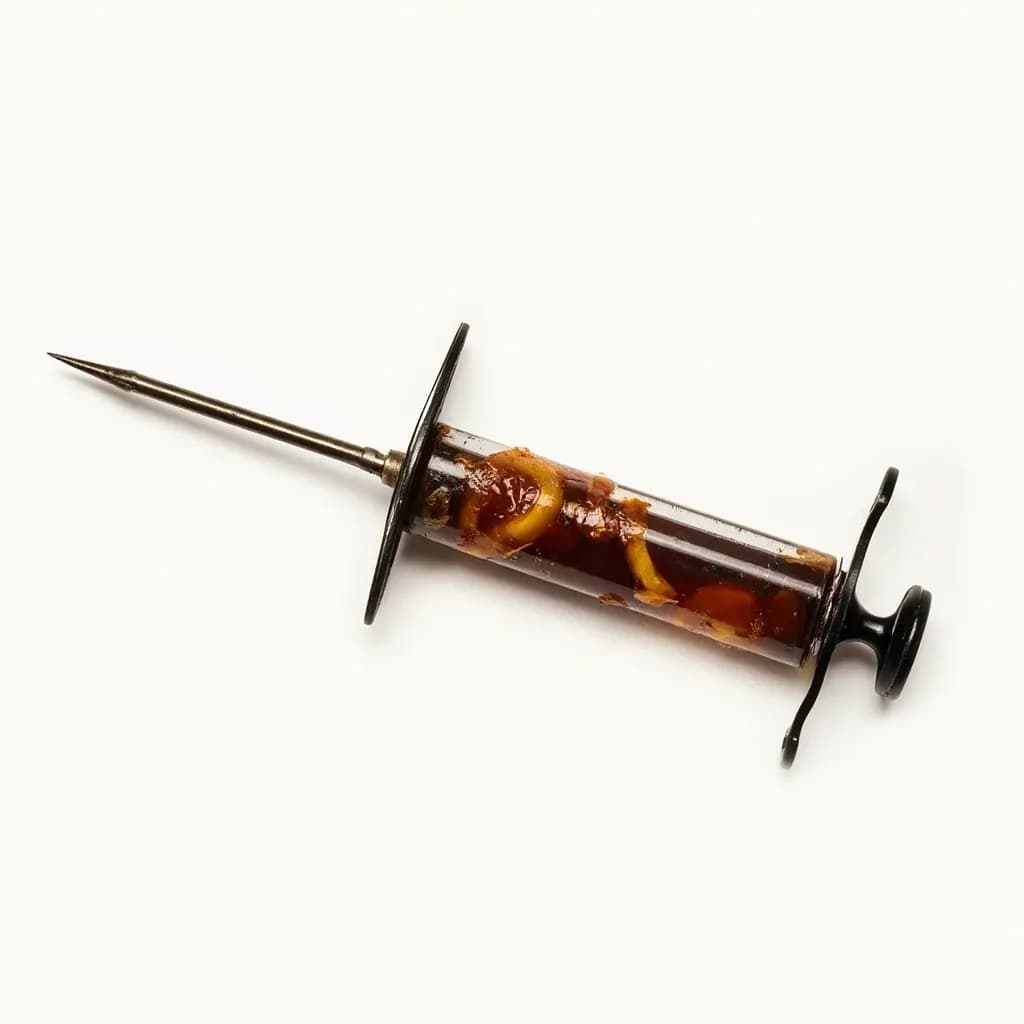
A heavy-duty syringe for pumping butter-and-spice Cajun marinade deep into turkey and roasts.
A Cajun marinade injector is a large syringe with a thick needle used to force melted-butter and Creole-spice blends into the interior of turkeys, pork, and other roasts. It is a fixture of Cajun and Southern cooking, especially for deep-fried and smoked turkey, where injected flavor reaches what a rub cannot. Wide-bore needles handle the spice particles and fat in chunky marinades without clogging.
The Cajun Marinade Injector is a heavy-duty syringe built to push seasoned liquids—most famously melted butter laced with Cajun spices—deep into the muscle of large cuts of meat. The tool itself is mechanically simple: a barrel, a plunger, and a needle. But the technique it enables transformed American turkey cookery in the 1980s, when chefs like Paul Prudhomme popularized the deep-fried, spice-injected bird that became a centerpiece of Louisiana entertaining. The injector solves a real problem that brining and surface rubs cannot: a whole turkey or pork shoulder seasoned only from the outside remains bland within, and traditional brining demands hours or days. A loaded injector delivers flavor and fat directly into the thickest portions of the meat in a matter of minutes.
Most injectors hold 1 to 4 ounces of liquid and use a stainless steel needle with a closed tip and side holes—the closed tip prevents backflow through the puncture, and the side holes disperse liquid in a fan pattern as the needle is withdrawn. Needle gauge matters more than most beginners expect: 12- or 13-gauge needles handle chunky seasoned butters with paprika, garlic, and minced onion, while 16-gauge needles are reserved for thin brines, stocks, and other thin liquids. The distinction between a "Cajun injector" and a generic marinade injector is really marketing and the included spice packets; mechanically, they belong to the same family of tools used across Cajun cooking, low-and-slow barbecue, and broader American roasting traditions.
A well-made stainless steel injector with a 2-ounce barrel and a 12-gauge closed-end needle is the standard workhorse setup most pitmasters and Louisiana home cooks reach for. Look for a replaceable rubber gasket on the plunger—once that hardens, the injector loses suction and starts leaking. It is one of the smallest, least expensive tools in the kitchen, and one of the most effective ways to put flavor where it actually counts: inside the meat, not just on the surface.
Alternatives
Types & varieties
Lightweight, low-cost starter kit; barrel may stain, cloud, or crack from repeated exposure to hot butter.
Professional workhorse; tolerates hot melted butter, resists staining, and lasts for years with a replaceable gasket.
Reduces refills when working on whole turkeys, Boston butts, or briskets.
Several needles firing at once for faster coverage on very large cuts; trades precision for speed.
Comes with multiple needle gauges and lengths matched to thin brines versus thick seasoned butters.
Heavy-duty stainless with reinforced plunger and gasket, built for restaurant volume and daily use.
Cajun Butter: The Classic Payload
The traditional payload for a Cajun injector is seasoned melted butter, often built up with garlic, paprika, cayenne, black pepper, and onion. Fat is a better carrier for fat-soluble spice compounds than water alone, and the injected butter self-bastes the meat from within as the muscle fibers contract during cooking. Common additions include lemon juice, Worcestershire, hot sauce, and a splash of stock for body. The butter must be fully liquid but not scalding—around 110–120°F is ideal—because boiling butter scorches the meat on contact and can warp or stain a plastic barrel. For a whole turkey, plan on roughly 1 to 1.5 ounces of injection liquid per pound of bird, distributed in a grid across the breast and thighs. Always strain the finished mixture through a fine-mesh sieve before loading the barrel; a single herb stem, garlic chunk, or spice flake is enough to clog the needle and force a mid-task disassembly.
- Melt butter with garlic, paprika, cayenne, and onion, then strain through a fine-mesh sieve.
- Hold the butter at 110–120°F—liquid, not boiling—so it flows freely and does not scorch the meat.
- Aim for 1–1.5 oz of injection liquid per pound of turkey or pork shoulder.
- Reserve a portion of the un-injected butter for basting during the cook to reinforce surface flavor.
Common uses
Tips & pitfalls
- Strain the marinade through a fine-mesh sieve before loading—any spice flake or herb stem will clog the needle mid-injection.
- Warm melted butter to liquid but not scorching, around 110–120°F; too hot warps plastic barrels and sears the meat on contact.
- Inject in a grid pattern across the thickest parts of the meat, spacing holes about 1.5–2 inches apart, and concentrate on the breast and thighs of poultry—those are the sections that dry out fastest.
- Insert the needle fully, then withdraw slowly while depressing the plunger so the liquid fans along the channel instead of pooling in one pocket.
- Do not inject partially frozen meat—ice crystals will block the needle and produce wildly uneven distribution.
- Avoid injecting too close to the surface; shallow injection causes visible bleed-out through the skin or cut sides.
- Let the meat rest 30–60 minutes after injecting so the liquid migrates through the muscle before it hits heat.
- Disassemble and wash the injector immediately after use; hardened butter sets in the barrel and is miserable to clear.
Good to know
- Type
- Syringe-style flavor injector
- Typical capacity
- 1–4 oz (30–120 mL); 2 oz is the workhorse size
- Needle
- Stainless steel, closed-end with side holes (standard)
- Needle gauge
- 12–14 gauge for thick Cajun butters; 16 gauge for thin brines and stocks
- Barrel material
- Stainless steel (pro) or food-grade plastic (entry-level)
- Cleaning
- Disassembles for hand-washing; many models are top-rack dishwasher safe; can be boiled to sterilize
- Technique origin
- Popularized in 1980s Cajun and Louisiana cooking for deep-fried turkey, associated with Paul Prudhomme's blackened/Cajun style
- Price range
- $10–$40 for consumer plastic; $40–$80+ for heavy-duty stainless models
Also called
marinade injector · meat injector · Creole injector
Related

Peeler
Swift blade for stripping skin off fruit and vegetables

Grater
Sharp-toothed surface for shredding cheese and vegetables

Microplane
Ultra-fine rasp for citrus zest, garlic, and hard cheese

Mixing Bowl
All-purpose bowl for combining, whisking, and tossing

Whisk
Looped wires that beat air into eggs, cream, and sauces

Spatula
Flat blade for flipping, lifting, and scraping

Slotted Spoon
Pierced spoon that lifts solids and drains the liquid behind

Wooden Spoon
Gentle, heat-friendly spoon for stirring anything