Prep Tools
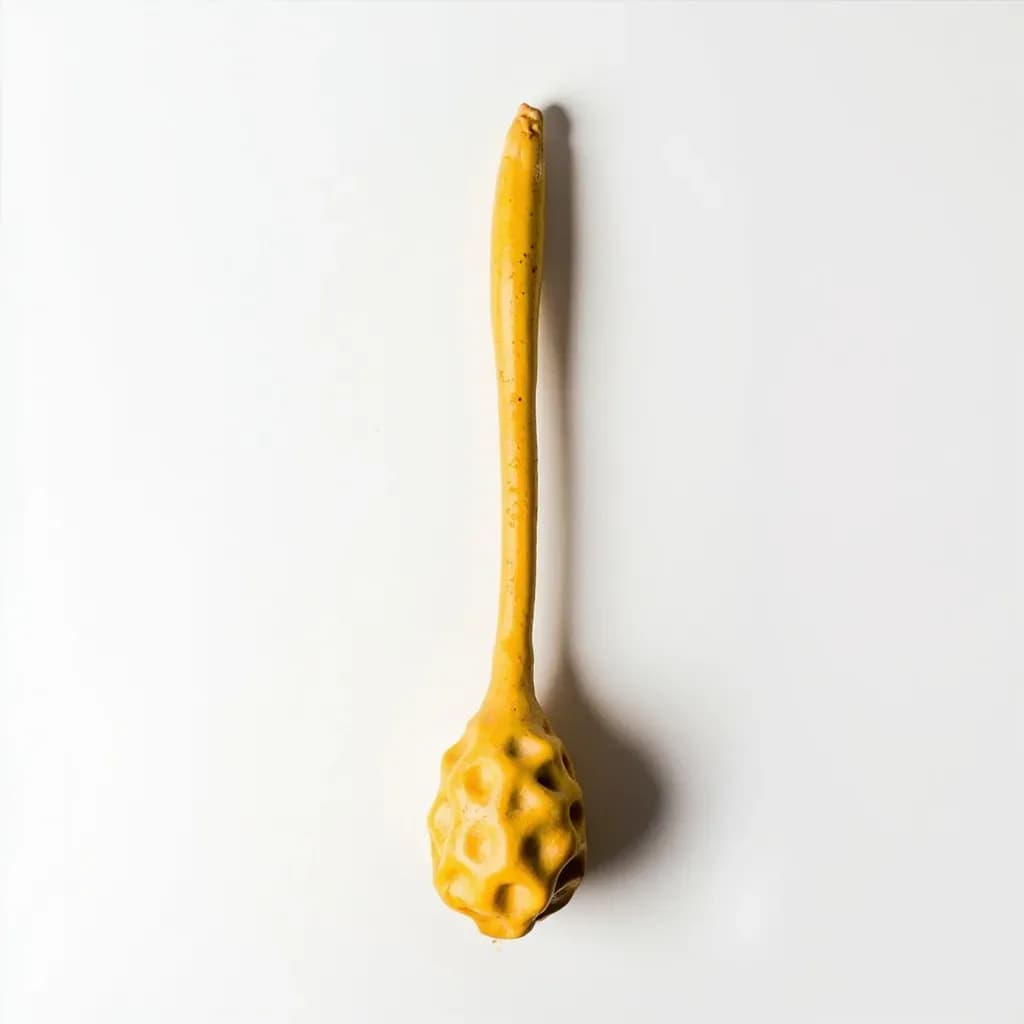
Calabash Ladle (Mukombe)
A scooping ladle carved from a dried gourd, used to serve porridge, water, and stews.
A calabash ladle, called mukombe in parts of Southern Africa, is made from a dried, hollowed gourd cut to form a bowl and handle. It is used to scoop and serve thick porridges, soups, water, and traditional brews across many African kitchens. The natural gourd is lightweight, heat-tolerant, and imparts no metallic taste to the food.
The calabash ladle — known as mukombe across many Bantu languages — is a serving utensil carved from a single dried bottle gourd (Lagenaria siceraria). The cured gourd is hollowed and finished so that the bowl and a long, slim handle form one continuous piece, typically 30–50 cm (12–20 in) overall, with smaller sauce dippers running closer to 20 cm. Across Southern and Eastern Africa — Zambia, Malawi, Zimbabwe, Tanzania, Mozambique, and the DRC — it is the traditional tool for moving food from a shared cooking pot to the plate or onto a woven serving mat.
What makes the mukombe more than a rustic scoop is the natural behavior of the gourd itself. Once seasoned with food-safe oil, the shell becomes supple and water-resistant, holding cool drinking water without weeping and releasing stiff maize porridges cleanly from its curved walls. The long handle keeps the hand well away from steam and hot pot lips, and lets the server reach the bottom of a three-legged cooking pot or a clay water vessel. It belongs to a wider family of gourd utensils — drinking cups, water pots, and storage containers — all shaped from the same vine-borne fruit and finished by hand.
Treat the mukombe as a serving vessel, not cookware. It should never go near a fire, stovetop, or oven, and it should never sit in standing water. With periodic oiling and quick towel-drying after each wash, a well-made ladle lasts for years, developing a soft patina with use.
Alternatives
Types & varieties
Extended handle and deep bowl; used to draw and serve cool water from clay pots (mbiya) and large calabash containers.
Sturdier, rounder bowl sized for scooping stiff maize porridges such as nsima, sadza, ugali, nshima, or pap.
Smallest form, used to serve stews, beans, groundnut sauces, and vegetable relishes alongside the main starch.
Larger gourds finished with incised, pyrography, or geometric patterns; reserved for honoured guests and ceremonies.
How a calabash ladle is made
Every mukombe begins as a fruit on a vine. Bottle gourds are left to mature and dry on the plant for several months until the outer skin hardens, the interior pulp dries to a papery layer, and the seeds rattle inside. The dried gourd is then cut to size, the seeds and pith scraped out, and the walls thinned by hand until only the hard woody shell remains. The handle is shaped from the neck of the same gourd — which is why the bowl and handle are one piece rather than joined — and the interior is smoothed and finished. The completed ladle is conditioned with food-safe oil before its first use, which closes the pores and makes the gourd water-resistant.
Common uses
Tips & pitfalls
- Never soak a calabash ladle in standing water — the dried gourd absorbs moisture, swells, and will crack or grow mould.
- Before first use, rub the interior (and ideally the exterior) with food-safe oil such as sunflower, groundnut, or coconut oil and let it sit overnight to condition the gourd.
- Re-oil every few weeks, or whenever the surface looks pale and dry, to keep it supple and water-resistant.
- Wash by hand with warm water and a mild soap, rinse quickly, and towel-dry immediately; dishwashers will destroy it.
- Do not use the mukombe over a fire, on a stovetop, or in an oven — calabash is a serving vessel, not cookware, and direct heat will scorch or split it.
- Store in a dry, well-ventilated spot out of direct sunlight to prevent warping, fading, and cracking.
- If the ladle develops an off smell, rinse it with a dilute vinegar solution, dry it thoroughly, then re-oil before next use.
- If the gourd becomes too dry and brittle, lightly sand the inside and re-oil; deep cracks usually mean the ladle has reached the end of its working life.
Good to know
- Material
- Dried calabash gourd (Lagenaria siceraria, the bottle gourd)
- Origin / cultural range
- Sub-Saharan Africa, particularly Southern and Eastern Africa (Zambia, Malawi, Zimbabwe, Tanzania, Mozambique, DRC)
- Other names
- Mukombe (Bantu languages), calabash dipper, gourd ladle
- Form
- One continuous piece — deep bowl with an integrated long, slim handle, carved from a single gourd
- Typical overall length
- Roughly 30–50 cm (12–20 in); sauce dippers around 20 cm
- Use type
- Serving only — not for stovetop, oven, or open-fire cooking
- Care
- Hand wash, towel-dry immediately, oil periodically with food-safe oil
- Lifespan
- Years when seasoned and kept dry; brittle if allowed to desiccate completely
Also called
mukombe · gourd ladle · calabash dipper
Related

Peeler
Swift blade for stripping skin off fruit and vegetables

Grater
Sharp-toothed surface for shredding cheese and vegetables

Microplane
Ultra-fine rasp for citrus zest, garlic, and hard cheese

Mixing Bowl
All-purpose bowl for combining, whisking, and tossing

Whisk
Looped wires that beat air into eggs, cream, and sauces

Spatula
Flat blade for flipping, lifting, and scraping

Slotted Spoon
Pierced spoon that lifts solids and drains the liquid behind

Wooden Spoon
Gentle, heat-friendly spoon for stirring anything