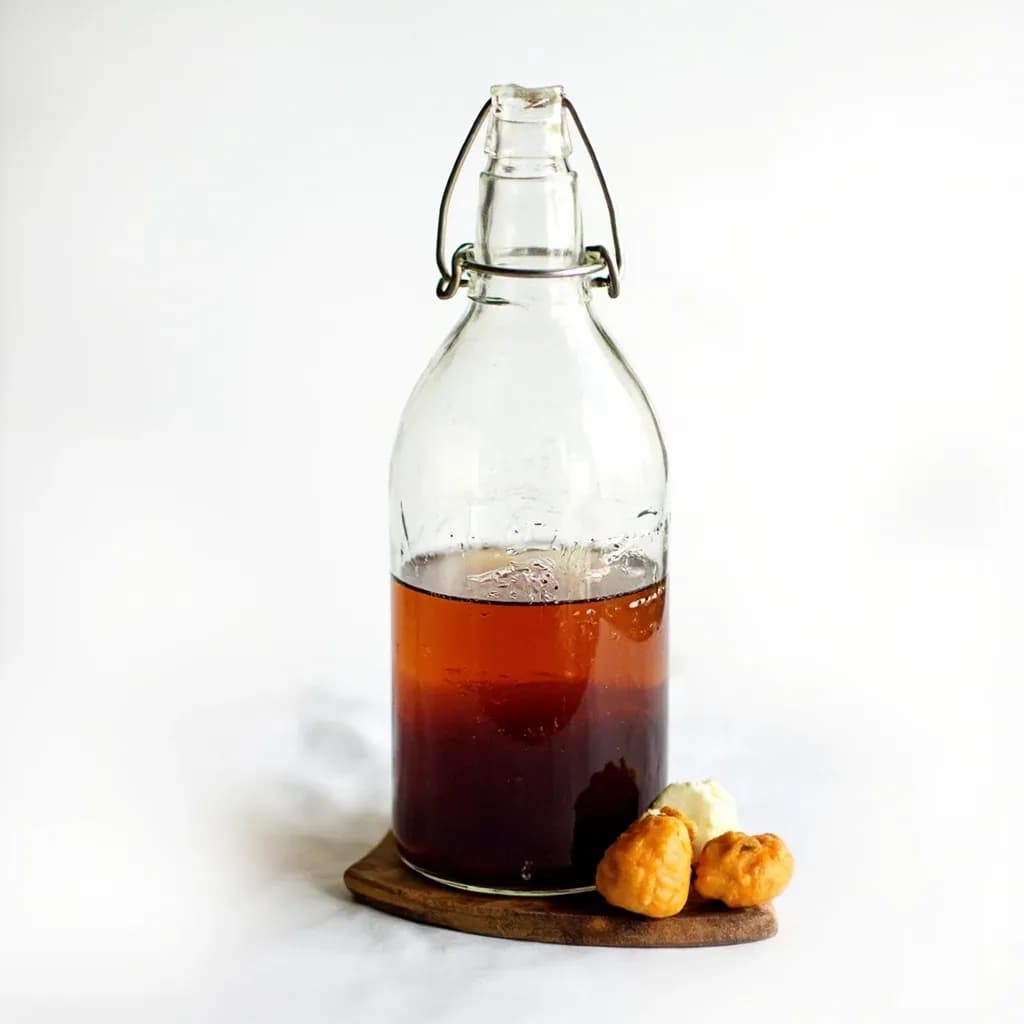
Prep Tools
Glass Carboy (Demijohn)
A large narrow-necked glass jug for fermenting and aging wine, cider, and mead.
A glass carboy, or demijohn, is a big-bellied, narrow-necked glass vessel used to ferment and age beverages with minimal air contact. Winemakers, cider and mead makers, and brewers use it for secondary fermentation and bulk aging, fitting an airlock in the neck. The clear glass lets you watch clarity and sediment, and the small neck limits oxidation during long aging.
A glass carboy — also called a demijohn, from the French dame-jeanne, or simply "Lady Jane," a term that entered English in the 17th and 18th centuries — is a thick-walled, narrow-necked vessel used for fermenting, aging, and storing liquids. Its body is typically cylindrical or slightly bulbous, capped by a neck only a few centimeters wide that accepts a rubber or silicone stopper (#6 through #8.5) fitted with an airlock or blow-off tube. Standard home-brewing sizes run from 1 to 6.5 gallons, with 12.5- and 15-gallon versions serving small commercial wineries. The narrow opening is intentional: it limits oxygen ingress and CO2 loss while still allowing gas to vent during active fermentation.
Glass earns its place in fermenting because it is chemically inert — neither absorbing nor imparting flavor — and essentially impermeable to oxygen when sealed properly. You can also see exactly what is happening inside: the krausen rising and falling, lees compacting, liquid clearing, color deepening. That visibility is a working tool, not a curiosity, because it tells you when to rack, when fermentation has stalled, when a wine has clarified, and whether anything has gone wrong — a vinegar mother creeping up the side, a pellicle forming on a sour beer, sediment disturbed by a careless move. No plastic or steel vessel offers that direct observation.
The trade-offs are real and worth respecting. A full 5-gallon carboy weighs roughly 55 lb, and the glass is unforgiving if dropped on a hard floor. Clear soda-lime glass transmits the full visible spectrum, including UV that skunks hop compounds and degrades delicate wine pigments, so carboys must live in darkness or be wrapped. Compared with PET plastic carboys (lighter and shatter-resistant but easily scratched and slowly oxygen-permeable over years) and stainless variable-volume tanks (expensive but excellent for commercial volumes and long aging), glass remains the small-batch default because it is durable, easy to sanitize, and visually informative.
Alternatives
Types & varieties
Cylindrical or slightly bulbous body with a flat bottom and narrow neck; the most common home-brewing form.
Molded handle near the neck for two-handed carrying; rounded shoulders and slightly heavier glass.
Traditional form encased in woven wicker or basketry to protect the glass; still produced in Italy, Spain, and Portugal for wine, oil, and vinegar.
Inward-pointing base like a wine bottle punt; adds structural strength and helps consolidate sediment.
1–3 gallon sizes for experimental batches, mead trials, or single-barrel wine varietals.
12.5–15 gallon vessels for commercial or serious hobbyist wine production.
Tinted glass variant (less common) that filters UV to protect light-sensitive beer styles like hefeweizens and pilsners.
Headspace, closures, and fermentation phases
The relationship between fill level and closure is the single most useful thing to internalize about working with a carboy. During active primary fermentation, yeast produces CO2 vigorously and a krausen — a foam of yeast cells, proteins, and hop or fruit debris — can climb several inches up the neck. Leave 10–20% headspace, typically a fist's width between the liquid surface and the bottom of the stopper, or risk a blowout in which fermenting liquid pushes past the airlock and creates a sticky mess. Once vigorous fermentation has tapered, top up with similar liquid so the surface sits within an inch or two of the stopper; this minimizes the ullage of oxygen-rich headspace that can oxidize a finished wine or sour beer during long aging.
- For wine and mead, fill the carboy to within 1–2 inches of the stopper before racking to secondary; this limits oxygen exposure during months of aging.
- During primary, fit a blow-off tube (length of tubing running from the stopper into a jar of sanitizer) for anything prone to explosive krausens — wheat beers, hefeweizens, big IPAs, and most fruit wines.
- Replace the blow-off with a three-piece airlock once fermentation activity drops below roughly one bubble per minute.
- Size the rubber stopper to the carboy's neck; a #6.5 or #7 fits most 5- and 6-gallon carboys, but Italian-handled and older models sometimes require a #8.5.
- A solid (non-vented) stopper is appropriate only for fully fermented, topped-up vessels that will not produce more CO2 — typically late-stage wine and finished vinegar.
Glass, PET, and stainless: choosing the right fermenter
Glass is not always the right answer. PET plastic carboys (the 'Better Bottle' style) weigh roughly a third as much as glass, shrug off drops, and are popular for primary fermentation where krausen blowouts and heavy lifting are most common. Their weaknesses are surface scratching that harbors bacteria, gradual oxygen permeability that matters for storage beyond a year, and an inability to be sanitized at very high temperatures. Stainless steel variable-volume tanks are the professional choice for volumes above 15 gallons and for extended aging of white wines and delicate beers; they are expensive but last decades, are oxygen-tight with a proper lid, and clean easily. A working kitchen or small winery often keeps all three: glass for visual monitoring of small lots, PET for messy primaries, and stainless for bulk aging.
- Choose glass when clarity, sanitation visibility, or long-term inert storage matter most.
- Choose PET for large primary fermentations, situations where breakage is a real risk, or batch sizes over 6 gallons on a budget.
- Choose stainless for commercial volumes, repeated temperature-controlled ferments, or aging wine longer than a year.
- Wicker-wrapped demijohns remain a practical vessel in parts of southern Europe — and a decorative object that happens to ferment very well.
Common uses
Tips & pitfalls
- Sanitize after scrubbing with a long-handled carboy brush and a no-rinse sanitizer like StarSan or One-Step; sanitizer alone cannot penetrate tannin or protein films.
- Never move a full carboy alone — even 5 gallons of liquid weighs roughly 42 lb on top of the vessel's own 12–15 lb; use a carboy carrier, Brew Hauler harness, or a second person and lift from the base, never the neck.
- Use a blow-off tube during vigorous fermentation instead of an airlock; trusting a small three-piece airlock on an active wheat-beer primary often ends in a sticky blowout.
- Store out of direct sunlight — UV causes light-struck (skunky) off-flavors in hop-forward beers and degrades color in pale wines; even indirect daylight over weeks is enough to do damage.
- Inspect every carboy before use for cracks, chips around the lip, or stress fractures near the neck; a single hairline crack can fail catastrophically under the weight of a full batch — discard any damaged vessel.
- Rack with a wine thief or auto-siphon rather than pouring; splashing introduces oxygen that oxidizes delicate aromatics and accelerates staling in wine and mead.
- Avoid thermal shock — never pour boiling or ice-cold liquid into a carboy at the opposite extreme; let liquids equilibrate to within 10–15°F of the vessel's contents first, or the glass can crack.
- Clean carboys promptly after emptying; dried tannin, protein, and sediment deposits become far harder to remove and can harbor bacteria that infect the next batch.
Good to know
- Also known as
- Demijohn, glass fermenter, glass secondary
- Origin of name
- From French 'dame-jeanne' ('Lady Jane'); term entered English in the 17th–18th century
- Material
- Thick-walled clear soda-lime glass (occasionally borosilicate)
- Common sizes
- 1, 3, 5, 6, 6.5, 12.5, and 15 gallon (≈4–57 L)
- Empty weight (5 gal)
- Approximately 12–15 lb (5.5–7 kg)
- Closure
- Rubber or silicone bung (#6, #6.5, #7, or #8.5) with airlock or solid stopper
- Light transmission
- Clear glass transmits the full visible spectrum; protect from sunlight and UV
- Oxygen permeability
- Essentially zero — fully airtight with proper stopper
- Cleaning tools
- Long-handled carboy brush; no-rinse sanitizer such as StarSan or One-Step
Also called
Demijohn · Carboy · Fermentation Jug
Related

Peeler
Swift blade for stripping skin off fruit and vegetables

Grater
Sharp-toothed surface for shredding cheese and vegetables

Microplane
Ultra-fine rasp for citrus zest, garlic, and hard cheese

Mixing Bowl
All-purpose bowl for combining, whisking, and tossing

Whisk
Looped wires that beat air into eggs, cream, and sauces

Spatula
Flat blade for flipping, lifting, and scraping

Slotted Spoon
Pierced spoon that lifts solids and drains the liquid behind

Wooden Spoon
Gentle, heat-friendly spoon for stirring anything