Cookware
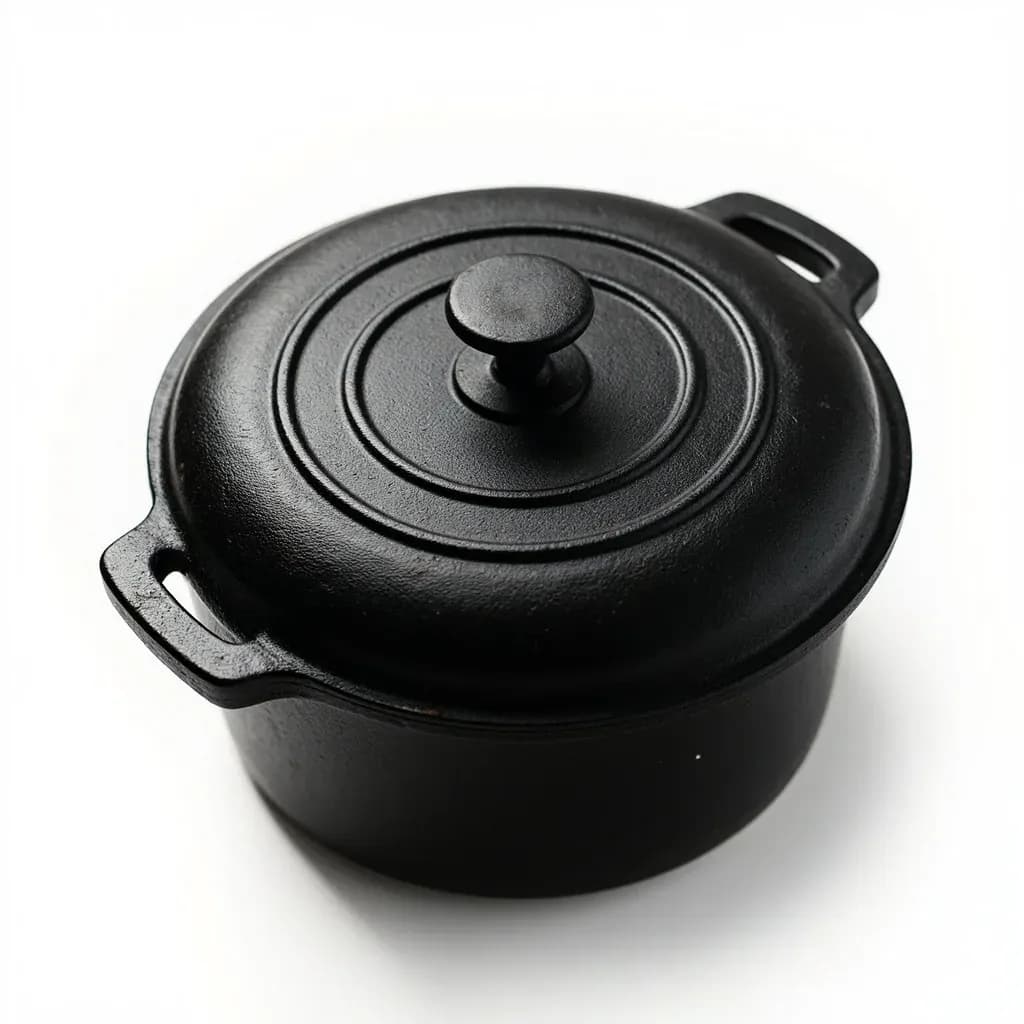
Cast-Iron Pot
Heavy iron pot that retains and radiates heat for braises, stews, and slow cooking.
A cast-iron pot is a thick, heavy vessel that holds and radiates heat exceptionally well, making it ideal for braising, stewing, deep-frying, and slow-cooked dishes. Bare cast iron must be seasoned to build a non-stick patina and protect against rust, while enameled versions need no seasoning and handle acidic foods. Its mass keeps temperatures steady but makes it slow to heat and heavy to lift.
A cast-iron pot is a lidded, heavy-walled cooking vessel made by pouring molten iron into a sand mold, then finishing it either as bare seasoned iron or with a porcelain-enamel coating. Its defining trait is thermal mass: the thick walls and tight lid absorb, hold, and slowly release heat, smoothing out the temperature swings of a stovetop or oven. Even a modest preheat leaves the pot with stored heat to give back once cold food goes in, which is exactly what braises, stews, and bread baking need.
The cook faces one main fork in the road: bare seasoned cast iron or enameled cast iron. Bare iron heats a touch faster, develops a genuinely nonstick surface with use, tolerates metal utensils, and is the traditional choice for searing and bread baking. Enameled iron costs more, but its glass-smooth interior shrugs off acidic ingredients like tomatoes and wine, doesn't demand a seasoning routine, and comes in colors that go straight to the table. Both work on every stovetop, including induction, and both shrug off oven heat that would scorch lighter pans.
What unifies them is what they do best: long, gentle cooking of tough proteins and dense vegetables, plus the unusual trick of trapping steam around a dough to mimic a brick hearth oven. The pot you reach for when a recipe asks for a 'Dutch oven' is almost always a cast-iron pot of this type.
Alternatives
Types & varieties
Uncoated cast iron with a lid; needs oil seasoning, darkens with use. Favored for bread baking, searing, and outdoor cooking.
Cast iron coated inside (and usually outside) with porcelain enamel; no seasoning needed, handles acidic foods, dishwasher-tolerant.
Bare cast-iron model with three short legs and a flanged, concave lid that holds hot coals; built for open-fire cooking.
Most common shape; efficient burner footprint and the right geometry for boule-shaped bread.
Holds whole poultry, large roasts, and long fish; capacity typically 9–13 qt.
Brand-marketing name (notably Le Creuset) for the enameled round Dutch oven.
French word for a lidded casserole; in modern retail it usually means a shallow enameled cast-iron braising dish.
Bare vs. Enameled: Choosing the Right Finish
The decision comes down to what you cook and how much upkeep you want. Bare seasoned iron is cheaper, slightly more responsive to temperature changes (the iron is in direct contact with food), and only gets better with decades of use — the patina becomes a true nonstick surface. It's the right choice for bread baking, searing, and high-heat stovetop work, and it shrugs off metal tools and the occasional overheated moment. The trade-off is maintenance: towel-dry and oil it after washing, and avoid long, acidic braises (tomato sauce, wine-heavy stews) that can strip seasoning and lend a metallic note.
Enameled iron trades a measure of thermal responsiveness for convenience. The porcelain coating is essentially glass fused to the iron, so it needs no seasoning, tolerates tomatoes and wine indefinitely, and washes clean with soap and a soft sponge. The surface is more delicate — chips if dropped or banged with a metal spoon — but it can't be damaged by acid and won't tint pale sauces the way thin seasoning sometimes can. Many serious home cooks end up with one of each: enameled for weeknight braises and acidic dishes, bare iron for bread and stovetop sears.
Sizing: Which Pot for Which Job
The 5.5-quart / 26-cm round is the all-purpose home size. It fits a whole chicken, a three-pound short-rib braise, a one-pound loaf of bread, and a generous stew for four. Smaller 3.5-quart rounds are right for side dishes and one- or two-person meals, while a 7.25-quart round handles a holiday side or a big batch of pasta sauce. Oval pots in the 9- to 13-quart range exist for whole turkeys, standing rib roasts, and long fish that won't fit a round footprint. As a rule, buy the pot you'll actually use at least weekly: an oversized pot that needs the burner on high to brown a small stew is a worse tool than a properly sized one.
The Bread-Baking Trick
A preheated cast-iron pot is unrivaled among home cookware for trapping a loaf's own steam against fierce, radiating heat, mimicking the spray-and-load of a professional hearth oven. The lid stays on for the first 20–30 minutes to lock in moisture (which delays crust formation and lets the loaf spring fully), then comes off so the crust can dry and brown. Both bare and enameled pots work well here; bare iron is the traditional choice because it's inexpensive to subject to repeated 450–500°F cycling and its dark walls absorb and reradiate heat efficiently, while enameled pots bake bread just as successfully and many bakers use them. A 4-quart round is favored for smaller, tightly shaped loaves; the 5.5-quart round is the all-purpose size and handles a standard 1-pound boule with room to spare, while larger loaves step up to a 7-quart round or an oval.
Common uses
Tips & pitfalls
- Preheat an enameled pot low and slow. An empty pot over medium-high heat can craze or crack the enamel; gentle preheating is enough on bare iron too and protects the seasoning.
- Match the burner to the base. Flames licking up the sides waste fuel and overheat enamel rims on gas stoves; an induction or correctly sized gas flame should just cover the bottom.
- Use wood, silicone, or nylon tools inside enameled pots. Metal utensils are fine on bare cast iron and won't strip a healthy seasoning.
- Avoid thermal shock: never set a screaming-hot pot on a wet or cold stone counter, and never pour ice-cold liquid into a dry pot cranked on high. Let it cool briefly before rinsing, or rinse with hot water.
- Lift, don't slide, a heavy enameled pot across glass or stone cooktops — the weight can crack the surface, and the enamel rim can chip on contact.
- For bread baking, preheat the empty covered pot in a 450–500°F / 230–260°C oven for 45–60 minutes so the walls deliver a sharp burst of heat for maximum oven spring.
- Dry bare cast iron immediately after washing (towel first, then a brief return to the burner), and wipe a thin film of neutral oil onto the warm surface. Don't soak it.
- Store with the lid slightly ajar or a paper towel tucked between pot and lid so residual moisture doesn't grow mildew or rust the seasoning. Stack enameled pieces with a cloth between them — the enamel chips easily on contact.
Good to know
- Material
- Cast iron, either bare/seasoned or coated with porcelain enamel
- Typical home sizes
- 3.5 qt round, 5.5 qt round (the workhorse), 7.25 qt round, and 9–13.25 qt oval
- Weight (5.5 qt enameled)
- Roughly 11–15 lb / 5–7 kg
- Heat tolerance
- Safe to 500°F / 260°C in the oven; enameled versions are stovetop- and oven-safe to the maker's stated limit
- Heat retention
- Very high; thick walls and tight lid hold and radiate steady heat
- Induction compatibility
- Yes — cast iron is ferromagnetic and works on every stovetop, including induction
- Lid feature
- Tight-fitting; Staub lids have raised self-basting spikes (picots); Le Creuset lids have a smooth dome with a sand-cast dimple
- Origin
- Sand-cast iron cookware dates to 17th-century Netherlands and early 18th-century England (Abraham Darby's sand-casting process, 1707); the enameled version was commercialized in the early 20th century (Le Creuset founded 1925 in Fresnoy-le-Grand, France)
Also called
cast-iron-pot · iron-pot
Related

Steamer
Gentle moist heat that keeps vegetables, fish, and dumplings tender

Frying Pan
Shallow sloped pan for frying, sautéing, and quick sears

Saucepan
Tall, straight-sided pot for sauces, grains, and small batches

Sauté Pan
Wide straight-sided pan with room to brown and braise

Dutch Oven
Heavy lidded pot that turns tough cuts tender over hours

Stock Pot
Tall, roomy pot for stocks, pasta, and big-batch cooking

Wok
High-sided bowl pan built for blistering-hot stir-fries

Griddle
Flat, broad surface for pancakes, smash burgers, and breakfast