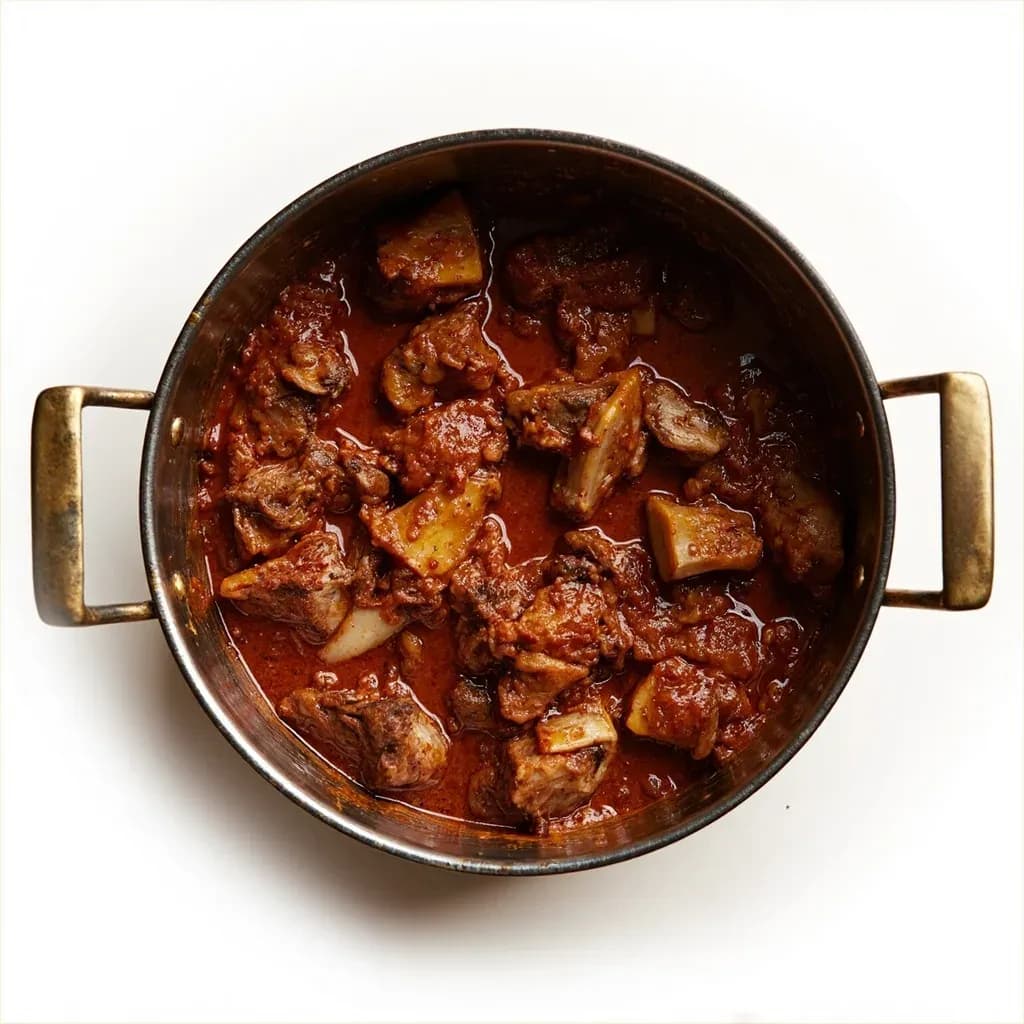
Cookware
Copper Cazo (Carnitas Pot)
A wide, deep copper pot used to slow-fry pork into carnitas over an open flame.
A cazo is a large, rounded copper basin traditionally used in Mexico to confit pork in its own lard for carnitas. The copper conducts heat evenly and quickly, helping the meat brown and the fat render without scorching. It is also used for frying chicharrones and cooking large batches of caramel candies like cajeta.
A cazo is a wide, shallow copper cauldron — the defining tool of Michoacán carnitas culture and the reason a pot of bubbling pork on a Quiroga street corner looks so different from a stew. The shape is the whole point: a cazo is far broader across the top than it is deep, often roughly twice as wide as it is tall, so steam and moisture can escape readily as the meat cooks. That geometry is what allows the pork to transition from a wet braise to a true confit-style fry in its own rendered fat, producing the crisp-edged, tender-centered chunks that distinguish real carnitas from pot-roasted pork.
Copper is the traditional material for sound reasons. It conducts heat roughly twice as efficiently as aluminum and far better than stainless steel, spreading flame-driven heat evenly across the broad bottom and up the curved sides of the pot. That uniformity matters once the braising liquid has evaporated and the pork is frying in two or three centimeters of its own accumulated lard — hot spots would scorch the meat long before the interior rendered. Traditional cazos are hand-hammered from 2.5–4 mm copper sheet and tin-lined on the interior, a craft maintained by coppersmiths in Santa Clara del Cobre and surrounding towns since the colonial era.
A well-tended cazo is a multi-generational tool. Families and carnitas stands pass them down for decades, retinning the interior every few years and drying the pot thoroughly after each wash to prevent the green verdigris that forms on damp copper. The same pot that rendered lard for a grandfather's Sunday carnitas will do the same for his grandchildren, so long as the lining is kept intact and the copper is never scorched dry or scrubbed with abrasives.
Alternatives
Types & varieties
The classic Michoacán version, tin-lined; made in Santa Clara del Cobre and surrounding towns.
Older or budget versions; can react with salty or acidic foods and need more careful maintenance.
Restaurant workhorse — durable and easy to clean, but conducts heat poorly and tends to develop hot spots.
Slow to heat but retains heat well; used by some traditionalists for outdoor wood-fired setups.
Lightweight and inexpensive; heats fast but reacts with acidic ingredients and lacks the thermal mass of copper.
A dedicated outdoor firebox of brick or stone built to cradle the cazo over a log fire — the classic cooking setup.
Why the Wide, Shallow Shape
A standard stockpot traps steam above the meat, which keeps everything wet and produces something closer to pulled pork or stew. The cazo is engineered to do the opposite: lose moisture as fast as possible. A broad, shallow basin with a wide mouth presents maximum surface area to the air, so the initial braising liquid boils off in 30–45 minutes and the pork drops into pure hot fat. That wet-to-dry transition is what gives carnitas its signature contrast of crackling edges and moist, tender centers. The sloping or straight sides also help the rendered fat climb and re-coat the meat as it is stirred and skimmed.
- Surface-area-to-volume ratio is the key engineering feature — more surface means faster evaporation.
- Sloping sides let rendered fat climb and re-baste the upper layer of pork as it is stirred.
- The open mouth lets the cook skim, baste, and turn the meat constantly — a defining part of the craft.
- Tall, narrow pots cannot replicate this effect; the pork will steam rather than confit.
The Michoacán Method in a Cazo
Traditional carnitas cookery follows a precise sequence that the cazo makes possible. The cook starts a wood fire — oak or mesquite is typical — and sets the empty cazo over it. A few centimeters of water, milk, or fresh orange juice goes in first, along with the pork pieces and a generous amount of salt. As the liquid simmers, the meat cooks through gently, fat renders, and the volume of liquid in the pot shrinks. Once it has fully evaporated — usually after 45 minutes to an hour — the pork is frying in its own accumulated lard. From here the cook skims, stirs, and raises the heat, crisping the exterior until the edges of some pieces approach chicharrón. Different cuts are added at different times so shoulder, belly, and cheek all finish tender at roughly the same moment.
- Stage 1: water, milk, or fresh orange juice plus pork and salt; gentle simmer.
- Stage 2: liquid evaporates and the pork drops into its own rendered lard.
- Stage 3: heat rises, stirring increases, and the exterior crisps.
- Stagger cuts by cooking time — shoulder first, belly next, cheek last.
- Some Quiroga stands add a measure of Coca-Cola during the cook for color and a touch of sweetness.
Common uses
Tips & pitfalls
- Start with a few centimeters of water, milk, or fresh orange juice in the bottom of an empty cazo. The liquid gently braises the meat through its first stage, then evaporates so the pork finishes frying in its own rendered fat — this is the heart of the Michoacán method.
- Cut pork into uniform 5–8 cm chunks. Uneven pieces burn on the edges while staying raw in the center, since smaller chunks render and crisp long before larger ones do.
- Maintain a layer of rendered lard at least 2–3 cm deep between batches. A dry cazo scorches the pork and the copper, and once the tin lining is burned through, the pot must be retinned before it can be used for food again.
- Use wood spoons or smooth-edged stainless skimmers — sharp or abrasive metal tools can gouge the tin lining, exposing copper that will transfer a metallic taste to the meat.
- Retin the interior every 2–3 years of heavy use, or sooner if bare copper patches appear. Bare copper in contact with salty, fatty food gives a metallic off-flavor and should not be used for cooking.
- Do not overcrowd the pot. The pork should sit in a loose, single-ish layer so steam can escape; a packed mound will steam itself, never crisp, and stay pale and gray.
- Bring the cazo up to heat gradually over 15–20 minutes. Cold copper plunged into a roaring fire can warp, especially in thinner modern pieces.
- Dry the cazo thoroughly after every wash and store it in a dry place. Copper left damp develops green verdigris that must be polished off before the next cook, and prolonged moisture will pit the metal.
Good to know
- Origin
- Michoacán, Mexico; particularly the Quiroga and Lake Pátzcuaro region
- Traditional material
- Hand-hammered copper, 2.5–4 mm thick, with a tin-lined interior
- Geometry
- Wide and shallow — typically about twice as wide across the top as it is deep, to maximize evaporation
- Home size
- Roughly 5–10 gallons (20–40 L)
- Commercial size
- 20–50 gallons (75–190 L); large enough for whole pork legs or multiple shoulders
- Heat source
- Traditionally a wood fire (oak or mesquite); modern setups use high-BTU gas burners
- Lining and care
- Tin (estañado); retinned every 2–3 years of heavy use, and dried thoroughly after washing to prevent verdigris
- Cook time
- 2–4 hours per batch, depending on quantity and cut
Also called
Copper Cazo · carnitas pot · cazo de cobre
Related

Steamer
Gentle moist heat that keeps vegetables, fish, and dumplings tender

Frying Pan
Shallow sloped pan for frying, sautéing, and quick sears

Saucepan
Tall, straight-sided pot for sauces, grains, and small batches

Sauté Pan
Wide straight-sided pan with room to brown and braise

Dutch Oven
Heavy lidded pot that turns tough cuts tender over hours

Stock Pot
Tall, roomy pot for stocks, pasta, and big-batch cooking

Wok
High-sided bowl pan built for blistering-hot stir-fries

Griddle
Flat, broad surface for pancakes, smash burgers, and breakfast