Appliances & Heat
Wood-Fired Hearth
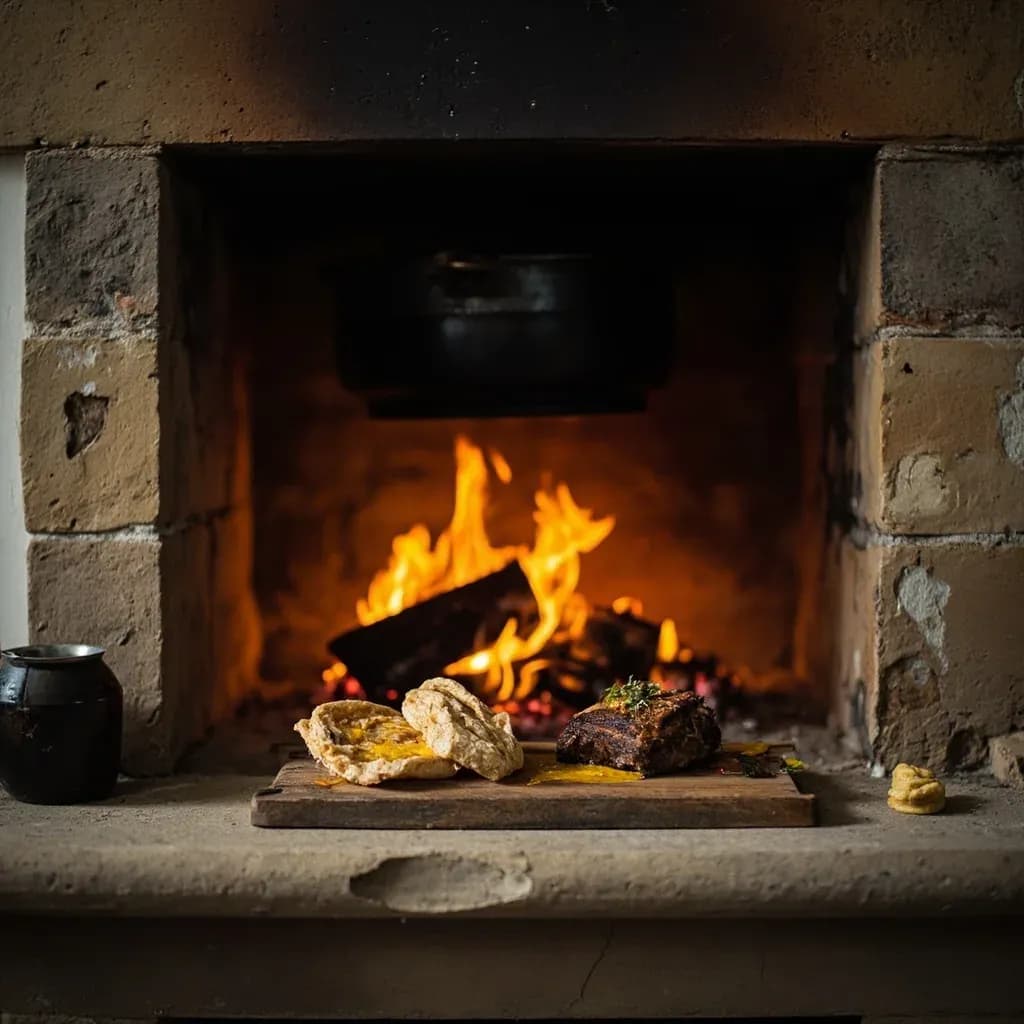
A built-in masonry fireplace hearth where food is cooked over and beside a live wood fire.
A wood-fired hearth is a stone or brick fireplace built into the kitchen, used both to heat the home and to cook. Pots hang over the flames or rest on a grate, while embers raked to the side roast, grill, or slow-cook food with woodsmoke flavor. Known across cultures as fogao de lenha, kamin, or ognjiste, it remains a daily cooking heat source in rural homes.
A wood-fired hearth is not a stove with a fire in it; it is a kitchen organized around a single fire. Built as a wide masonry opening in a kitchen wall — typically five to eight feet across, with a stone or brick floor and a firebox lined in firebrick — the hearth gives the cook one fuel source that produces, at the same moment, direct flame, radiant heat, banked coals, and (when a bake oven is built into the mass) stored convection heat. The cook's job is to read those zones and route the right pot, joint, or loaf to the right one. Mastering a hearth is less about a recipe than about reading fuel: knowing what a clean bed of white-ashed coals looks like, when to bank for the morning, when to rake embers out of the oven, and when to let the brick itself do the slow work.
For most of Western history this was simply "the kitchen." From Roman villas through colonial American farmhouses, the hearth was where the household cooked, heated water for brewing and laundering, dried fruit and herbs, warmed the room, and gave off light after dark. Cast-iron stoves began displacing it around 1750, and by 1900 it was a country curiosity. It has never fully vanished, though: historic sites like Colonial Williamsburg, Plimoth Patuxet, and the Weald and Downland Museum keep the craft alive, and a new generation of open-fire chefs — Francis Mallmann, Dan Barber at Blue Hill at Stone Barns, the Noma fire crew — has re-introduced the logic of one fire, many heat zones, to modern professional cooking.
Alternatives
Types & varieties
The standard medieval-to-colonial form: andirons hold the logs, a swing-arm crane lowers pots into the heat, and iron trivets set pots at fixed heights beside the flame.
A domed masonry chamber built into the mass beside the firebox, heated by the same fire and used for bread, pastry, and slow roasts; the Roman and medieval standard.
A recessed hearth set into a deep alcove with seating on either side; common in Scottish, English, and Tudor homes and prized for retaining room heat.
A tall flue hood that channels smoke upward, letting the kitchen stay usable while the fire burned; replaced the older smoke-blackened open hall from roughly the 14th century on.
A wide low masonry platform rather than a wall fireplace, with multiple chain-hung pots and grills suspended over a long fire; ancestor of modern asado and barbacoa setups.
A plain open hearth equipped with a tin or sheet-iron 'kitchen' (reflector) placed beside the fire to bake small items by reflected radiant heat.
A hearth where a thick iron disc on a long handle is heated in the embers and held over food to brown crusts — the historical equivalent of a broiler.
The Cooking Zones of a Hearth
A single fire in a wide hearth gives the cook five distinct heat environments at once. Learning to read and use them is the whole skill.
- Direct flame at the logs: the hottest, most aggressive zone — for toasting bread on a fork, charring peppers, or searing a chop laid on the bars.
- Radiant heat 12–18 inches to the side of the fire: intense, dry, even — the classic spot for a Dutch oven, a reflector oven, or a trivet-set saucepan.
- Banked coals raked to one side: a steady medium-low that will simmer a pot for hours without scorching, and the only safe place to nestle a long-stewing bean pot overnight.
- The warm zone at the back of the firebox and on the chimney-side wall: gentle enough to warm plates, dry herbs, or rest a roast without overcooking it.
- The attached bake oven: thermal mass that has absorbed hours of fire heat and releases it slowly and evenly — the right tool for anything that needs steady ambient heat rather than flame.
Reading the Fire
Hearth cooks talk about fire the way bakers talk about dough. The stages are predictable and each one is good for something different.
- Newly laid logs: full of flame and black smoke — useless for cooking, and the soot will foul food. Wait it out.
- First bed of coals, still flame-flecked: good for high-heat grilling and for loading the bake oven.
- Clear, white-ashed coals with no visible flame: the prime cooking fire — steady radiant heat, clean smoke, predictable temperature. This is what you want under a crane-suspended stew pot or in front of a reflector oven.
- Banked coals, covered with a thin skin of ash: held this way they will keep all night and reignite cleanly in the morning — the colonial cook's slow cooker.
- Dead ash: the end of the fire's useful life; rake it out, set aside any still-live coals, and start again.
The Hearth Toolkit
The hardware of a working hearth is mostly cast iron, designed to manage heat and weight at arm's length from an open fire.
- Andirons: the tall iron stands that hold the logs off the hearth floor and let air circulate beneath them — a fire laid directly on stone smokes and dies.
- Crane: a swing-arm cast from the side wall, originally pivoting on a vertical post; a pot hangs from the end and can be swung out for stirring or moved closer to or farther from the fire for temperature control.
- Trammel: a notched iron bar with an S-hook, the simpler adjustable-height pot hanger for everyday cooking.
- Spit and spit-rack: a long iron rod (typically 3 to 6 feet) turned by hand, by a dog in a treadmill ('dog-wheel'), or by a smokejack powered by the rising flue gases.
- Salamander: a thick iron disc on a long handle, heated in the embers and passed over food to flash-brown crusts.
- Long-handled slice, ladle, and peel: wooden-handled iron tools for working at the back of the firebox without getting burned.
- Dutch oven and bastible: lidded cast-iron pots with short legs and a flanged lid that holds embers — the workhorse vessel for hearth braises and stews.
Cooking With the Bake Oven
The attached masonry oven is the part of the hearth most often misunderstood by cooks used to a modern kitchen. It is not preheated and then held at one temperature; it is a heat reservoir that falls through a range, and the cook plans a descending sequence across the day.
- Build and maintain a hot fire in the firebox for 2 to 4 hours so the brick dome of the oven soaks up heat; long preheating is the price of even baking.
- Rake the live coals and ash out of the oven floor, mop it clean with a damp cloth on a pole, and load the bread quickly — a dirty floor scorches the bottom and taints the crust.
- Bake bread first, at roughly 450–550 °F, when the brick is hottest and the heat is most even.
- Follow with pies, custards, and cakes as the temperature drops through the 350–300 °F range over the next hour or two.
- Use the final residual warmth (under 200 °F) to slow-cook beans, dry fruit leathers, or crisp jerky — heat that would otherwise be wasted is doing useful work.
Common uses
Tips & pitfalls
- Burn the fire for 30–60 minutes before you start cooking so it reaches a deep bed of glowing coals; surface flame cooks unevenly and deposits soot on the food.
- Push the fire to one side of the hearth and use the opposite side as your medium-heat zone — this is how a single fire becomes three or four useful temperatures at once.
- Never bake bread on a dirty oven floor; rake out coals and ash and mop the brick with a damp cloth on a pole or the bottom of the loaf will scorch and taste of ash.
- Use the trammel and crane to swing pots on and off the heat rather than dragging them across hot iron — safer for the cook and for the pot.
- Bank the coals at night (heap them, dust with a thin layer of ash) to keep them alive for morning cooking; this was the colonial household's overnight simmer.
- Burn tight-grained hardwoods — oak, beech, ash — for long, clean fires; reserve fruitwoods (apple, cherry) for short cooks where you want a sweeter smoke note.
- Heat a salamander iron red-hot in the embers and pass it across the top of a pie or pudding to flash a browned crust in seconds — the original broiler.
- Season cast-iron hearth tools the same way you season a skillet: a thin film of oil rubbed on after cleaning prevents rust from the constant steam and ash.
- Keep a damp cloth or bowl of water within reach when grilling or spitting — dripped fat flaring up from the coals is the single most common hearth injury.
- Plan a descending bake-oven sequence across the day (bread → pies → drying fruit) instead of trying to hold one temperature; the oven is falling whether you use it or not.
- Don't try to bake a delicate custard or cake over an open flame — the bake oven or a reflector oven is the right tool for gentle, even heat.
Good to know
- Definition
- A masonry cooking fireplace built into a kitchen wall, with a live wood fire providing multiple cooking zones at varying heats.
- Footprint
- A working cooking hearth is wide — usually 5 to 8 feet across the opening — to allow andirons, a spit, and side-trivet space simultaneously.
- Fuel
- Seasoned hardwoods: oak, hickory, ash, beech, maple. Softwoods and green wood are avoided because of resinous smoke and heavy creosote.
- Heat zones
- Direct flame (searing), radiant heat beside the fire (medium), banked coals (steady medium-low), top of firebox (warming), and attached bake oven (steady even heat).
- Bake-oven preheat
- An adjacent masonry bake oven needs 2 to 4 hours of burning to saturate the brick before coals are raked out and bread is loaded.
- Bake-oven temperature
- Roughly 450–550 °F right after raking; drops over several hours, allowing a cook to bake successively at descending heats (bread → pies → drying).
- Fuel use
- A working kitchen hearth can burn a half-cord or more of wood per week during heavy use.
- Status today
- Preserved at historic sites and revived by open-fire chefs; the underlying logic — one fire, many zones, thermal mass as battery — underpins most modern wood-fired restaurant cooking.
Also called
Wood-Fire Hearth · Fogao de Lenha · Firewood Hearth · Komin · Ognjiste
Related

Stovetop
The everyday burners where most cooking actually happens

Oven
Enclosed dry heat for roasting, baking, and braising

Grill
Live-fire or gas grates for char, smoke, and high heat

Smoker
Low, slow heat and wood smoke for barbecue and brisket

Air Fryer
Countertop convection that crisps with little or no oil

Slow Cooker
Set-and-forget low heat for stews, beans, and braises

Pressure Cooker
Sealed steam pressure that cooks tough food in a fraction of the time

Rice Cooker
Foolproof, perfectly steamed rice every single time