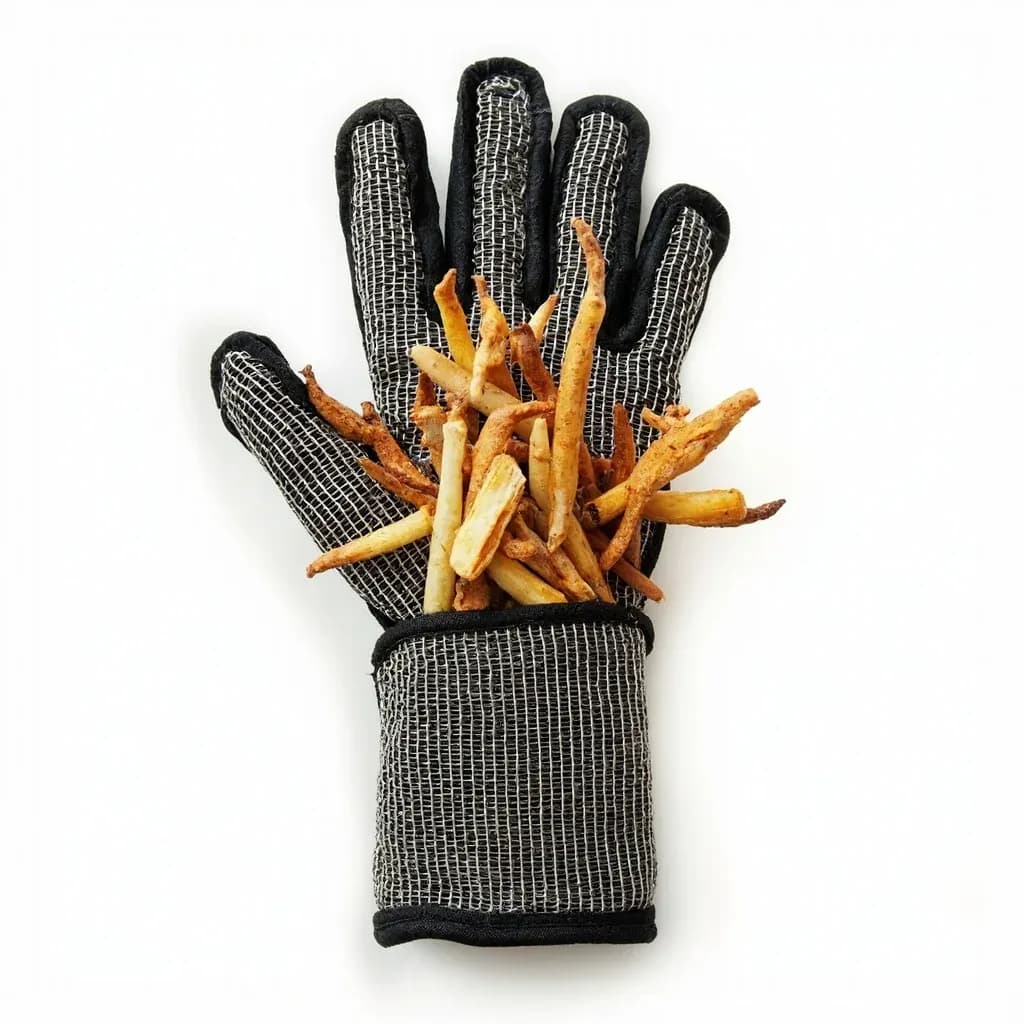
Prep Tools
Cut-Resistant Chainmail Glove
A glove of interlocked metal rings worn to protect the hand while shucking, slicing, or grating.
A chainmail glove is made from interlinked stainless-steel rings that resist cuts and punctures, worn on the guiding hand for dangerous tasks. Cooks use it for shucking oysters, holding food against a mandoline, and working with very sharp blades. It protects against slicing but not stabbing force, and is food-safe and dishwasher friendly.
The cut-resistant chainmail glove is a glove of interlocked stainless steel rings — a kitchen adaptation of the butcher's glove that has been standard PPE in European meatpacking plants since the mid-twentieth century. Its protective principle is deceptively simple: a sharp, straight edge cannot bite into the curved surface of a metal ring, so the blade is deflected rather than cutting. A dull or serrated edge defeats the effect, and any point narrow enough to pass between rings will still puncture, which is why oyster knife tips, chicken bones, and skewers are not stopped by the glove.
Chefs adopted it first in oyster bars and high-volume butcher shops in the late 2000s; home cooks followed once brands like NoCry, Stark, and Coolneon pushed prices under $40. It is not a substitute for good knife technique or a sharp blade — it is a backup that lets a cook work faster and grip food harder than they would bare-handed. Once accustomed to the weight and feel, many cooks reach for it during any prep involving a sharp blade, a box grater, or a mandoline.
The glove changes how you grip, and that is the point. With a chainmail glove on the guiding hand, cooks can hold a butternut squash steady for a heavy rocking chop, curl fingers around a fish carcass during filleting, or palm an oyster without flinching from the shucking knife. The protection is passive — the rings do the work — so the cook's hands stay relaxed, which usually means cleaner, more confident cuts.
Alternatives
Types & varieties
Maximum protection covering every digit; standard for oyster shucking and deboning.
Exposes the ring and pinky finger for fine dexterity; used for sashimi carving and delicate slicing.
Short cuff suited to general prep and grating; lighter and cooler to wear.
Extended sleeve covering wrist and lower forearm; preferred for oyster shucking and butchery.
Pure interlocked rings; most breathable, the traditional meat-processing style.
HPPE or Spectra knit inner glove beneath a steel mesh shell, adding comfort and insulation.
Symmetrical design that fits either hand; the most common and least expensive format.
Ergonomically shaped for left or right hand; more comfortable for long prep sessions.
Why the rings actually work
The protection depends on geometry, not strength. A blade edge is, at the microscopic level, a straight line, while the outer surface of each ring is a curve. When the knife meets the ring, the straight edge has no purchase on the curve and skids sideways instead of cutting in. This is also why a dull knife is more dangerous against the glove than a sharp one: a dull edge has a thicker, more irregular profile that can catch and snag a ring, pulling it out of alignment or tearing it loose. The same logic explains why serrated blades defeat the glove — the teeth are short, hooked curves that hook into the rings the way they hook into bread crust. Keep the glove paired with sharp, straight-edged tools only.
- Sharp straight edges skid over the curved rings instead of biting.
- Dull blades snag and can pull rings out of alignment, compromising the whole glove.
- Serrated teeth hook into the mesh the way they hook into crust.
- Points narrower than the gap between rings — about 4–6 mm — will still penetrate.
Choosing the right glove
Match the glove to the work. Oyster shucking and any task where the wrist is exposed to a slipping blade calls for a forearm-length cuff in 316 stainless, which resists salt water and acid better than 304. Fine vegetable work, sashimi, and decorative cuts demand dexterity, so a three-finger or short-cuff ambidextrous model preserves the finger control those jobs require. Long butchery sessions benefit from a hand-specific ergonomic fit and a mesh-plus-liner construction that absorbs sweat and cold.
- Shucking and butchery: forearm-length cuff, 316 stainless, five-finger coverage.
- Sashimi and decorative slicing: three-finger or short-cuff for fingertip control.
- Cold, wet work (oysters, fish): wear a thin nitrile glove underneath the mesh.
- Long sessions: choose a hand-specific ergonomic model over ambidextrous to reduce fatigue.
Care and longevity
A chainmail glove is essentially indestructible if treated well, but a single broken ring compromises its protection immediately. Inspect before every use by running a hand across the inside and outside of the mesh; any snagging point, bent ring, or gap means the glove should be retired. Rinse after contact with lemon, vinegar, tomato, or brine — prolonged acid exposure can pit even stainless steel. Store flat or loosely rolled; folding stresses rings and can crack welds over time.
- Inspect the entire mesh before each use; one broken ring compromises the whole glove.
- Rinse and dry after acidic or salty foods to prevent pitting.
- Store flat or rolled, never folded — creases fatigue the rings.
- Replace the glove immediately if any ring is missing, bent, or no longer moves freely against its neighbors.
Common uses
Tips & pitfalls
- Wear the glove on the hand that holds the food — the guiding hand — not on the knife hand.
- Fit must be snug; a loose glove lets the blade catch between rings and actually reduces control.
- Inspect the mesh before every use — a single missing or bent ring compromises the entire glove.
- Rinse and dry the glove after contact with acidic foods (lemon, vinegar, tomato) to prevent pitting.
- Do not pair the glove with a serrated blade; the teeth snag and pull rings out of alignment.
- Wear a thin nitrile or food-grade rubber glove underneath for wet, slippery, or cold work — bare metal against wet skin is uncomfortable and the glove can slip.
- Use the glove as a backup to good technique, not a replacement for a claw grip on the guide hand or a sharp knife.
- If the knife snags on the rings instead of sliding, the blade is likely dull — sharpen it; a sharp knife is actually safer against the mesh than a dull one.
Good to know
- Material
- Interlinked stainless steel rings, typically grade 304 or 316 (food-safe, corrosion-resistant)
- Cut resistance
- ANSI/ISEA 105 Cut Level A9 (highest) and EN 388 5XXXX when the mesh is undamaged
- Ring size
- ~4–6 mm outer diameter; smaller rings give more flexibility and more protection
- Fit
- Sold XS–XL; must be snug like a second skin or rings can catch the blade
- Cuff length
- Wrist-length (~7–8 cm) or forearm-length (~20–25 cm)
- Working hand
- Worn on the non-dominant hand — the guiding/holding hand, not the knife hand
- Cleaning
- Rinse under hot water; dishwasher-safe on the top rack; most models are machine-washable
- Does not protect against
- Puncture from thin points (oyster knife tip, needles), crushing, or serrated-edge snags
Also called
Cut-Resistant Mesh Glove · Cut-Resistant Glove · Oyster Glove
Related

Peeler
Swift blade for stripping skin off fruit and vegetables

Grater
Sharp-toothed surface for shredding cheese and vegetables

Microplane
Ultra-fine rasp for citrus zest, garlic, and hard cheese

Mixing Bowl
All-purpose bowl for combining, whisking, and tossing

Whisk
Looped wires that beat air into eggs, cream, and sauces

Spatula
Flat blade for flipping, lifting, and scraping

Slotted Spoon
Pierced spoon that lifts solids and drains the liquid behind

Wooden Spoon
Gentle, heat-friendly spoon for stirring anything