Prep Tools
Cast-Iron Chainmail Scrubber
A mat of linked stainless rings that scours stuck-on food off cast iron without stripping seasoning.
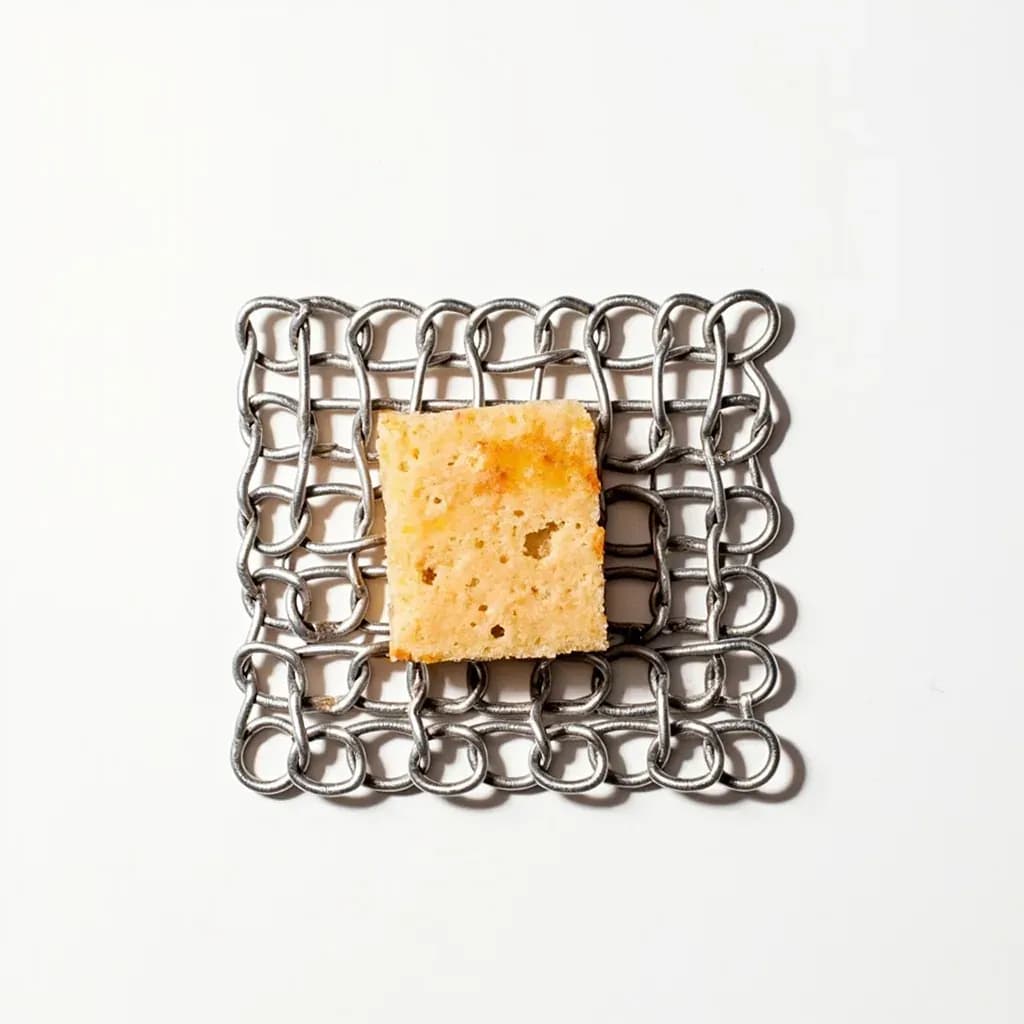
A cast-iron chainmail scrubber is a square or disc of tightly linked stainless steel rings used to scrub baked-on residue from cast-iron and carbon-steel pans. The flexible ring mesh is abrasive enough to lift stuck food but gentle enough to leave the pan's seasoning largely intact. It is used with hot water and little or no soap, then rinsed and dried.
A chainmail scrubber is a small pad of interlocking stainless-steel rings, almost always welded shut at every joint, that cleans cookware through abrasion distributed across hundreds of small wire links rather than through brute force. Each ring behaves like a miniature, flexible scraper: when you move the pad across a hot pan, the round wire flexes and lifts away polymerized fat and charred food, while the smooth, curved surface of the wire glides over the seasoning itself, leaving the thin, oil-baked film largely intact. It is the rare cleaning tool designed around the specific needs of seasoned carbon-steel and cast-iron cookware, where the goal is to remove what cooked onto the pan without undoing the patina that keeps food from sticking in the first place.
The design emerged in the early 2010s as cast iron's home-cook revival made people newly aware that steel wool, abrasive sponges, and the dishwasher were quietly stripping their pans. The principle is loosely borrowed from historical mail armor — small, articulated metal links that transmit force without rigidity — and modern versions are almost always made of food-grade 304 stainless, which does not rust, tolerates the dishwasher, and outlasts years of weekly use. The pad is sized to fit in the palm, sits flat on the pan, and works with nothing more than hot water and a few seconds of pressure.
Used correctly, it is faster, gentler on seasoning, and more sanitary than a soggy sponge or a wad of paper towels. Used carelessly — pressed too hard, dragged across enamel, or applied to non-stick coatings — the same steel that protects cast iron will scar anything softer than itself.
Alternatives
Types & varieties
The standard form — a 4×4 in or 5×5 in chainmail square with a fabric or silicone center. The most common and most versatile shape.
Disc-shaped, sized for grill grates, griddle plates, and the lids of round Dutch ovens.
A whole-hand or fingertip covering for cleaning grates, grill parts, and the outsides of Dutch ovens where rubbing against a flat pad is awkward.
A short strip that slips over the hand; lighter and cheaper than a full glove for quick jobs.
Chainmail on one face, a softer scouring or sponge face on the reverse — a two-in-one for general sink work.
More flexible, grips better when wet, and tolerates heat; the most user-friendly everyday choice.
Stiffer and more aggressive; better for heavy carbon buildup but harder on the hand and harder to control.
How the rings clean without stripping seasoning
Seasoning on cast iron is a thin layer of polymerized oil, hard but not infinitely so. The genius of a chainmail pad is geometry: each ring is a closed loop of round wire, so it contacts the pan in a small, curved line rather than a flat face. As the pad moves, the wire flexes and lifts away thicker, burnt-on residue, while its smooth surface glides over the harder, glassier seasoning without scoring it. The result is a tool that cuts selectively. Steel wool, by contrast, has thousands of random sharp tips and no rounded faces, so it scours everything — including the patina you spent hours building.
- Warm the pan to loosen polymerized fat before scrubbing; cold, hardened residue resists the rings.
- Work in circular motions rather than straight lines; circular action distributes pressure and evens out wear on the pan's surface.
- Light pressure is enough — the rings do the work, and pressing hard deforms them and can score the seasoning.
- Hot running water is more effective than cold; heat softens cooked-on fat and lets the rings peel it away cleanly.
Common uses
Tips & pitfalls
- Scrub while the pan is still warm — stuck food releases far more easily than when it has fully cooled and hardened.
- Pair with hot running water; the heat softens polymerized fat so the rings can lift it without scoring the seasoning.
- A drop of dish soap is fine if you rinse and dry immediately; the old taboo against soap on cast iron is mostly outdated, and the stainless rings handle soap without issue.
- Always finish by drying the pan on a burner over low heat right after scrubbing to evaporate moisture and prevent flash rust.
- Don't use it like steel wool — let the rings do the cutting. Pressing hard can gouge seasoning and deform the rings themselves.
- Replace the pad the moment you see a cracked or opened ring; a broken end can catch on the pan's surface and scratch it.
- Skip it entirely on enameled cast iron, vintage polished iron with a mirror finish, or anything with a non-stick coating — the steel will mark them.
- For heavy carbon or rust, soak the pan briefly in hot water first; the scrubber then finishes the job in seconds.
Good to know
- Material
- Interlocking rings of stainless steel, almost always food-grade 304, occasionally 316 marine grade
- Typical form
- Flat square or rectangular pad, commonly 4×4 in (10×10 cm) or 5×5 in, with a fabric or silicone core for grip
- Ring construction
- Rings are welded shut rather than butted or split, so nothing snags on a pan or sheds into food
- Compatible cookware
- Bare or seasoned cast iron, raw carbon steel, stainless steel, and hard-anodized surfaces
- Not recommended for
- Non-stick coatings (PTFE or ceramic), enameled cast iron, copper, aluminum, or any polished finish
- Care
- Rinse, shake dry, and stand upright to air-dry; a light smear of oil on the rings prevents rust spots over time
- Dishwasher safe
- Yes, top rack; the stainless tolerates the heat and detergent, though the heated-dry cycle can shorten the life of a silicone core
- Lifespan
- Months to years of regular use; replace once a ring cracks, deforms, or pulls open
Also called
Chainmail Scourer · Cast-Iron Cleaner
Related

Peeler
Swift blade for stripping skin off fruit and vegetables

Grater
Sharp-toothed surface for shredding cheese and vegetables

Microplane
Ultra-fine rasp for citrus zest, garlic, and hard cheese

Mixing Bowl
All-purpose bowl for combining, whisking, and tossing

Whisk
Looped wires that beat air into eggs, cream, and sauces

Spatula
Flat blade for flipping, lifting, and scraping

Slotted Spoon
Pierced spoon that lifts solids and drains the liquid behind

Wooden Spoon
Gentle, heat-friendly spoon for stirring anything