Prep Tools
Chashaku (Bamboo Tea Scoop)
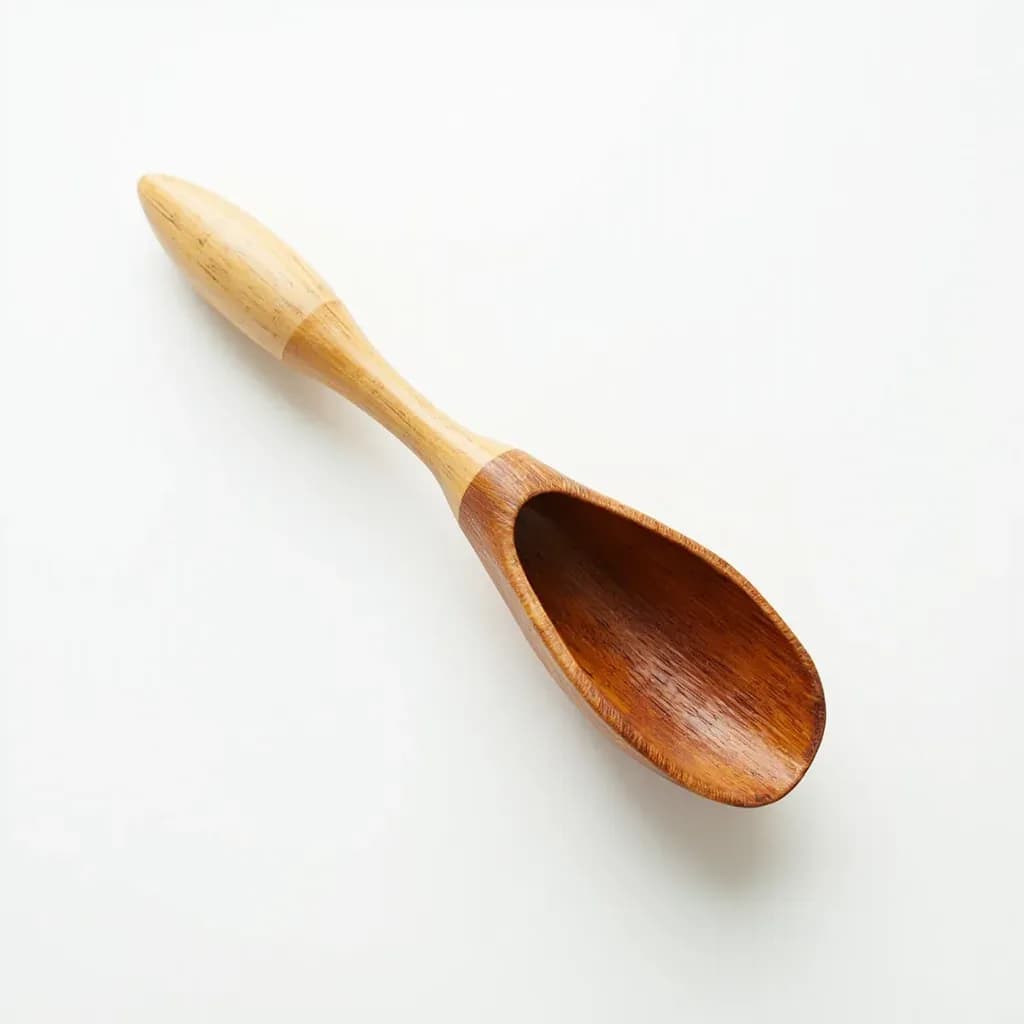
A slender carved bamboo scoop that measures powdered matcha into the tea bowl.
A chashaku is a thin, gracefully curved bamboo scoop used in the Japanese tea ceremony to portion powdered matcha from its caddy into the bowl. One or two scoops measure a serving before hot water is added and whisked. Carved from a single piece of bamboo, the chashaku is both a precise measure and a ceremonial object handled with care.
A chashaku is a slender, single-piece bamboo scoop used to measure and transfer powdered matcha from a tea caddy into the tea bowl during the Japanese tea ceremony. Carved from the pale, smooth section of a bamboo culm between two nodes, it measures roughly 18 cm long with a gently curved bowl at one end and a tapering handle at the other. The bamboo's slight porosity is said to quietly discharge static from the matcha, which is why ceremonial practitioners consider metal and plastic scoops inferior.
Beyond its practical function, the chashaku is a visual and philosophical centerpiece of chanoyu. Its handling is governed by precise etiquette — picked up with the right hand, set down on the lid of the natsume rather than passed between hands — and its form reflects the wabi-sabi sensibility that prizes restraint, age, and the marks of use. A fine chashaku acquires a deeper amber tone and a soft sheen with decades of handling, and antique pieces by named carvers are treated as living heirlooms rather than mere tools.
For everyday home use, the chashaku's main job is reliable portioning: about two scoops for usucha (thin tea) and four to five for koicha (thick tea). Even outside formal chanoyu, many drinkers keep a dedicated chashaku for the quiet pleasure of a tool made for a single purpose.
Alternatives
Types & varieties
The most prized style, from Takayama in Nara Prefecture. Long, straight handle with a slender, slightly curved scoop carved just below a node; recognized as an Important Intangible Cultural Property craft of Japan.
Named for Sen no Rikyū; elegantly simple with a graceful scoop curve and slightly thicker waist. The classic form taught in Urasenke and other major schools.
From the Suruga region of Shizuoka; distinguished by a thicker neck and a more rounded, almost ladle-like scoop.
Attributed style of the 16th-century carver Hyakuhide (Yoshitaka); rare and highly valued as antiques.
A simpler, ladle-shaped scoop used in some regional tea traditions; less formal than the Urasenke-standard forms.
Anatomy of a Chashaku
Although it reads as a single graceful line, a well-made chashaku has distinct sections that the eye learns to read.
- Handle: the long, tapering shaft that rests in the hand; should feel balanced, not tip-heavy.
- Waist (kubire): the narrow point just behind the scoop where the carver thins the bamboo for elegance and balance.
- Neck: the short, slightly thicker section between the waist and the bowl that gives the scoop its strength.
- Scoop (hera): the small curved bowl that holds roughly 1 g of matcha — the standard single measure.
- Node mark (me): the faint line visible on the finished scoop showing where the bamboo's internal diaphragm was cut away.
Choosing and Buying
A good chashaku is judged as much by feel and patina as by form.
- Look for a smooth, knot-free grain running the full length of the handle; blemishes weaken the piece and are considered flaws.
- A slightly oily sheen and warm amber tone signal well-aged, properly cured bamboo.
- Pick up several pieces: balance matters more than length, and a tip-heavy scoop is awkward to use.
- Beginners should start with a Rikyū-gata in an affordable range; save antique Takayama pieces for formal gatherings.
- Match the style to the school you study — Urasenke, Omotesenke, and Mushakōjisenke each have subtle preferences.
Care and Storage
Bamboo is forgiving if treated simply: keep it dry, keep it cool, and never wash it.
- Wipe gently with a dry, soft cloth (a kashikiri or unused cotton handkerchief) before and after each use.
- Store in its own silk bag (chashaku-bukuro), ideally inside a tea chest away from sunlight and humidity.
- Never rinse with water — moisture causes the bamboo to crack and the patina to dull.
- If the scoop ever feels sticky, brush it with a soft, dry cloth; never use soap, oil, or chemicals.
- Rotate between two chashaku if you brew daily, so each can fully air-dry between uses.
Common uses
Tips & pitfalls
- Hold the chashaku in the right hand only during temae; place it on the lid of the natsume to transfer it between actions — never hand it directly to another person.
- Keep the bamboo from touching the rim of the natsume or the chawan; contact is a serious breach of form and can chip delicate antique lacquerware.
- Scoop lightly so the matcha mounds softly in the bowl; pressing or packing gives an inaccurate measure and compresses the powder.
- Wipe with a dry cloth only — never introduce water, which causes bamboo to crack and lose its luster.
- Store in the silk bag (chashaku-bukuro) away from direct sunlight, heat, and humidity to prevent warping and fading.
- When buying, choose a piece with a smooth, knot-free grain and a slightly oily sheen; these signal well-aged, properly cured bamboo.
- Match the chashaku's style and formality to the occasion — antique Takayama pieces are reserved for the most formal gatherings.
- If using at home without ceremony, a small measuring spoon (about ½ tsp) is the practical substitute, but it will not discharge static the way bamboo does.
Good to know
- Material
- Single piece of bamboo, traditionally cut from the white culm section between two nodes
- Length
- Approximately 18 cm (about 7 inches); ranges from roughly 15 to 22 cm
- Measure (usucha)
- About 2 chashaku scoops per serving of thin tea (roughly 2 g of matcha)
- Measure (koicha)
- About 4–5 chashaku scoops per serving of thick tea (roughly 4–5 g of matcha)
- Origin
- Japan; emerged during the Muromachi period (14th–16th century), codified in the Edo period
- Used with
- Natsume or chaki (tea caddy) and chawan (tea bowl)
- Crafting
- Hand-carved with a small knife (sasakaki) and shaped over heat; most are signed by the maker
- Storage
- Kept in a silk bag (shifuku) or wrapped in a soft cloth; never washed with water
Also called
bamboo tea scoop · matcha scoop
Related

Peeler
Swift blade for stripping skin off fruit and vegetables

Grater
Sharp-toothed surface for shredding cheese and vegetables

Microplane
Ultra-fine rasp for citrus zest, garlic, and hard cheese

Mixing Bowl
All-purpose bowl for combining, whisking, and tossing

Whisk
Looped wires that beat air into eggs, cream, and sauces

Spatula
Flat blade for flipping, lifting, and scraping

Slotted Spoon
Pierced spoon that lifts solids and drains the liquid behind

Wooden Spoon
Gentle, heat-friendly spoon for stirring anything