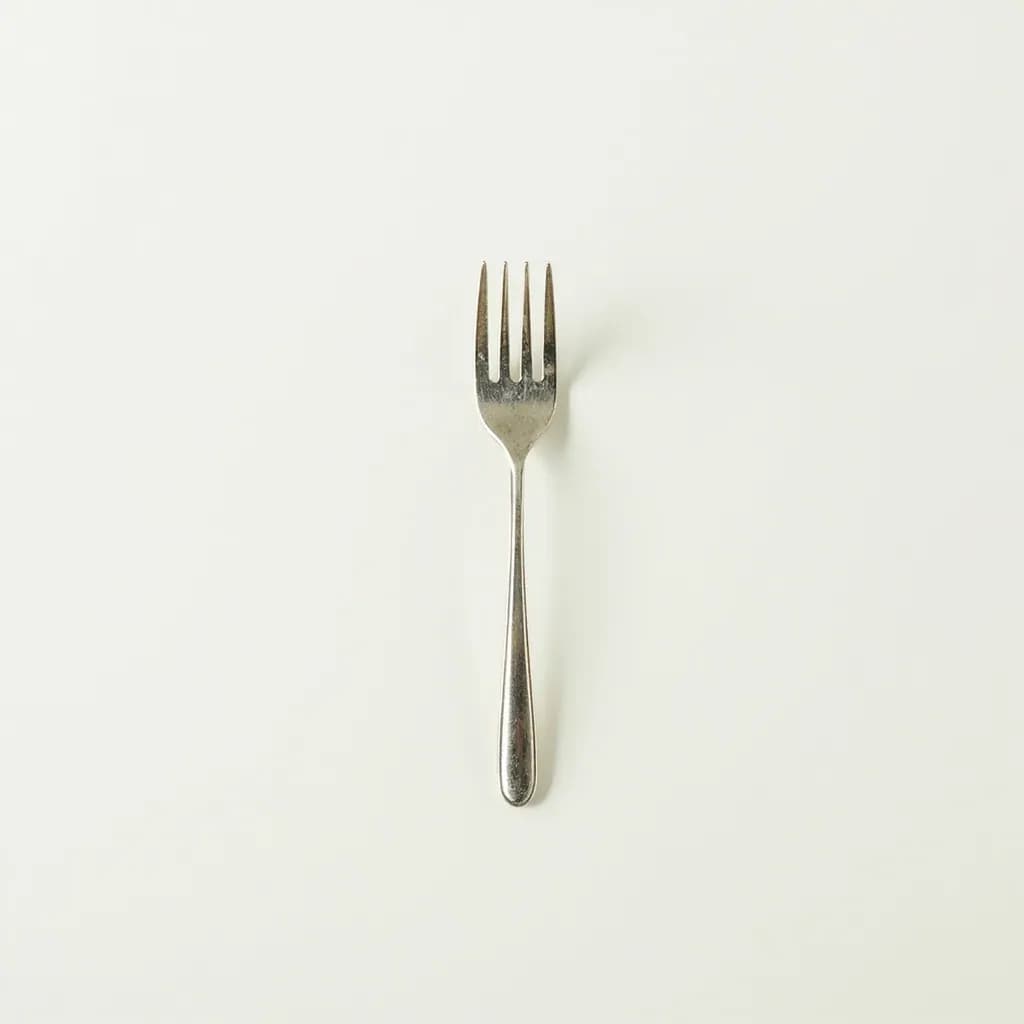
Prep Tools
Cheese Fork
A small two-pronged fork for serving sliced or crumbled cheese without touching it by hand.
A cheese fork is a short, sturdy two- or three-pronged fork used to hold a wedge steady while cutting or to lift and serve slices and crumbles from a board. It often pairs with a cheese knife as part of a serving set. The wide-set tines spear firm pieces and keep hands off the cheese during plating.
A cheese fork is a small, dedicated serving fork used to lift and transfer pieces of cheese at the table or from a cheese board without touching the food. It is shorter than a dinner fork — usually around 5 to 7 inches overall — and has short, stout tines built to pierce firm and semi-soft cheese cleanly without splitting or crumbling it. Most are two-pronged, though three- and four-tine versions exist for crumbly cheeses, and a single-tine cheese pick is its close cousin on cocktail and party boards.
The fork exists because a regular dinner fork is the wrong tool for cheese service: long, thin tines let cubed or sliced cheese slide off, and the proportions look awkward next to a cheese knife. A cheese fork's stubby tines give a real grip on a wedge of Manchego, a chunk of aged cheddar, or a spear-pointed piece of Brie, and they keep the diner's fingers out of a soft, oily paste. In formal settings the fork is paired with a matching cheese knife as part of a dedicated cheese service set; on a home cheese board, it is simply placed to the right of each cheese with the knife beside it.
Cheese forks became widespread in the 19th century as dedicated cheese courses and elaborate cheese services took hold in European and American dining. Today they remain a quiet but real piece of cheese infrastructure — not strictly required for casual eating, but the difference between fumbling with a dinner fork and an actual composed cheese course is, quite literally, a matter of two short tines.
Alternatives
Types & varieties
The classic, most common form; short stout tines ideal for transferring sliced or cubed cheese.
A slightly more secure grip for crumbly cheeses like aged cheddar, Cheshire, or aged Gouda.
A long sharp pick that the guest holds by the handle to spear cubed cheese for cocktails or passing plates.
One tine ends in a small spiral or sharp point for spearing soft bloomy-rind cheeses like Brie or Camembert.
Traditional formal-dining version; the non-reactive handle won't pit from acidic cheese the way silver can.
A close cousin with the same short two-prong form, sized for olives, cornichons, and other board condiments.
Cheese fork vs. other forks
It is easy to mistake a cheese fork for a butter fork or a fondue fork, and the differences matter at the table. A butter fork has broader, flatter tines shaped to crumble and lift soft butter; it will not grip a wedge of firm cheese. A fondue fork is much longer — typically 9 to 12 inches — with a long, slim shaft designed to be plunged into a communal pot and held safely over a flame, which is the wrong tool entirely for a cheese board. An olive or aperitif fork shares the cheese fork's compact scale but is sized for small round garnishes rather than cheese portions.
- Butter fork: broad, flat tines for soft butter — wrong shape for firm cheese.
- Fondue fork: long shaft for dipping into hot pots — not a serving fork.
- Dinner fork: too long and thin; cheese slides off the tines.
- Olive/aperitif fork: same compact scale, sized for small garnishes.
Setting a board with forks and knives
On a cheese board or at a cheese course, the fork and knife work as a pair: the diner cuts with the knife and lifts with the fork, keeping fingers out of the cheese. The standard placement is fork to the right of each cheese, knife to the right of the fork (mirror this for left-handers). For one cheese, a single fork is plenty; for a board of four or more cheeses, plan one fork and one knife per cheese so flavors don't cross.
- One fork per cheese on a multi-cheese board.
- Place fork to the right of the cheese, knife to the right of the fork.
- Use the same metal for fork and knife to avoid galvanic reactions with soft cheese.
- Replace the fork when you replace the cheese, the way you would a knife.
Common uses
Tips & pitfalls
- Choose short, stout tines for firm cheese; long thin tines snap crumbly cheeses like aged Parmesan or aged Gouda before they get off the board.
- For very soft bloomy-rind cheeses, spear the rind rather than the paste so the fork holds its shape and doesn't tear the surface.
- Hand-wash and dry sterling or silver-plated forks promptly — cheese is acidic and will etch polished silver if it sits wet.
- Don't substitute a dinner fork: long tines let cheese slide off, and the proportions look awkward next to a cheese knife.
- On a cheese course, set the fork above the dessert fork or to the right of the plate, not in with the salad fork; it belongs with the cheese service, not the place setting.
Good to know
- Type
- Specialized serving fork in the cheese service cutlery family
- Tine count
- Typically 2 prongs; 3- and 4-tine and single-tine (pick) versions also exist
- Typical length
- About 5–7 inches (13–18 cm) overall — noticeably shorter than a dinner fork
- Tine design
- Short, stout, slightly curved tines built to pierce cheese cleanly without splitting the paste
- Common materials
- Stainless steel, sterling silver, silver-plate, sometimes with wood, bone, or mother-of-pearl handles
- Sold as
- Usually paired with a matching cheese knife in a cheese service set
- Origin era
- Popularized in the 19th century alongside formal cheese courses in European and American dining
- Care
- Stainless steel is generally dishwasher-safe; sterling silver and silver-plate should be hand-washed and dried promptly to prevent tarnish
Also called
cheese serving fork
Related

Peeler
Swift blade for stripping skin off fruit and vegetables

Grater
Sharp-toothed surface for shredding cheese and vegetables

Microplane
Ultra-fine rasp for citrus zest, garlic, and hard cheese

Mixing Bowl
All-purpose bowl for combining, whisking, and tossing

Whisk
Looped wires that beat air into eggs, cream, and sauces

Spatula
Flat blade for flipping, lifting, and scraping

Slotted Spoon
Pierced spoon that lifts solids and drains the liquid behind

Wooden Spoon
Gentle, heat-friendly spoon for stirring anything