Prep Tools
Cheese Iron / Trier
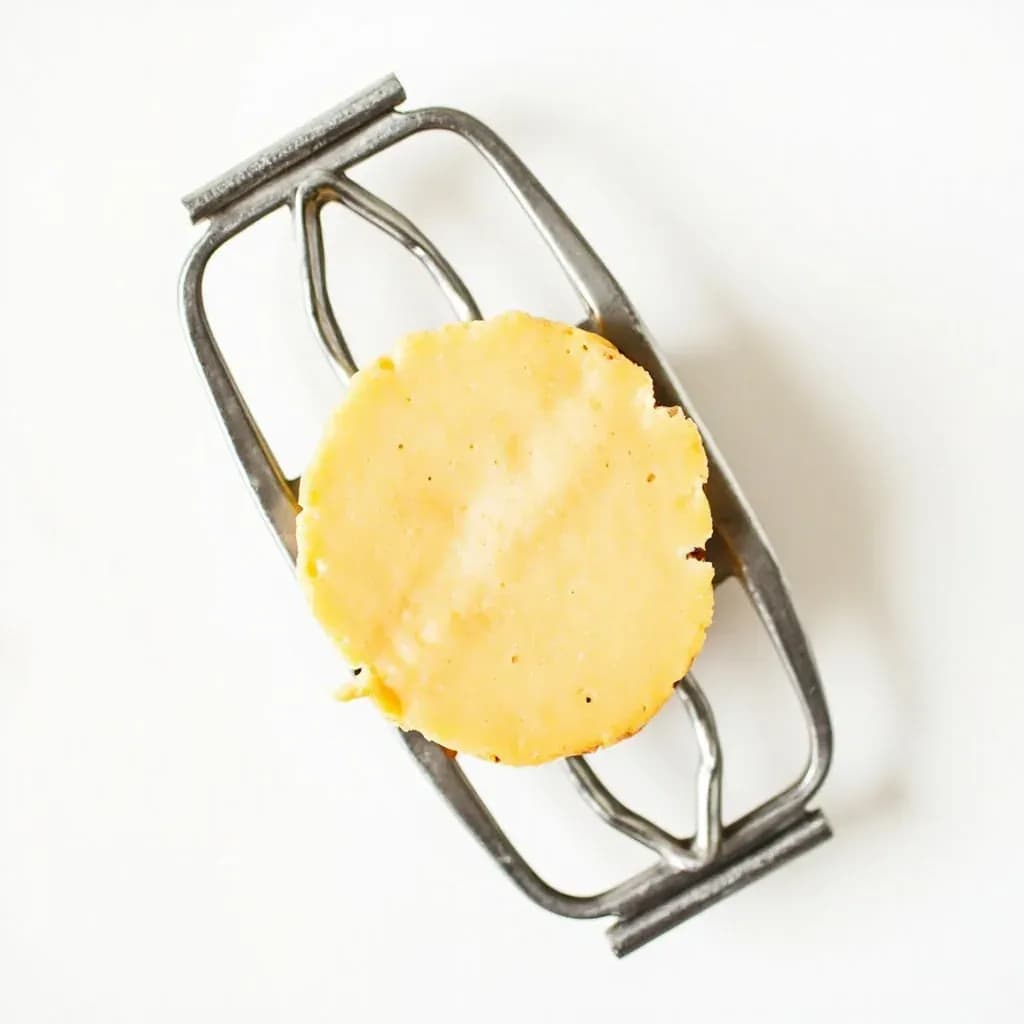
A curved coring tool that pulls a sample plug from a whole cheese to judge ripeness.
A cheese iron, or trier, is a half-cylinder coring tool that is bored into a whole wheel of cheese and twisted to extract a slender plug. The cheesemaker or grader smells and tastes the core to assess aroma, texture, and ripeness without cutting the wheel open. The plug is then pushed back to reseal the hole and preserve the cheese.
A cheese iron — more properly called a trier (from the French tirer, "to draw or pull") — is a small, hand-held coring tool with a curved, half-moon blade sharpened along its inside edge and a T- or D-shaped handle set perpendicular to the shaft. When pushed into the side or top of a wheel and given a half-turn, it cuts and retains a clean cylindrical plug of cheese the full depth of the blade, which can be smelled, tasted, and examined before being pressed back into place. In this way it functions much like a wine thief or a cider "must" sampler: a way to read the interior of a sealed, aging product without committing to cutting it open.
The tool has deep roots in the European cheese trade. Affineurs, cheesemakers, graders, and market buyers have long used it to judge whether a wheel is ready to sell, whether the paste is developing as it should, and whether the price being asked is fair. At traditional markets the seller would draw a sample, the buyer would taste it, and the two would then bargain. Modern fromageries preserve the ritual: a monger will often offer a customer a freshly drawn plug as proof of what lies beneath the rind of an expensive wheel of Comté, Gruyère, or Parmigiano-Reggiano.
Because it samples without destroying, the trier is uniquely valuable in affinage rooms, where individual wheels may be checked repeatedly over months or years of aging. The extracted plug — sometimes called a "tiring" — reveals the color and texture of the paste, the size and distribution of any eyes, the presence of crystals in aged cheese, and any off-aromas that signal trouble. It is, in short, the cheesemaker's stethoscope.
Alternatives
Types & varieties
The most common form: a single curved half-moon blade set into a T-bar grip, suited to general inspection of hard and semi-hard wheels.
Two curved blades of different widths or depths on opposite ends of one shaft, giving the affineur a choice of sample size.
Extended shaft (sometimes 20+ cm) for reaching deep into very large wheels such as Swiss Gruyère or Italian Parmigiano.
Blade has a notch or channel along its length that holds the extracted plug so it does not fall off as the tool is withdrawn.
Traditional European model with a steel or tin blade and a turned bone, horn, or wooden grip; now collected as a kitchen antique.
Smaller, folding or short-bladed version used at the cheese counter for tasting samples in front of customers.
Reading a cheese by its core
Once the plug is drawn, the affineur looks and smells before tasting. Color should be even from rind to center, though it often deepens toward the rind in a well-aged wheel; a pale, dry interior can indicate under-aging, while an overly dark, damp paste may point to over-affinage or unwanted fermentation. Eyes — the round holes formed by gas-producing bacteria in styles like Emmental or Comté — should be evenly distributed and roughly the size of a pea to a hazelnut; very large or irregular holes, or none at all, signal an atypical make. In long-aged hard cheeses, look for the snap and crunch of tyrosine crystals, a sign of proper proteolysis. Finally, smell the plug: clean, nutty, brothy, or hay-like aromas are welcome; ammoniac, yeasty, or barnyard notes at high intensity can indicate a wheel in decline.
- Even paste color from rind to center is a good baseline; deep color near the rind is normal in long-aged wheels.
- Even, pea-sized eyes signal a healthy make in Swiss-style Alpine cheeses; oversized or missing eyes suggest fermentation problems.
- Tyrosine crystals in aged hard cheese — those crunchy white specks — are a mark of well-developed proteolysis.
- Clean, nutty, or brothy aromas on the plug indicate sound aging; sharp ammonia, sour yeast, or barnyard stink may signal decline.
How to draw a clean plug
Technique matters as much as the tool itself. A hesitant, rocked insertion will split the rind and tear the paste; a confident, straight push with a single half-turn leaves a clean cylindrical hole and a tidy plug that pops back in without crumbling.
- Aim for the cheek (the side) of the wheel whenever possible — the hole is easier to reseal and the rind grows back over it during further aging.
- Push straight in with firm palm pressure on the T-handle; resist the urge to angle the blade.
- Give the handle a clean half-turn (roughly 180°) and withdraw without rocking side to side.
- Smell the plug as it emerges, then break or taste it before pressing it back into the hole and smoothing the rind flat.
Common uses
Tips & pitfalls
- Press the extracted plug back into the hole and smooth the rind flat; on natural-rind wheels the surface heals over as the cheese continues to age.
- Clean and thoroughly dry the trier between every cheese, especially when moving between varieties, to avoid transferring molds and stray aromas.
- Do not use a cheese iron on soft, bloomy, or fresh cheeses — the paste is too soft to core and you will crush the wheel; reach for a knife instead.
- Match blade width to the job: a narrower trier suits smaller wheels and younger paste, while a wider blade gives a more representative sample of a large, aged wheel.
- Choose a grooved or channeled blade if you sample often; it holds the plug in place so it does not fall off as you withdraw the tool.
- Avoid sampling in places that would disfigure a wheel being sold whole — for example, near a stamped face or branded rind — and pick an inconspicuous spot instead.
Good to know
- Also known as
- Cheese trier, cheese tester, cheese sampler, cheese scoop
- Primary use
- Drawing a cylindrical core sample from a whole wheel to judge ripeness, aroma, and paste without cutting the cheese open
- Typical length
- Approximately 12–18 cm (5–7 in) overall, with a blade of roughly 8–10 cm
- Blade shape
- Curved half-moon or scoop-shaped cutting edge, sharpened on the inside curve so it cores cleanly on the half-turn
- Handle style
- T-shaped or D-shaped grip mounted perpendicular to the blade, allowing downward palm pressure and a controlled twisting motion
- Material
- Stainless steel in modern examples; historically nickel-plated steel, tin, or silver-plated brass paired with turned wood, bone, or horn handles
- Origin / tradition
- Long-standing tool of European cheesemakers, affineurs, graders, and merchants in France, Switzerland, Italy, the Netherlands, and the United Kingdom
- Sample recovered
- A small plug (a 'tiring') the full depth of the blade, typically tasted and then pressed back into the wheel
- Compatible cheeses
- Semi-hard and hard wheels such as Gruyère, Comté, Parmesan, Emmental, Cheddar, Gouda, Manchego, and aged tommes; not suitable for soft or bloomy-rind cheeses
Also called
Half-Wheel Cheese Iron · Cheese Trier (Iron/Plug) · Cheese Trier · Cheese Iron
Related

Peeler
Swift blade for stripping skin off fruit and vegetables

Grater
Sharp-toothed surface for shredding cheese and vegetables

Microplane
Ultra-fine rasp for citrus zest, garlic, and hard cheese

Mixing Bowl
All-purpose bowl for combining, whisking, and tossing

Whisk
Looped wires that beat air into eggs, cream, and sauces

Spatula
Flat blade for flipping, lifting, and scraping

Slotted Spoon
Pierced spoon that lifts solids and drains the liquid behind

Wooden Spoon
Gentle, heat-friendly spoon for stirring anything