Prep Tools
Cheese Mill
A grinder that crumbles and breaks up curd or hard cheese during cheesemaking.
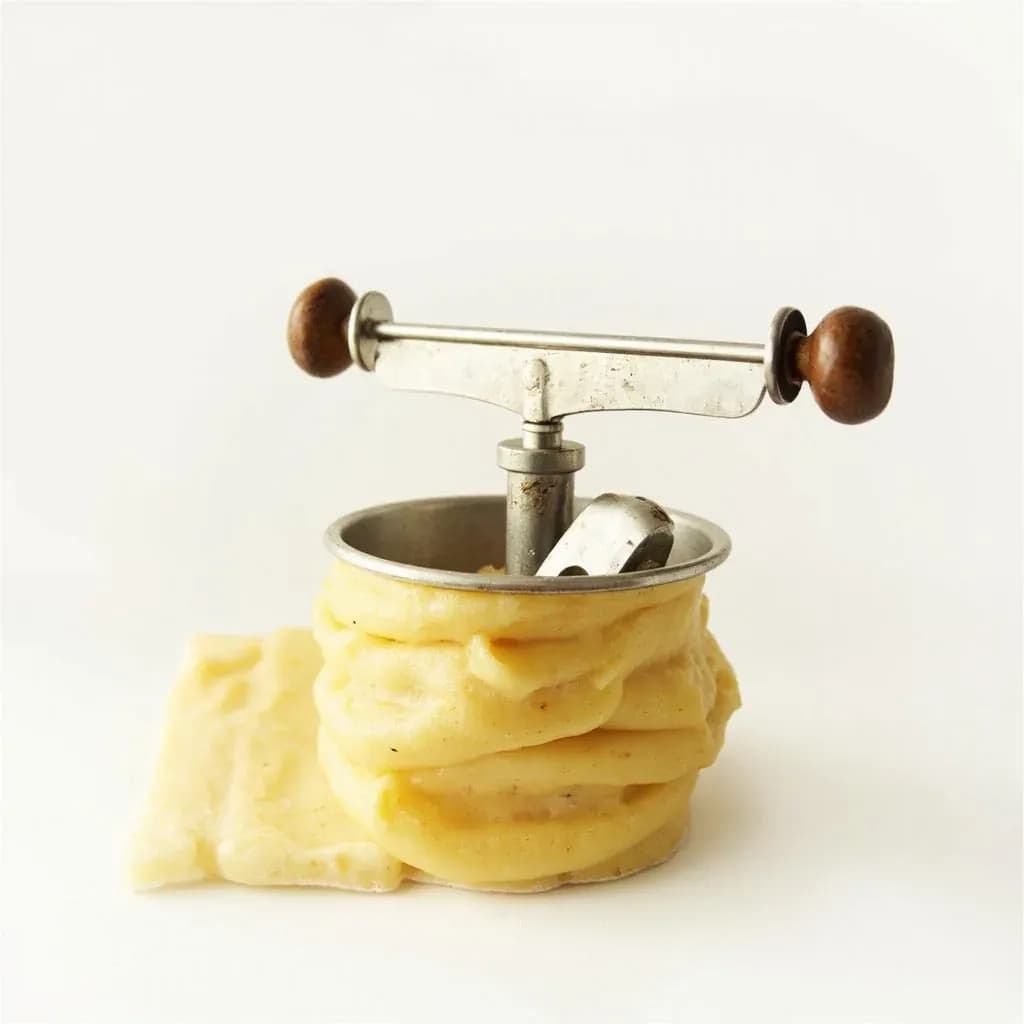
A cheese mill is a tool that grinds pressed curd into small, even pieces during cheesemaking so salt can be mixed in evenly and the curds knit properly when pressed. The classic Roquefort cheese mill breaks up curd for blue cheese before it is salted and packed into molds. Hand-cranked and powered versions both exist for different scales of production.
A cheese mill is a hopper-fed grinder that pushes a slab of warm, drained curd through a perforated plate, breaking it into uniform rice- to marble-sized pieces before salting and pressing. It sits squarely in the middle of the cheesemaking workflow: after the curd has been cut, cooked, and the whey drained off, the dense mat of curd is fed into the mill and emerges as the small, even particles that define a pressed-curd cheese like cheddar, Colby, or Gouda.
The uniformity matters more than it might seem. Curd particle size directly controls how the cheese behaves during pressing and aging — smaller pieces release more whey and produce a drier, crumblier body, while larger pieces trap more moisture and yield a smoother, more elastic texture. Even sizing also means salt dissolves and distributes predictably across every piece, rather than burying some and missing others. A mill delivers that consistency in seconds; a knife and a pair of hands cannot.
For home cheesemakers working with a single gallon of milk, hand-chopping the curd mat is perfectly serviceable. For anyone making pressed cheeses regularly, or working with more than a few pounds of curd, a mill is the standard tool — and the one piece of equipment that visibly improves the finished cheese.
Alternatives
Types & varieties
Hopper with auger turned by a side handle; the standard tool for home and small-scale cheesemakers
Same mechanism as the hand-crank but motor-driven; suited to larger batches and small commercial production
Most common material; durable, sanitary, and accepts warm curd without warping
Lighter and cheaper; acceptable for occasional use, though stainless is preferred for longevity and cleanability
Allows the cheesemaker to swap perforated disks for different curd sizes
Bolts to a work surface or the rim of a milk bucket for stability during cranking
Built-in whey collection tray beneath the perforated plate
How a cheese mill works
At its core, a cheese mill is a short auger inside a hopper that pushes curd through a perforated end plate. The curd enters as a warm, cohesive mat and exits as discrete, similarly sized pieces. The diameter of the holes in the plate sets the curd size; the speed of the auger sets the throughput. Most home mills sit on a stand over a bowl or the draining cloth, so the milled curd drops directly into its next vessel.
- Hopper receives the slab of drained curd straight from the vat or draining cloth.
- A rotating auger, turned by hand or motor, advances the curd toward the perforated plate.
- Pressure forces the curd through the holes, shearing it into uniform pieces.
- The milled curd falls into a receiving bowl, draining cloth, or hooping form below.
Mill vs. hand-chopping
Hand-chopping the curd mat with a long knife — slicing it into strips, then cross-cutting into cubes — is the original method and still perfectly adequate for small home batches. The trade-off is consistency: knife work produces a range of sizes and the slab compresses unevenly under the blade. A mill produces visibly more uniform pieces, which translates into more predictable moisture, salt uptake, and final texture. For anyone making more than a few pounds of pressed-curd cheese at a time, the mill quickly pays for itself in consistency alone.
Common pitfalls
The mistakes that show up most often with cheese mills are timing and overworking. Milling cold, drained curd produces ragged pieces and a lot of dust; milling the same batch twice reduces it to a mealy paste. Both of these can be avoided by milling within fifteen to thirty minutes of draining and running the curd through the plate just once. A jammed mill, on the other hand, almost always means the curd was too firm or the hopper was overfilled — solve both and the crank turns easily.
Common uses
Tips & pitfalls
- Mill the curd while it is still warm — typically within 15–30 minutes of draining. Cold curd crumbles unpredictably and the mill has to work harder.
- Run the curd through only once unless the recipe specifies otherwise; over-milling creates a mealy, overly dry texture.
- Crank steadily rather than forcing the handle. Let the auger do the work to avoid jamming or bending the plate.
- If the curd is too soft to cut cleanly, chill the mill in cold water first — this firms the curd just enough for clean, even cutting.
- Salt the milled curd promptly and toss gently rather than stirring, so the individual pieces stay intact.
- Disassemble and rinse the mill immediately after use. Dried curd lodged in the perforations is hard to remove and can harbor bacteria.
- Sanitize all parts with a food-safe sanitizer (such as a no-rinse acid sanitizer or a diluted bleach rinse) before the next batch.
- For larger home batches, mill in two smaller loads rather than overfilling the hopper, which causes uneven breakage.
- Do not use a curd mill to shred aged cheese wheels — they are designed for soft, fresh curd and will jam or break on hard, aged blocks. Reach for a rotary grater instead.
Good to know
- Purpose
- Breaks drained cheese curd into small, uniform pieces (rice- to marble-sized) before salting and pressing
- Also called
- Curd mill, cheese curd mill
- Typical materials
- Food-grade stainless steel, sometimes with food-safe plastic hoppers and crank handles
- Hole sizes
- Perforated plates typically 1/4"–3/8" (6–10 mm) diameter; interchangeable on some models
- Drive mechanism
- Hand-crank or electric motor
- Capacity (home models)
- Roughly 1–10 lb (0.5–4.5 kg) of curd per batch
- Used for cheese styles
- Cheddar, Colby, Monterey jack, brick, Gouda-style, Havarti, and other pressed/stirred-curd cheeses
- Where it fits in the process
- After the curd is cut, cooked, and whey-drained; before salting and pressing
Also called
Roquefort Cheese Mill · Curd Mill
Related

Peeler
Swift blade for stripping skin off fruit and vegetables

Grater
Sharp-toothed surface for shredding cheese and vegetables

Microplane
Ultra-fine rasp for citrus zest, garlic, and hard cheese

Mixing Bowl
All-purpose bowl for combining, whisking, and tossing

Whisk
Looped wires that beat air into eggs, cream, and sauces

Spatula
Flat blade for flipping, lifting, and scraping

Slotted Spoon
Pierced spoon that lifts solids and drains the liquid behind

Wooden Spoon
Gentle, heat-friendly spoon for stirring anything