Prep Tools
Cheese Mold (Fuscella)
Perforated form that drains whey and shapes fresh curds into a wheel of cheese.
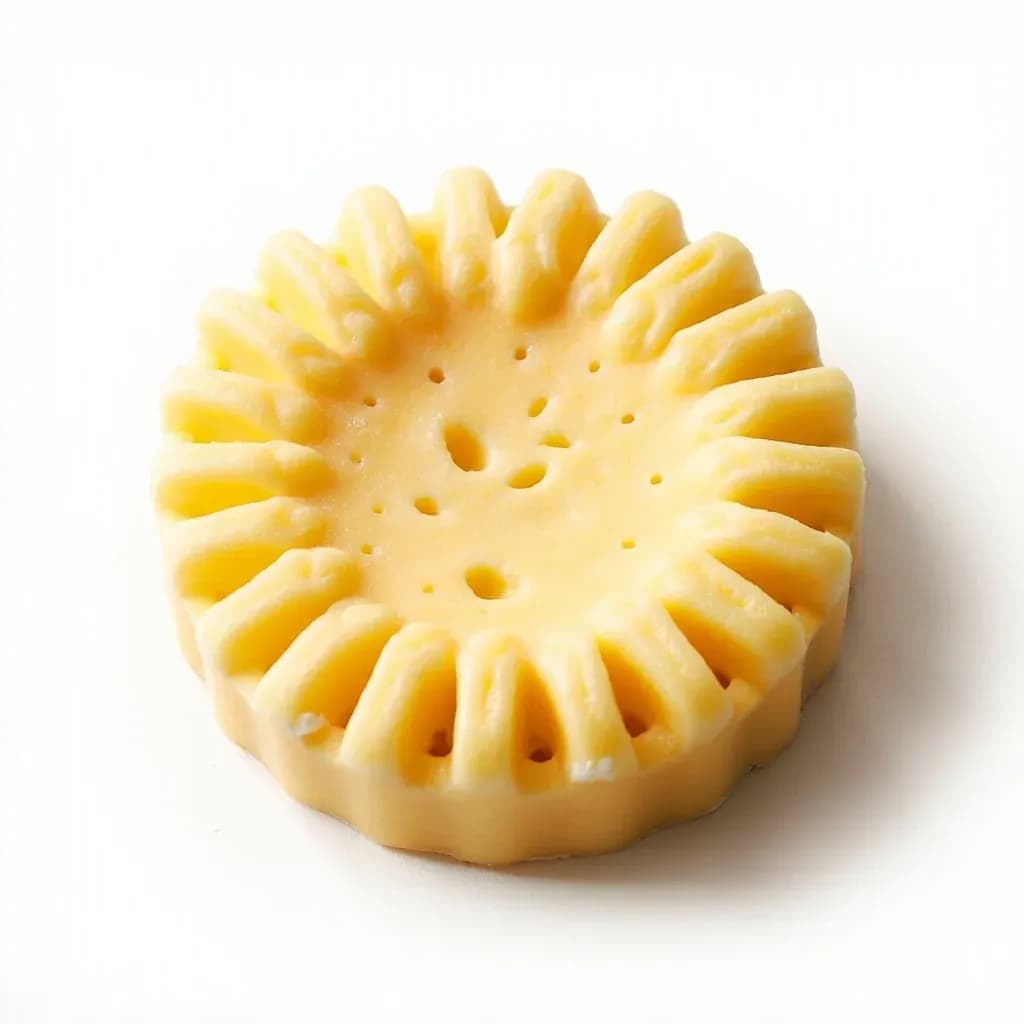
A cheese mold is a perforated basket or cylinder that holds fresh curds while whey drains away, pressing and shaping them into a firm cheese. The Italian fuscella gives ricotta and fresh cheeses their basket-weave pattern. Holes in the walls and base let liquid escape so the cheese knits together and holds its form.
A cheese mold is a perforated form that does two jobs at once: it shapes loose curds into a defined wheel, log, or ball, and it lets whey drain freely as the curd settles. The holes are the whole point — without them the curd would sit in its own liquid and never close into a coherent mass. Hole size, mold material, and shape each shape the finished cheese: a smooth, glossy mozzarella comes from a fine micro-perforated plastic mold, while a Canestrato Pugliese owes its basketweave rind to a woven rush basket.
In the home cheesemaker's kitchen, the mold works in partnership with a follower disc and a weight to press the cheese over hours. Modern plastic and stainless steel molds are the practical standard — hygienic, dimensionally consistent, and tolerant of the heat of pasta filata curds. Traditional rush or wicker molds, called canestri in Puglia and fuscedde in Sicily, remain in active use for DOP and farmhouse cheeses where the rind pattern is part of the cheese's identity. Italian DOP specifications prescribe mold dimensions and materials: Mozzarella di Bufala Campana uses molds of specific diameters to control finished weight, and Canestrato Pugliese requires draining in a rush or reed canestro to earn its basketweave rind.
Most home cheesemakers start with a single 8 cm round plastic mold with 1–2 mm holes, which handles mozzarella, scamorza, trecce, and small caciotte. From there the kit typically grows to include a larger mold for pecorino-style wheels, a conical form for provola, and a perforated draining mat or open hoop for harder pressed cheeses. Whatever the type, the mold's job is to disappear from the recipe — to shape and drain without leaving any flavor, smell, or surface defect on the finished wheel.
Alternatives
Types & varieties
Modern workhorse for mozzarella, scamorza, trecce, and ovolini; gives a smooth rind and fast whey release at low cost.
Heavy-duty option for hot pasta filata curds and large pecorino wheels; durable, heat-tolerant, and the most expensive of the standard types.
Traditional basket mold that imprints the characteristic basketweave rind on Canestrato Pugliese and similar cheeses; must be dried thoroughly to prevent mildew.
Rush or plastic-wrapped rush mold used for pecorino siciliano, primo sale, and tuma; often tied with cord to set the shape.
Tapered form for provola and provolone; encourages downward whey drainage and produces the classic pear or bullet shape.
For caciotta, tome, and caciocavallo-style logs; usually paired with a flat follower for even pressing.
Pressing molds that apply consistent pressure without external weights — useful for small home batches and reproducible results.
Open-sided stainless or polycarbonate hoop for hard cheeses pressed from the top; has no bottom drainage holes and sits on a draining mat.
Choosing the Right Mold
The first decision is size, because finished weight is largely a function of mold diameter. Small 5–8 cm molds are used for individual mozzarella, bocconcini, and trecce; 15–20 cm molds are the working size for caciotte and small pecorino; 25–30 cm molds are reserved for large wheels. Hole pattern comes next: micro-perforations under 2 mm give a smooth, closed rind suited to pasta filata and fresh cheese eaten within days. Larger 3–5 mm holes suit pressed wheels where a drier surface helps a brine or oil rub take. Material is the third call. Plastic is light, cheap, and easy to sanitize; stainless is heavier, lasts decades, and handles hot curds without warping; rush or wicker is the only way to imprint a basketweave rind and is required for some DOP cheeses, but it absorbs moisture and must be dried completely between uses to prevent mildew.
Common uses
Tips & pitfalls
- Match hole size to cheese type — micro-perforations give mozzarella its smooth, glossy skin, while larger holes suit pressed wheels and encourage a drier rind.
- Pre-warm the mold in hot whey or warm water before filling with hot pasta filata curds; a cold mold halts stretching and leaves a lumpy surface.
- Never fill above the rim; curds rise slightly and whey needs room to escape, or it will leak over the edge.
- Flip the cheese at the halfway point of draining — typically 30–60 minutes for fresh cheeses — to ensure even shape and uniform moisture distribution.
- For basket-patterned rind, drain in the woven mold, then transfer to a smooth mold only after the pattern is set; don't let the curd sit in a damp wicker mold longer than necessary or it sticks.
- Use a follower disc of the same diameter as the mold's interior; a wobbly follower produces uneven pressing and a leaning wheel.
- Sanitize with food-grade peracetic acid or a brief boil rather than chlorine-based sanitizers, which can leave residues that affect flavor and starter cultures.
- For very moist fresh cheeses, line the mold with butter muslin to help release the cheese cleanly; for drier pressed wheels, leave unlined.
- Avoid aluminum molds for acidic fresh cheeses; lactic acid etches the metal and can impart a metallic taste. Use stainless or food-grade plastic instead.
- Dry molds thoroughly before storage to prevent mildew, especially the traditional rush and wicker types.
Good to know
- Also called
- Fuscella (Italian); fuscedda (Sicilian diminutive); canestro or canestrello for woven basket styles; cheese hoop or cheese mold in English; faisselle or moule à fromage in French.
- Etymology
- From Latin fiscella (small basket), referring to the original woven rush form; the southern Italian fuscella preserves the meaning while shifting the initial consonant.
- Primary function
- Shapes fresh curds and drains whey simultaneously through perforations in a single step.
- Materials
- Modern: food-grade plastic or stainless steel. Traditional: woven rush, wicker, or plastic-wrapped rush.
- Typical perforations
- 0.5–2 mm micro-holes for soft paste cheeses like mozzarella; 3–5 mm larger holes for harder, well-drained wheels.
- Shape options
- Round, oval, rectangular, conical (provola-style), and basket-shaped; sizes from about 5 cm to over 30 cm in diameter.
- Capacity guide
- Roughly 1 kg of drained curds yields a 350–500 g fresh cheese after molding and pressing, depending on mold size.
- Pressing accessories
- A follower disc (disco) the same diameter as the mold interior, paired with a weight of 2–10× the cheese's weight to control final moisture.
- Origin
- Southern Italy — the term is documented across Campania, Calabria, Basilicata, Puglia, and Sicily.
- Sanitation
- Boil, dishwasher, or soak in food-safe sanitizer between batches; rinse to remove sanitizer residue.
Also called
sannas-mould · Fuscella · Cheese Basket · Cheese Form
Related

Peeler
Swift blade for stripping skin off fruit and vegetables

Grater
Sharp-toothed surface for shredding cheese and vegetables

Microplane
Ultra-fine rasp for citrus zest, garlic, and hard cheese

Mixing Bowl
All-purpose bowl for combining, whisking, and tossing

Whisk
Looped wires that beat air into eggs, cream, and sauces

Spatula
Flat blade for flipping, lifting, and scraping

Slotted Spoon
Pierced spoon that lifts solids and drains the liquid behind

Wooden Spoon
Gentle, heat-friendly spoon for stirring anything