Prep Tools
Cheese Plane (Slicer)
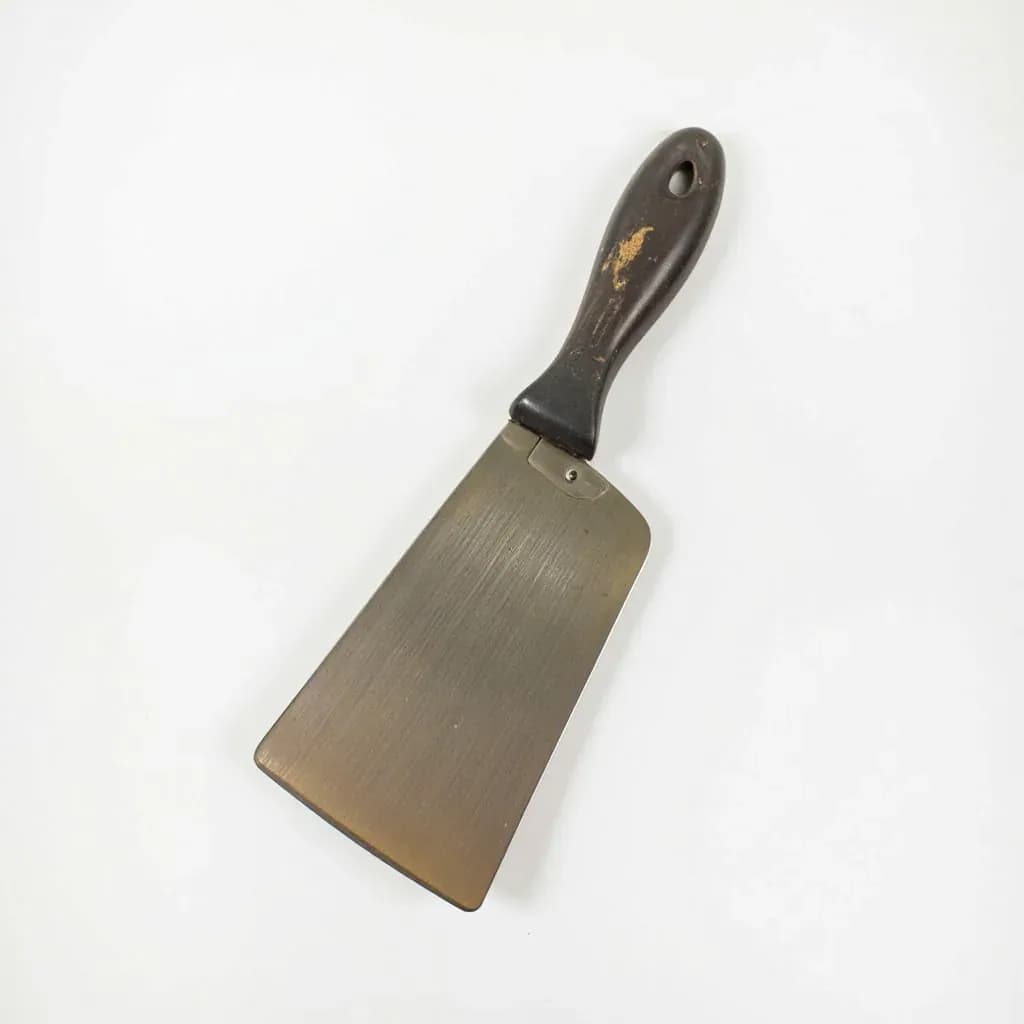
A flat trowel-shaped tool with a slotted blade that shaves thin, even slices from a block of firm cheese.
A cheese plane is a handheld trowel with an angled cutting slot that pares uniform thin slices off semi-hard to hard cheeses like Gouda or Jarlsberg. It is drawn across the surface of the block, the slot regulating slice thickness. The design is a Scandinavian classic, often paired with a slotted board version that uses a roller wire.
The cheese plane is a deceptively simple tool: a flat, slotted metal blade mounted on a short handle, designed to shave thin, even slices from a block of firm cheese with a single pull. Unlike a knife, which cuts by pressing down through the cheese, the plane works by drawing the sharpened inner edge of its slot across the surface, peeling off a wafer that forms within the slot itself. That single mechanical difference is why a plane produces cleaner, more uniform slices than a chef's knife on a block of Gouda, Jarlsberg, Cheddar, or Manchego, and why it remains the default table tool for cheese across Scandinavia.
Invented in 1925 by the Norwegian craftsman Thor Bjørklund and still sold in its original form (osthøvel, literally "cheese shaver"), the cheese plane was designed for the firm, low-moisture cow's-milk cheeses that anchor Norwegian and Dutch tables. It works best on cheese cold from the refrigerator but not frozen, when the curd is firm enough to release a clean slice and the fat is rigid enough not to smear. A wire cheese slicer is a different tool — it cuts a whole wheel with a tensioned wire — and the two are not interchangeable, a point that trips up a lot of cooks who use the names as if they were synonyms.
In practice, the plane is a tool of restraint. It does not chop, cube, or portion; it produces a slice of a particular character — thin, broad, and slightly curved — that suits bread, crispbread, open-faced sandwiches, and cheese boards where appearance matters as much as flavor.
Alternatives
Types & varieties
The 1925 patented form: an angled stainless steel blade with a riveted wooden handle — the shape that defines the category and the one most cooks picture when they hear 'cheese plane.'
A handle-less rectangular blade the user grips directly; common in stainless steel or aluminum and frequently placed on the table alongside a cheese board.
Features a thumb-screw or shim that raises or lowers the cutting edge, allowing the cook to vary slice thickness from paper-thin to a few millimeters.
A cold stone body with a slot cut through it; the chilled marble keeps firm cheese from sticking or warming during a long serving session.
A two-in-one design that adds a spatula, spreader, or fork tip to the opposite end, useful when the plane is the only tool at the table.
Larger, often decorative versions intended to be used directly on a wheel or wedge at the table, sized for presentation as much as function.
How a cheese plane actually cuts
The cutting edge of a cheese plane is not a straight bar but the inner edge of a slot punched or milled through a flat blade. When the cook draws the plane across the face of a block, that inner edge passes through the cheese just ahead of the slot, and the freed slice curls into the slot as it is cut. The geometry does two things at once: it controls thickness (set by the width of the slot and the angle at which the plane is held) and it protects the slice from being crushed, because the slice is never pressed between two hard surfaces. This is why a plane produces a slice that looks the way it does — flat, broad, and gently curved — and why a knife cannot quite replicate it on firm cheese.
Cheese plane versus wire cheese slicer
The two tools are constantly confused, even in kitchen catalogs, but they do different jobs.
- A plane is pulled across a face of cheese — a block, a wedge, or a cut surface. It needs something flat to press against.
- A wire slicer has a tensioned wire stretched across a frame; the frame is pushed down through a whole wheel or a flat-topped piece, slicing it the way a cheese wire cuts a wheel of Cheddar at the deli.
- A plane produces a thin, broad slice from a single face. A wire slicer produces a flat disc from a whole wheel.
- The two cannot substitute for each other: a plane cannot cut cleanly through a round, and a wire slicer cannot peel a shaving from a face of cheese.
Choosing the right cheese
A cheese plane rewards the right texture and punishes the wrong one. The tool was designed for cheeses in the 30–45% moisture range, firm enough to hold a slice, dry enough that the cut edge does not smear.
- Ideal: Gouda, Edam, Jarlsberg, Cheddar, Manchego, Cantal, Tomme, mid-aged Comté, aged Provolone.
- Workable: aged hard cheese such as Parmesan or aged Gouda, though the slice will be thicker and the plane will struggle near the rind.
- Poor choice: soft and fresh cheeses — brie, Camembert, chèvre, ricotta, cream cheese, mozzarella. They smear, clog the slot, and tear.
- If you need to slice a soft cheese, use a wire slicer on a cold wheel, or a thin knife wiped clean between cuts.
Common uses
Tips & pitfalls
- Chill the cheese to 40–50°F / 4–10°C. Warm cheese smears and clogs the slot; frozen cheese shatters into crumbs.
- Set the block on a damp tea towel so it cannot slide while you pull the plane — the most common cause of torn slices is a cheese that moved mid-pull.
- Pull the plane toward you in one smooth, confident stroke. Sawing or pressing down ruins the slice and dulls the edge.
- Let the blade do the work. The plane should glide; if you are forcing it, the cheese is probably too cold, too hard, or the blade is dull.
- Clear softened cheese out of the slot between slices. A clogged slot is the usual reason a clean plane suddenly starts tearing.
- Do not use a cheese plane on soft or fresh cheeses such as brie, chèvre, or mozzarella. The result is smearing, not slicing — use a knife or wire instead.
- Replace or sharpen the blade when slices start to crumble or feather at the edge instead of peeling in one piece. A dull plane is a dangerous plane, because cooks compensate by pressing harder.
- For very hard aged cheeses like Parmigiano-Reggiano, a vegetable peeler or a dedicated Parmesan knife often outperforms a standard cheese plane, whose slot is too wide for the brittle texture.
Good to know
- Origin
- Norway, patented 1925 by Thor Bjørklund
- Norwegian name
- osthøvel ("cheese shaver")
- How it cuts
- A sharpened slot in a flat blade peels a wafer as it is drawn across the cheese
- Best for
- Semi-hard to hard cheeses such as Gouda, Edam, Jarlsberg, Cheddar, Manchego, and Parmesan
- Ideal cheese temperature
- 40–50°F / 4–10°C — cold but not frozen
- Common build
- Stainless steel blade with a beech or other hardwood handle, riveted on
- Not the same as
- Wire cheese slicers, which cut a whole wheel with a tensioned wire
- Where it lives
- Standard equipment in Norwegian kitchens and a common Scandinavian design export
Also called
Roller Wire Cheese Slicer · Wire Slicer Board · Cheese Slicer · Ostehøvel
Related

Peeler
Swift blade for stripping skin off fruit and vegetables

Grater
Sharp-toothed surface for shredding cheese and vegetables

Microplane
Ultra-fine rasp for citrus zest, garlic, and hard cheese

Mixing Bowl
All-purpose bowl for combining, whisking, and tossing

Whisk
Looped wires that beat air into eggs, cream, and sauces

Spatula
Flat blade for flipping, lifting, and scraping

Slotted Spoon
Pierced spoon that lifts solids and drains the liquid behind

Wooden Spoon
Gentle, heat-friendly spoon for stirring anything