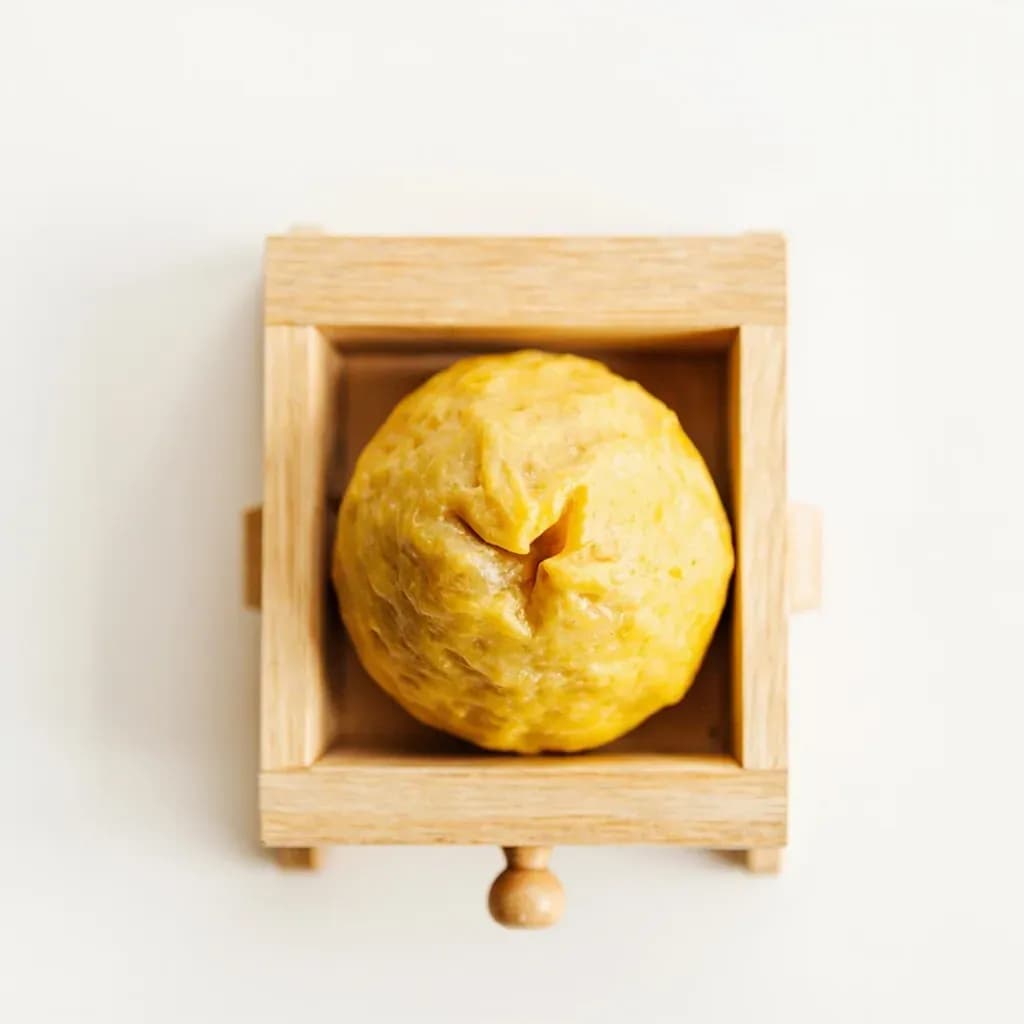
Prep Tools
Cheese Press
A frame and weight system that compresses curds to expel whey and form firm cheese.
A cheese press applies steady, controlled pressure to fresh curds packed in a mold, squeezing out whey and knitting the curds into a solid wheel. Cheesemakers use it for hard and semi-hard cheeses like cheddar, gouda, and tomme, often increasing the weight in stages over hours. A follower (pressing disc) sits between the press and the curd to distribute force evenly.
A cheese press is a frame-and-weight system designed to apply sustained, even pressure to draining curds inside a perforated mold, fusing loose curds into a single cohesive wheel or block while forcing out residual whey. Mechanically, it is the bridge between a finished curd and a wheel ready for brining or aging: pressure consolidates the protein matrix, closes the rind, and sets the moisture content that will define the cheese's final texture and aging behavior. The press does this work in cooperation with the curd's own chemistry — acid development, temperature, and mineral content all influence how the curds respond to force, which is why pressing schedules are tightly scripted in cheesemaking recipes rather than left to feel.
The amount of pressure, the speed at which it is applied, and the duration together determine whether a wheel becomes a fresh, crumbly queso fresco or a dense, long-aging Parmesan. Soft cheeses tolerate only a few pounds of force; aged hard cheeses may need 40 PSI or more, applied gradually in stages so the rind can knit before deeper pressure would crack it. A press is also what gives a cheese its shape: a clean, even wheel with parallel faces is the product of a press that holds the follower level throughout the run.
The single most important concept behind any cheese press is that pressure is force per unit area, not total weight. A 20-pound load on a 4-inch hoop delivers far more PSI than the same 20 pounds on a 10-inch hoop, and recipes written in PSI or kg/cm² must be translated against the mold's diameter. Home cheesemakers who skip this step routinely under-press their wheels or, less often, crush them.
Alternatives
Types & varieties
Traditional European design with a long lever arm and fulcrum; applies pressure through mechanical advantage and is favored for soft to semi-hard cheeses like scamorza
Hand-cranked screw drives the follower down into the hoop; the most common home cheesemaker press, with precise, repeatable control
Two side-by-side hoops compressed by a horizontal screw; the classic configuration for Gouda and Edam wheels
Calibrated plates, jugs of water, or bricks loaded directly onto the follower; pressure is absolute and does not sag over time
A compressed spring maintains near-constant pressure as the wheel shrinks; common in compact home presses
Shop air or a hydraulic ram delivers very high, even pressure; standard in commercial and large artisan operations
Vertical mold with internal followers stacked to press multiple small cheeses (tomme and other small-format wheels) at once
Minimalist setup: a perforated hoop, a fitted follower disc, and a separate weight or lever, used inside a bucket or sink
Calculating the Pressure You Need
Recipes specify pressure in PSI or kg/cm², but most home presses are loaded by adding weight. The conversion is straightforward: divide the total downward force (in pounds or kilograms) by the cross-sectional area of the mold (in square inches or square centimeters). For a round mold, area = π × r². A 15 cm (about 5.9 in) diameter hoop has roughly 177 cm² (27.4 in²) of cross-sectional area, so 1 kg of weight delivers about 0.006 kg/cm², or roughly 0.08 PSI. A 10 cm (about 4 in) hoop, by contrast, has about 78.5 cm² (12.2 in²), so 1 kg of weight on it delivers roughly 0.013 kg/cm², or about 0.18 PSI. The same stack weight can produce dramatically different pressures depending on mold size, which is why a recipe's PSI target must always be translated against your specific hoop. A printed conversion chart taped to the press saves a great deal of trial and error.
- Round mold area = π × radius²; square mold area = length × width
- Always convert the recipe's PSI or kg/cm² to total weight using your specific hoop diameter
- Stage the increase: low pressure for the first 15–30 minutes, then step up to the recipe's target
Staged Pressing Schedules
Nearly every aged cheese recipe uses a staged schedule: light pressure first to knit the curd surface, heavier pressure once a skin has formed, and often a final overnight press at full weight. Rushing straight to maximum pressure traps whey inside the wheel, produces a lop-sided top, and can force curds out through the mold perforations. The first flip should happen within the first 30–60 minutes, both to even the surfaces and to confirm the curd is releasing cleanly from the cloth.
Care and Sanitation
Wooden presses develop a patina over time that is normal and protective, but they should never be soaked. Stainless steel and HDPE parts can be washed in hot, soapy water or run through a dishwasher. A monthly wipe-down with food-grade sanitizer (or a 1:10 white vinegar rinse followed by air drying) keeps both materials in good order. Always air-dry wooden parts thoroughly before storage to prevent mold on the press itself.
Common uses
Tips & pitfalls
- Press in stages — start at low pressure for 15–30 minutes to let the rind knit, then increase; jumping straight to full weight cracks the surface and traps whey inside
- Flip the wheel halfway through pressing so both faces dry and flatten evenly; an unflipped wheel will have a slanted top and a wet underside
- Always line the hoop with cheesecloth, and add a pressing mat for aged cheeses to reduce rind marks and even out moisture
- Calibrate by weighing the stack on a bathroom scale (dead-weight presses); lever and spring presses drift as the wheel shrinks and should be reset periodically
- Never over-press soft cheeses — too much force squeezes out butterfat and produces a dry, crumbly texture instead of a creamy one
- Wait for the curd to reach the recipe's target pH (often 5.2–5.4 for Cheddar) before applying the heaviest pressure; acid level is what determines final texture
- Chill the hoops briefly before pressing warm curd — this slows acid development and helps the rind close cleanly
- Keep a pressing log with weight schedule, flip times, pH, and ambient temperature; the difference between repeatable wheels and lucky ones is documentation
Good to know
- Primary function
- Applies sustained, even pressure to curds in a mold to fuse them into a solid wheel while expelling whey
- Typical pressure range
- From a few pounds of weight for soft cheeses up to 200+ lb of force (40+ PSI) for very hard aged cheeses like Parmesan
- Core components
- Frame or base, perforated mold or hoop, follower disc, pressure mechanism (lever, screw, spring, weights, or pneumatic), and a drainage tray
- Common materials
- Food-grade stainless steel, hardwoods (maple, oak, beech), food-safe HDPE plastic, and cast iron
- Mold sizes
- Home hoops 4–6 in (10–15 cm) diameter; artisan wheels 8–14 in (20–35 cm); commercial molds up to 80 lb wheels
- Pressing duration
- From 15 minutes for fresh, fast-pressed cheeses to 24+ hours for aged hard cheeses, often in staged increments
- Pressure unit
- Reported in PSI (lb/in²) or kg/cm²; 1 kg of stack weight on a 15 cm diameter hoop delivers about 0.006 kg/cm², or roughly 0.08 PSI
- Pairing tools
- Used with cheesecloth, pressing mats, draining mats, molds/hoops, thermometer, and pH meter
Also called
Dutch-Style Cheese Press · Follower (Pressing Disc) · Curd Press
Related

Peeler
Swift blade for stripping skin off fruit and vegetables

Grater
Sharp-toothed surface for shredding cheese and vegetables

Microplane
Ultra-fine rasp for citrus zest, garlic, and hard cheese

Mixing Bowl
All-purpose bowl for combining, whisking, and tossing

Whisk
Looped wires that beat air into eggs, cream, and sauces

Spatula
Flat blade for flipping, lifting, and scraping

Slotted Spoon
Pierced spoon that lifts solids and drains the liquid behind

Wooden Spoon
Gentle, heat-friendly spoon for stirring anything