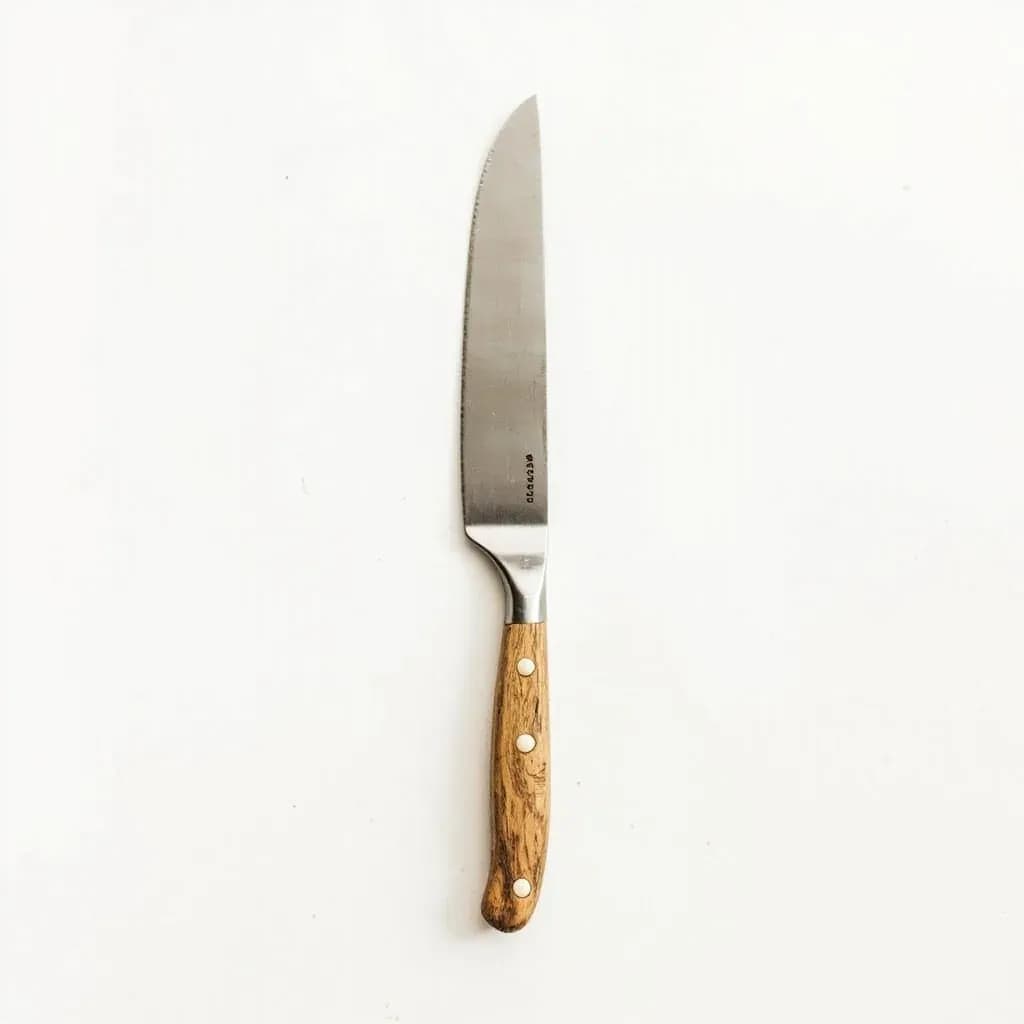
Prep Tools
Cheese Spreader
A short, blunt-bladed knife for spreading soft cheese and butter onto bread and crackers.
A cheese spreader is a small knife with a wide, rounded, blunt blade designed to scoop and smear soft cheeses, butter, and pâté onto bread or crackers. The flat blade picks up a generous amount and spreads it evenly without tearing the surface. It is a staple of cheese boards and appetizer service, often sold in matching sets.
The cheese spreader is a small table knife purpose-built for soft dairy. Its defining feature is a short blade — typically two to three inches — that is flat or gently dished, with a blunt or only lightly sharpened edge and a rounded, oval, or spear tip. That blunt, paddle-like profile is the point of the tool: a sharp chef's knife or table knife tears bread and mashes soft cheese, while the spreader's short, broad blade presses and glides, laying down a clean, even layer in a single pass. The handle is scaled to match — total length sits around six to seven inches — so the tool feels balanced in the hand and stays out of the way on a crowded board or place setting.
The spreader earns its place in the cheese toolkit because soft, ripened, and fresh cheeses behave differently from aged ones. Brie, Camembert, cream cheese, goat cheese, ricotta, and triple-crèmes are too yielding to slice cleanly and too sticky to scoop with a fork. A quick rinse under hot water briefly warms the metal, softening the surface of cold butter or chilled cream cheese just enough to release a clean portion, and the dished blade carries that portion from board to cracker without dragging.
As cheese service moved from the kitchen to the board and from wedges to whole wheels in the 20th century, dedicated matched sets appeared — spreader, fork, plane, and piercer in silver, bone, mother-of-pearl, or carved wood — refining the older European butter knife into the specialist tool we know today. The spreader is now sold both as a single piece and as part of those matched services, with inexpensive plastic versions for commercial use and Laguiole-style or sterling heirlooms for the table.
Alternatives
Types & varieties
Short, flat, paddle-shaped blade with a rounded or oval tip; the most common all-purpose style for soft cheese and butter.
Blade tapers to a pointed, symmetrical 'spear' end; used both for spreading and for piercing garnishes or olives on a cheese board.
Made in two pieces so the handle can be filled with hot water to warm the blade, softening cold butter or hard cream cheese.
Smaller, lighter version of a butter knife designed for individual place settings; works equally well for soft cheese.
Blade has decorative holes or slots that reduce sticking and let small bits of curd pass through; used to portion semi-soft cheeses from a wheel or log.
Handles of sterling silver, bone, mother-of-pearl, or carved wood; often part of a matched cheese service set and used at the table rather than for prep.
Inexpensive, color-coded versions often used in commercial kitchens and at catered events.
French regional style recognized by the traditional bee emblem on the handle; typically stainless blade with resin, wood, or horn handle.
The Cheese Tool Family
The cheese spreader is the soft-cheese specialist in a broader family of cheese tools. On a well-set board it is usually joined by a few complementary pieces, each built for a different cheese texture. Knowing which is which prevents the common mistake of using a spreader to attack a hard wheel — or a heavy chef's knife to slice a runny one.
- Hard-cheese knife: a sharp, often pointed blade with a forked tip, used to cut and spear aged cheddars, Gruyère, Comté, and other firm wheels.
- Cheese plane: a flat blade with a slot that shaves thin curls from very hard, dry wheels like Parmesan and aged pecorino.
- Cheese fork (or 'cheese stabber'): a two-tined fork used to hold a wedge steady while a guest cuts or spreads.
- Cheese wire (or 'cheese harp'): a thin wire stretched between two handles, used to slice through very soft, runny wheels such as Vacherin Mont d'Or without crushing them.
- Master butter spreader: a smaller, lighter version of a butter knife set at each place; functionally identical to a cheese spreader and often used interchangeably at the table.
Common uses
Tips & pitfalls
- Warm the blade under hot running water and wipe dry before spreading cold butter or chilled cream cheese; the heat briefly softens the fat and prevents tearing bread.
- Use a dedicated hard-cheese knife or plane for aged, crumbly cheeses; the blunt edge of a spreader will mash them rather than cut cleanly.
- Choose a spreader with a slightly concave blade when you want to carry a generous dab of cheese from board to cracker in one motion.
- Wash and dry the blade immediately after contact with soft cheese; dairy proteins stick and harden once dry, especially on stainless steel.
- Match the spreader to the setting: a small master/hostess spreader belongs on the breakfast or dinner place setting, while a larger paddle spreader is better for the cheese board.
- Avoid the dishwasher for silver-plated, sterling, wood, bone, or mother-of-pearl handles; the heat and detergent strip plating and crack organic materials.
- Pull the spreader toward you rather than pushing it away when laying cheese on soft bread; pushing compresses the crumb and tears the surface.
- If the spreader's tip has become slightly bent or nicked from contact with hard rinds, retire it from the cheese board — a rough edge drags on soft cheese and leaves tears on the bread.
Good to know
- Tool type
- Small spreading knife with a short, blunt or paddle-shaped blade
- Primary function
- Portioning and spreading soft cheese (and butter) onto bread, crackers, and fruit
- Typical total length
- Approximately 6–7 inches (15–18 cm)
- Typical blade length
- Approximately 2–3 inches (5–7.5 cm)
- Blade shape
- Flat or slightly concave (dish-shaped) with a rounded, oval, or spear tip; cutting edge is blunt or only very lightly sharpened
- Common materials
- Stainless steel, sterling silver, silver plate, wood, bone, mother-of-pearl, acrylic, or ceramic handles with metal blades
- Origin
- Evolved from the 18th- and 19th-century European butter knife; the dedicated cheese spreader became common in 20th-century flatware and cheese service sets
- Not for
- Hard aged cheeses such as aged Parmesan or pecorino, which require a separate hard-cheese knife, plane, or grater
Also called
spreader knife · butter spreader · soft cheese knife
Related

Peeler
Swift blade for stripping skin off fruit and vegetables

Grater
Sharp-toothed surface for shredding cheese and vegetables

Microplane
Ultra-fine rasp for citrus zest, garlic, and hard cheese

Mixing Bowl
All-purpose bowl for combining, whisking, and tossing

Whisk
Looped wires that beat air into eggs, cream, and sauces

Spatula
Flat blade for flipping, lifting, and scraping

Slotted Spoon
Pierced spoon that lifts solids and drains the liquid behind

Wooden Spoon
Gentle, heat-friendly spoon for stirring anything