Baking & Pastry
Chilled Saucer (Wrinkle Test Plate)
A frozen small plate used to test whether jam or jelly has reached its setting point.
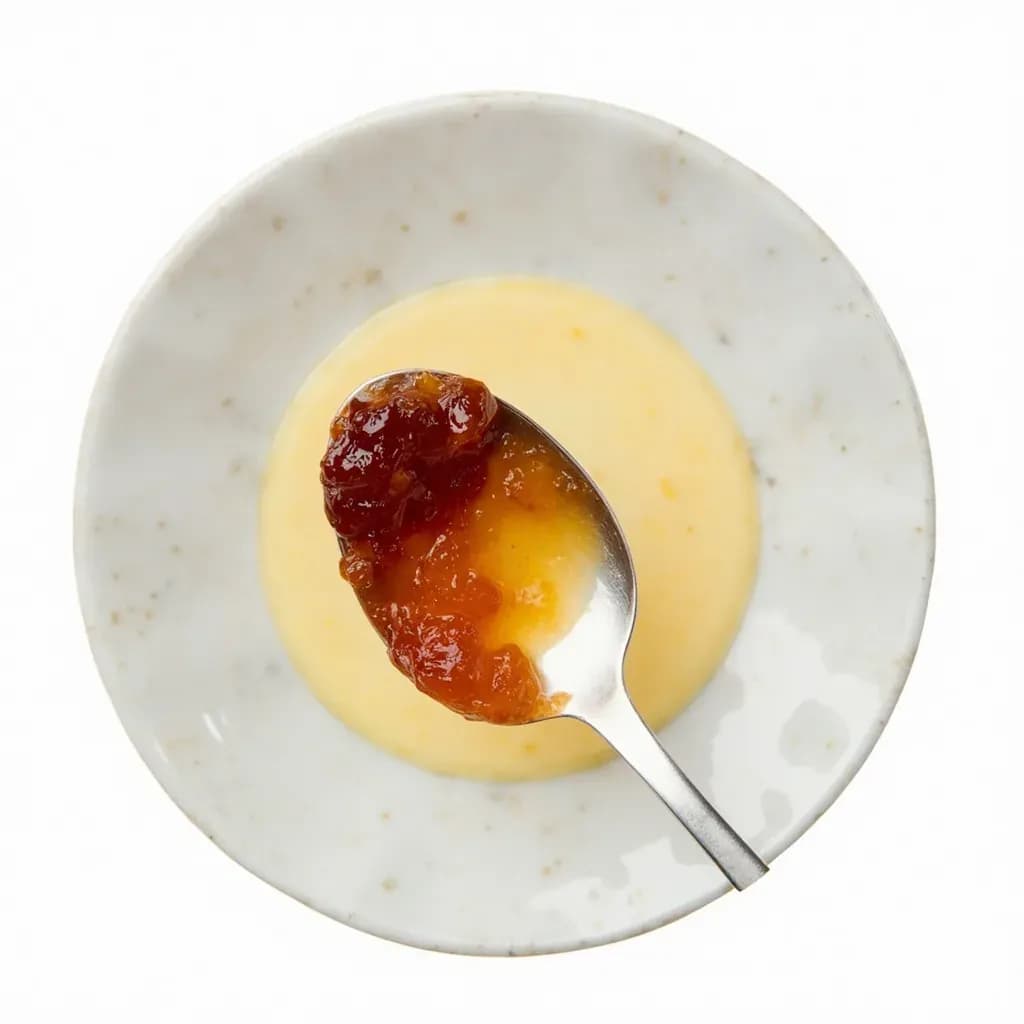
A chilled saucer is simply a small plate kept in the freezer and used to test jam, jelly or marmalade for set. A spoonful of hot preserve is dropped onto the cold plate, left a moment, then nudged with a finger; if the surface wrinkles, the preserve has reached gel stage and is ready to jar. It is a low-tech alternative to a candy thermometer for judging setting point.
The chilled saucer, more formally the wrinkle test plate, is the workhorse tool of home jam- and jelly-making: a small ceramic, porcelain, or glass plate kept in the freezer and used to check whether a boiling preserve has reached its setting point. A drop of the cooking jam is spooned onto the cold surface, left for half a minute, then pushed with a finger. If the surface wrinkles and holds the line, the pectin–sugar–acid gel has formed; if it floods back into a pool, the pan goes back on the heat. It needs no thermometer, no specialist kit, and costs nothing if there is a spare saucer to hand, which is why it has survived from pre-instrument preserving into modern kitchens.
The test relies on a small but useful piece of physics. The cold plate mimics the rapid cooling the jam will undergo once potted, and a thin drop cools in roughly 30 seconds — long enough for a true gel to set, short enough to give a fast read while the pan is still boiling. Material matters. Ceramic and glass are poor thermal conductors and let the drop behave naturally; a metal plate, by contrast, draws heat out of the jam almost instantly, so even an under-set preserve wrinkles on contact and the cook is told the batch is done when it is not.
The wrinkle test is folk technique refined by repetition. It is subjective, dependent on the cook's finger and eye, and worth cross-checking with a thermometer until confidence is built. It is, however, exceptionally reliable for high-pectin, high-acid fruits such as quince, crab apple, and Seville orange, and remains the default method in British and Northern European preserving manuals.
Alternatives
Types & varieties
The standard household choice; a white or pale surface shows the jam colour and the wrinkle clearly.
Works well and conducts cold efficiently; avoid heavily patterned glass that obscures the drop.
The traditional British kitchen choice; ideal size, weight, and chill retention.
Commercial tools, often with a small central well or printed temperature guide; sold by preserving suppliers.
A cold marble pastry slab performs the same role on a larger scale; not a saucer, but the same logic.
Reading the wrinkle
The wrinkle is not a binary yes/no; it has degrees, and learning them is the real skill of the test. A clear, sharp ridge that holds its shape as the drop is pushed sideways means the preserve is fully set and will hold a soft slice in the jar. A soft, lazy wrinkle that slowly relaxes back means the jam is at gel point but on the looser side — fine for a spooning preserve, possibly under-set for a sliceable jelly. No wrinkle at all, with the drop spreading and flooding the plate, means keep boiling and retest in 1–2 minutes.
- High-pectin, high-acid fruits (quince, crab apple, citrus, gooseberry) wrinkle cleanly and the test is highly reliable.
- Low-pectin fruits (strawberry, blueberry, cherry, rhubarb) wrinkle more gently; expect to retest two or three times in the final minutes of cooking.
- Modern added pectins set faster and firmer than traditional ones — the wrinkle can look correct before the full boil time on the packet has elapsed, so cross-check the clock as well.
- A drop that sets almost rock-hard on the plate, with no soft centre, suggests over-cook: the jam will be thick, dull-flavoured, and may weep or crystallise in the jar. An under-set jam, by contrast, tastes thin and syrupy.
Common uses
Tips & pitfalls
- Chill at least two or three saucers at once so a cold one is always to hand; a warm plate gives a runny read and wastes cooking time.
- Drop only ¼ to ½ teaspoon of jam onto the plate — a large pool stays liquid in the middle and fools the eye into thinking it is under-set.
- Return the plate to the freezer for 2–3 minutes between tests; even slight warming ruins the result.
- Push the cooled drop with the pad of the finger, not the tip: a clear wrinkle that holds as it is pushed means set; a flood-back means keep boiling.
- Test only in the last 5–10 minutes of cooking. Repeated early testing just cools the pan, lengthens cook time, and dulls the fresh fruit flavour.
- Use a metal teaspoon rather than a wooden spoon to lift the test drop; metal is non-absorbent and delivers a clean, consistent drop to the plate.
- At altitudes above about 900 m (3,000 ft) the gel point drops roughly 1 °C per 300 m — lean slightly earlier on the wrinkle test rather than waiting for an over-cook.
- If using commercial pectin, the wrinkle test alone can be misleading because some modern pectins set fast and firm; cross-check the boil time stated on the packet.
Good to know
- Also known as
- Wrinkle test plate, plate test, freezer plate test, saucer test
- Purpose
- Tests jam, jelly, marmalade, and other sugar preserves for gel/set point without a thermometer
- Typical material
- Ceramic, porcelain, or glass; metal conducts cold too quickly and gives false readings
- Recommended size
- Small side plate or saucer, roughly 10–15 cm (4–6 in) in diameter
- Prep temperature
- Stored in the freezer at about −18 °C (0 °F) for at least 15–30 minutes before use
- Setting point (sea level)
- Jam gels at roughly 105 °C (220 °F); the wrinkle test is its no-instrument proxy
- Working time per plate
- A chilled saucer warms in 30–60 seconds; keep 2–3 spares rotating in the freezer
- Skill level
- Beginner-friendly; the standard method in British and Northern European home preserving
Also called
Wrinkle Test Plate · Jam Test Saucer
Related

Muffin Pan
Multi-cup pan for muffins, cupcakes, and egg bites

Bundt Pan
Fluted ring mold for showstopping cakes with a center hole

Springform Pan
Latch-release pan that frees delicate cakes without flipping

Pie Dish
Sloped round dish for crisp-bottomed pies and quiches

Tart Pan
Fluted pan with a pop-out base for clean-edged tarts

Rolling Pin
Rolls dough into even sheets for pastry and bread

Pastry Brush
Brushes on egg wash, glaze, butter, and marinades

Bench Scraper
Flat blade that divides dough and clears your work surface