Prep Tools
Sausage Clip Gun
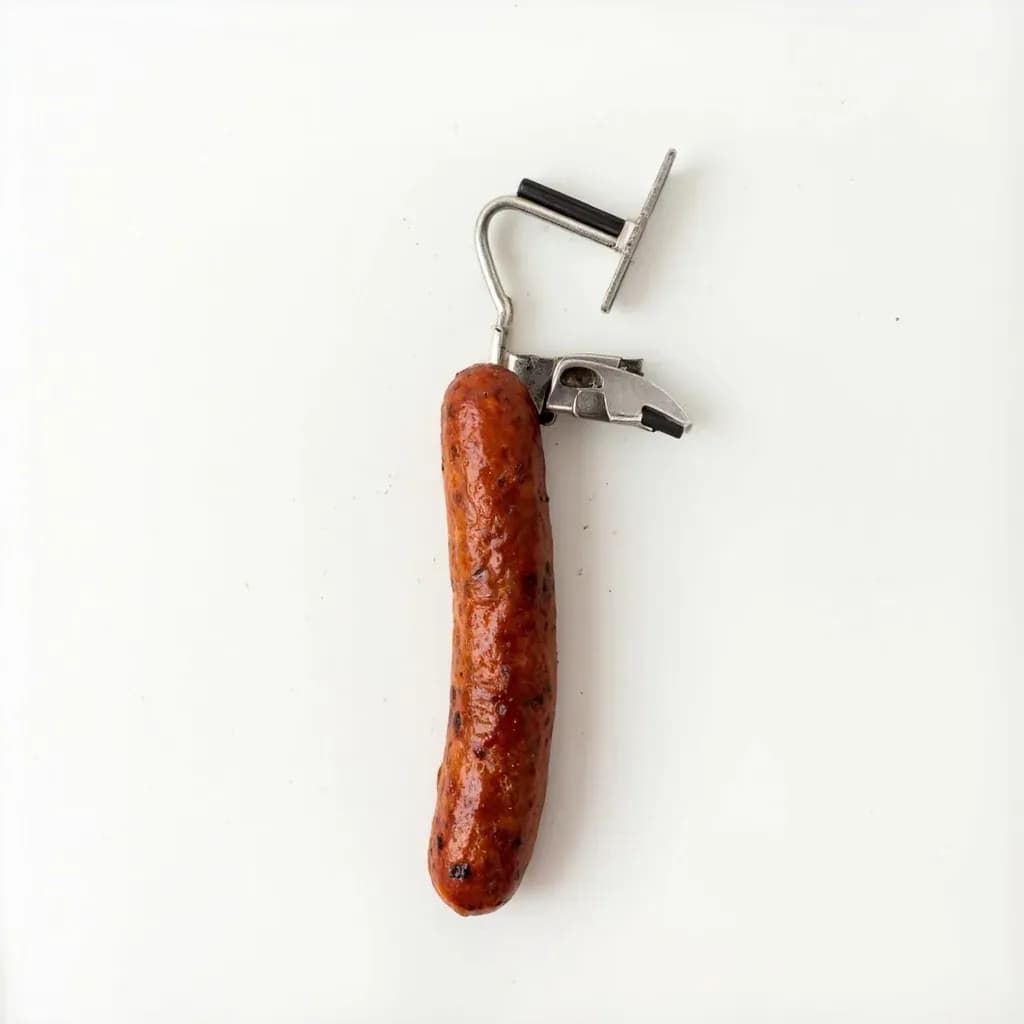
A handheld crimping tool that fastens metal clips to seal the ends of stuffed sausage casings.
A sausage clip gun is a plier- or trigger-style tool that crimps a U-shaped metal clip around the twisted end of a stuffed casing to seal it shut. It gives a fast, secure closure that holds better than tied string, useful for sealing summer sausage, salami, and casing chubs after stuffing. Loaded with strips of clips, it lets a butcher seal many sausages in quick succession.
A sausage clip gun is a pistol-grip crimping tool that seals the open end of a stuffed sausage casing with a pre-formed aluminum clip. Squeeze the lever and the jaw closes around a single C-shaped clip, deforming it into a closed oval that grips the casing tightly enough to hold through stuffing pressure, cooking, smoking, and drying. The tool is fed from a strip or spool of clips that loads into a side magazine, so each squeeze advances the next clip into place automatically.
For a home sausage maker, the clip gun replaces the hand-tying or pinching methods that give uneven results and often pop open during cooking. For a commercial shop, a pneumatic version is the standard way to close hundreds of links per hour with identical crimp pressure. Either way, a clipped seal is more secure than a hand-twist or string tie, faster than butcher's twine, and leaves a clean, professional-looking end on everything from breakfast links to bologna chubs.
It is a finishing tool, not a stand-alone gadget: you still need a sausage stuffer to fill the casing, and ideally a linking setup if you want uniform portions. But once the emulsion is in the casing, the clip gun is the last step that determines whether the sausage holds together all the way to the pan.
Alternatives
Types & varieties
Hand-squeeze pistol grip that fires one clip per squeeze; the standard for home sausage makers and small producers.
Air-powered for speed and uniform crimp pressure on production lines.
Fires two clips at once with a knife between them, producing a closed link in one motion; the commercial standard for linked sausages.
Heavier-duty model sized for 40–120 mm casings used on bologna, salami chubs, and cooked hams.
U.S. designs that feed clips from a linked plastic strip.
European designs with a distinct spool-fed clip system, widely used in EU sausage plants.
Choosing the Right Clip Size
Clip guns and clips are sold in matched gauges — 12, 13, 15, 17, 18, 20, and 25 mm are common for fresh and small-diameter sausages, with larger sizes up to about 50 mm for bologna and cooked-ham chubs. Sizing is based on the outside diameter of the casing after stuffing, not the nominal casing size. Measure with calipers or compare to the gauge card your supplier provides.
A clip that is too small cuts through the casing wall and can split it during cooking, releasing fat and juices. A clip that is too large looks loose from the start and tends to slip off once the meat contracts in the pan or smoker. The right clip seats firmly without crushing the casing, and you should leave 3–5 mm of casing tail extending past the crimp so the clip is biting on casing, not on exposed meat.
Clips are not fully standardized between manufacturers, so it is worth buying clips and the gun from the same supplier — a '15 mm' from one maker may not seat the same as a '15 mm' from another.
Linked Sausage with a Double-Clip Gun
Double-clip guns are designed for the production line. They fire two clips at once, one on each side of a measured portion, and a small knife between the jaws cuts the casing between the clips. The result is a uniform link with a closed end on both sides, produced in one motion as the casing is fed off a stuffing horn.
To use one, the gun is mounted on a clipping bracket attached to the outlet of the stuffer, and the operator indexes the casing forward by the desired link length, then triggers the gun. A typical breakfast link is 10–12 cm, a bratwurst around 12–15 cm, and a frankfurter 8–10 cm. The speed — often 60–100 links per minute — is why commercial plants standardized on this method.
For a home cook making a small batch, a single-clip gun paired with hand-twisting is simpler and adequate. The double-clip setup earns its keep when you are producing dozens of identical links for freezing or sharing.
Common uses
Tips & pitfalls
- Match the clip size to the outside diameter of the casing, not the inside — a too-small clip cuts the casing, a too-large clip slips off after cooking.
- Leave 3–5 mm of casing tail past the crimp so the clip seats on casing, not on exposed meat.
- Keep casings taut but not stretched over the stuffing horn; wrinkled casing gives a poor crimp and can split under the clip teeth.
- Dry the inside of the gun's jaw and the clip path before loading — moisture makes the next clip misfeed.
- Pre-load the magazine and store the gun with the feed path closed so clips don't fall out or rust.
- After every few hundred cycles (manual) or daily (pneumatic), oil the pivot and jaw spring with food-grade lubricant.
- Practice on water or cheap pork trimmings before using expensive cured forcemeats — you want a feel for trigger pressure.
- For natural casings, soak them briefly in warm water first; dry casings tear under the clip teeth.
- When making linked sausages by hand, twist the casing one full turn between marks before clipping the final end so the links stay distinct.
- Don't try to clip a casing that is still warm and steamy from a hot fill — let it cool or chill briefly for the cleanest seal.
Good to know
- Tool Type
- Handheld crimping tool (manual or pneumatic) that fastens pre-formed metal clips around sausage casings to seal them
- Power Source
- Manual hand-squeeze lever for home and small-batch use; compressed-air pneumatic (typically 6–8 bar) for production lines
- Clip Material
- Food-grade aluminum is standard; stainless steel appears on larger clips for chubbs and bologna
- Typical Clip Sizes
- 12, 13, 15, 17, 18, 20, and 25 mm for fresh sausages; up to ~50 mm for chubbs and bologna
- Compatible Casings
- Natural (hog, sheep), collagen, fibrous, and plastic casings
- Loading Method
- Clips arrive on a continuous plastic-linked strip (Rex/Tipper Tie style) or a spool (Poly Clip/Plastro style) that feeds into the magazine
- Approximate Cost
- Manual single-clip guns run $40–$150; pneumatic units range from ~$500 to several thousand dollars
- Cleaning
- Wipe-down only — never washed. Brush off debris and apply a light food-grade oil to the pivot and spring
- Origin
- Modern pistol-grip and pneumatic clip guns were developed by companies such as Tipper Tie (USA, founded 1930s) and Poly Clip (Germany)
Also called
sausage clipper · clip gun · casing clipper · sausage clip tool
Related

Peeler
Swift blade for stripping skin off fruit and vegetables

Grater
Sharp-toothed surface for shredding cheese and vegetables

Microplane
Ultra-fine rasp for citrus zest, garlic, and hard cheese

Mixing Bowl
All-purpose bowl for combining, whisking, and tossing

Whisk
Looped wires that beat air into eggs, cream, and sauces

Spatula
Flat blade for flipping, lifting, and scraping

Slotted Spoon
Pierced spoon that lifts solids and drains the liquid behind

Wooden Spoon
Gentle, heat-friendly spoon for stirring anything