Prep Tools
CO2 Regulator
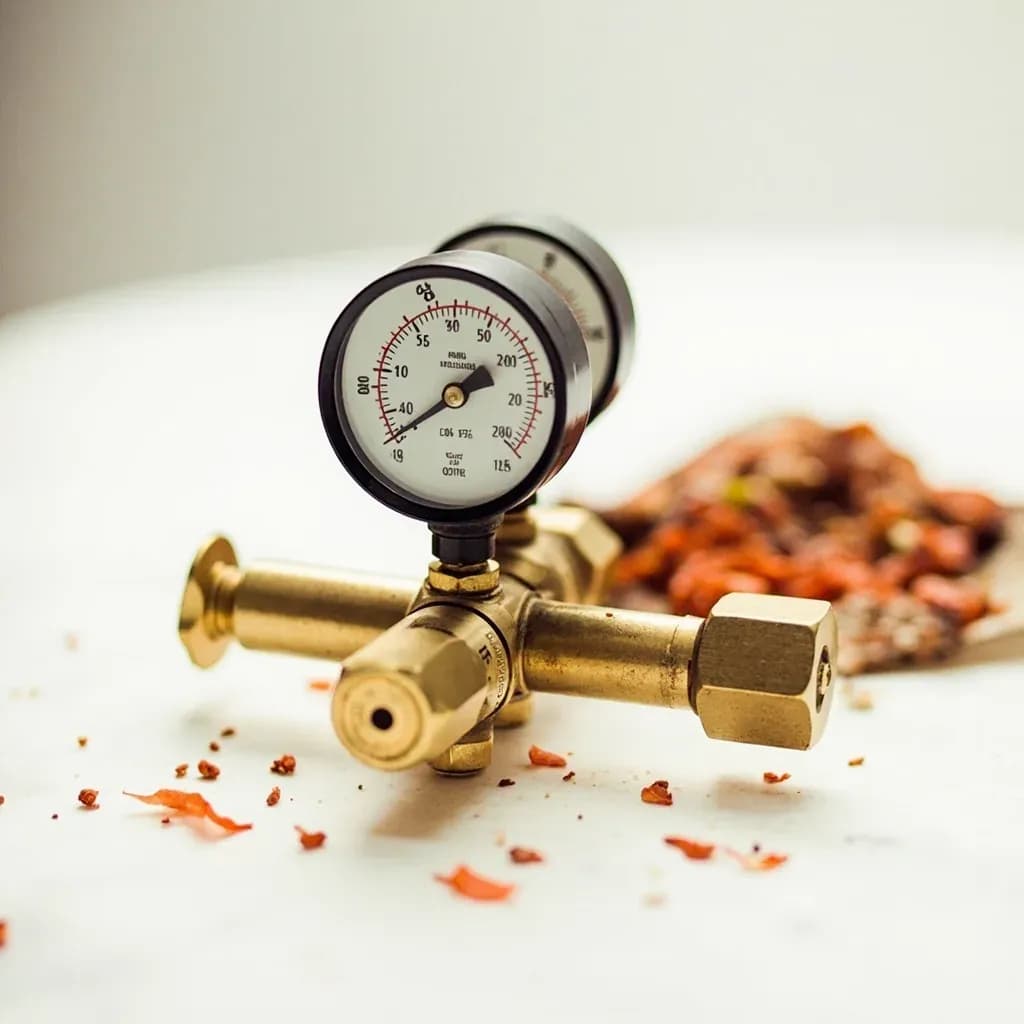
A valve-and-gauge unit that steps CO2 from a tank down to a safe, set working pressure.
A CO2 regulator attaches to a carbon-dioxide tank and reduces its high internal pressure to a precise, adjustable output for carbonating and dispensing. Cooks and brewers use it to force-carbonate water, soda, and kombucha, push draft beer, and run soda guns. Twin gauges show tank reserve and delivery pressure so you can dial in the exact fizz or pour.
A CO2 regulator is a pressure-reducing valve that takes the roughly 800–900 PSI sitting inside a full carbon dioxide cylinder and steps it down to a controllable, much lower working pressure suited to whatever you have it plumbed to — a keg, a whipping siphon, a countertop carbonator cap. Without the regulator that cylinder is unusable; with it, the same tank becomes the gas supply for draft beer, force-carbonated water, rapid infusions, and a handful of modernist techniques that rely on pressurized gas. The unit combines a high-pressure inlet that connects to the cylinder, an adjustable spring-loaded diaphragm that sets the outlet pressure, and one or two gauges so you can see both what's left in the tank and what's actually being delivered downstream.
For cooks, the regulator's real job is repeatability. CO2 absorption into a cold liquid depends on pressure, temperature, and time in a predictable way, and the regulator is what lets you dial in "30 PSI for two days at 38°F" and trust the result batch after batch. It also makes the cylinder safe to handle: the relief valve built into most units vents automatically if the diaphragm fails or the adjustment screw is cranked past the unit's rating. Brass bodies with chrome plating are standard because brass machines cleanly to the tight tolerances the seat and diaphragm require, and it resists the modest corrosion that can occur as trace moisture accumulates inside the line.
The hardware looks industrial, but the daily skill set is small: connect the right fitting to the right cylinder, open the tank valve fully before adjusting, set the working pressure, and test every joint for leaks with soapy water. Once those habits are in place, a single well-chosen regulator covers most of what a home cook or brewer will ever do with CO2.
Alternatives
Types & varieties
One pressure reduction stage; cheaper and lighter; outlet pressure drifts upward as cylinder pressure drops, which can over-carbonate a keg as the tank empties.
Two reduction stages; holds outlet pressure flat from a full cylinder to nearly empty. The right choice for repeatable carbonation and any setup you don't want to babysit.
Low-pressure (0–15 PSI) variant built for countertop soda makers and Cornelius-keg carbonation caps; usually pairs with a 3/8" flare or push-to-connect outlet.
0–60 PSI range with a 1/4" flare outlet; the workhorse for kegerators, keezers, and home draft towers.
0–120+ PSI units used for specialty applications such as supercharged brining or high-pressure cooking chambers.
Plumbed downstream of a primary tank regulator to step pressure down further for a second device — useful when one cylinder feeds both a draft system and a carbonator at different pressures.
Choosing between single- and dual-stage
The single-stage vs. dual-stage decision is the one most home cooks actually have to make. A single-stage regulator has one reduction chamber: as cylinder pressure falls from 900 PSI toward zero, the force pushing on the diaphragm drops too, and the outlet pressure gradually rises — sometimes by several PSI over the life of a tank. For draft beer served at 12 PSI, that drift is barely noticeable. For a keg you plan to carbonate at 40 PSI for two days, that same drift can push you past the target and over-carbonate the batch.
A dual-stage regulator puts two reduction chambers in series. The first stage absorbs most of the cylinder-pressure drop, so the second stage sees a much more stable input and delivers a nearly flat outlet pressure from a full tank to the last few PSI. If you carbonate more than occasionally, or if you set up a kegerator and walk away from it for months, dual-stage is worth the modest price premium. For a kitchen that only charges whipping siphons a few times a month, a single-stage unit is fine.
- Single-stage is acceptable for draft beer and intermittent whipping-siphon use.
- Dual-stage is the better choice for keg carbonation, soda making, and any unattended setup.
- Rebuild kits are available for both types and are far cheaper than replacement.
Cylinder sizing and gas economics
In the US, CO2 is sold by the pound, not by tank size — a 5 lb cylinder and a 20 lb cylinder filled at the same shop cost the same per pound. Larger cylinders are almost always the better value, with two caveats: they are heavy (a 20 lb cylinder weighs about 38 lb full), and they must be stored upright and secured so they cannot fall. A 5 lb cylinder is enough for several months of occasional whipping-siphon and soda work; a draft system pulling 12 PSI around the clock will empty one in a few weeks.
- Buy the largest cylinder your storage and handling allow.
- Have cylinders hydrostatically tested and re-certified per local code — usually every 5–10 years.
- Keep at least one spare on hand; swapping tanks mid-carbonation is annoying.
- Store upright, chained or strapped, away from heat sources and direct sun.
Setup basics and leak testing
Every connection in the gas path — tank nut to regulator, regulator to hose, hose to keg or siphon — is a potential leak point, and even a slow leak will empty a cylinder in days. The standard test is simple: after assembly with the tank valve closed, pressurize the line to working pressure, then brush a 50/50 dish-soap-and-water mix on every joint and watch for bubbles. A bubble that grows steadily means a real leak; a single fizz that stops is usually just residual soap. The most common leak site is the flat washer inside the CGA-320 tank nut — if it is missing, cracked, or dry, replace it before anything else.
- Always open the tank valve slowly and fully (back-seating the stem) before adjusting the regulator.
- Bleed downstream pressure through the relief valve or by opening the keg before disconnecting any line.
- Mark your working pressure on a label taped to the regulator so it resets correctly each session.
- Mount the regulator vertically for accurate gauge readings and proper diaphragm action.
Common uses
Tips & pitfalls
- Test every joint with a 50/50 soap-and-water mix after assembly — bubbles reveal leaks that will silently drain a cylinder.
- Open the tank valve slowly and fully before adjusting the regulator; cracking it partially wears the seat and gives unstable readings.
- Always bleed downstream pressure before disconnecting any line; never crack a fitting under pressure.
- Use only food-grade CO2 labeled E290 — welding-grade gas lacks purity certification for beverage contact.
- Check the flat washer inside the CGA-320 tank nut before every hookup; a missing or cracked washer is the most common leak source.
- Never mate a CO2 regulator to an argon, nitrogen, or air cylinder with an adapter — the fittings and seals are gas-specific and mismatches can damage equipment.
- If the outlet gauge needle bounces or creeps, the seat or diaphragm is fatigued; rebuild kits are inexpensive and worth installing before replacing the whole unit.
- Mount regulators upright and vertical — sideways mounting skews gauge readings and can affect diaphragm action.
Good to know
- Function
- Reduces cylinder pressure (~800–900 PSI when full at room temperature) to a controlled, lower working pressure suited to the connected device.
- Tank connection (US)
- CGA-320 nut-and-nipple fitting is the standard for CO2 cylinders in North America; adapters for other gas types must never be used.
- Common working pressures
- Draft beer: 10–30 PSI depending on style and temperature. Cornelius-keg force carbonation: 30–50 PSI. Low-pressure carbonators: 0–15 PSI. Pressure fermenters: 10–15 PSI.
- Gauges
- Single-gauge models show cylinder pressure only; dual-gauge models add an outlet-pressure dial and are strongly preferred for carbonation work where the outlet reading is what actually matters.
- Single vs. dual stage
- Single-stage units are simpler and cheaper but allow outlet pressure to creep upward as cylinder pressure drops. Dual-stage units hold a steadier outlet from full to nearly empty and give more repeatable carbonation.
- Safety relief
- Built-in relief valve typically vents at roughly 1.5× the regulator's maximum rated outlet pressure, protecting downstream equipment from over-pressurization.
- Outlet fittings
- 1/4" flare for most draft systems, 3/8" flare for some kegerators, and push-to-connect for countertop soda makers — some units offer swappable outlets to cover both.
- Maintenance
- Sintered bronze inlet filter should be inspected annually; the nylon seat inside the regulator and the flat washer inside the CGA-320 tank nut should be replaced every 2–3 years under heavy use.
Also called
CO2 Tank & Regulator · Carbonation Regulator · Gas Regulator
Related

Peeler
Swift blade for stripping skin off fruit and vegetables

Grater
Sharp-toothed surface for shredding cheese and vegetables

Microplane
Ultra-fine rasp for citrus zest, garlic, and hard cheese

Mixing Bowl
All-purpose bowl for combining, whisking, and tossing

Whisk
Looped wires that beat air into eggs, cream, and sauces

Spatula
Flat blade for flipping, lifting, and scraping

Slotted Spoon
Pierced spoon that lifts solids and drains the liquid behind

Wooden Spoon
Gentle, heat-friendly spoon for stirring anything