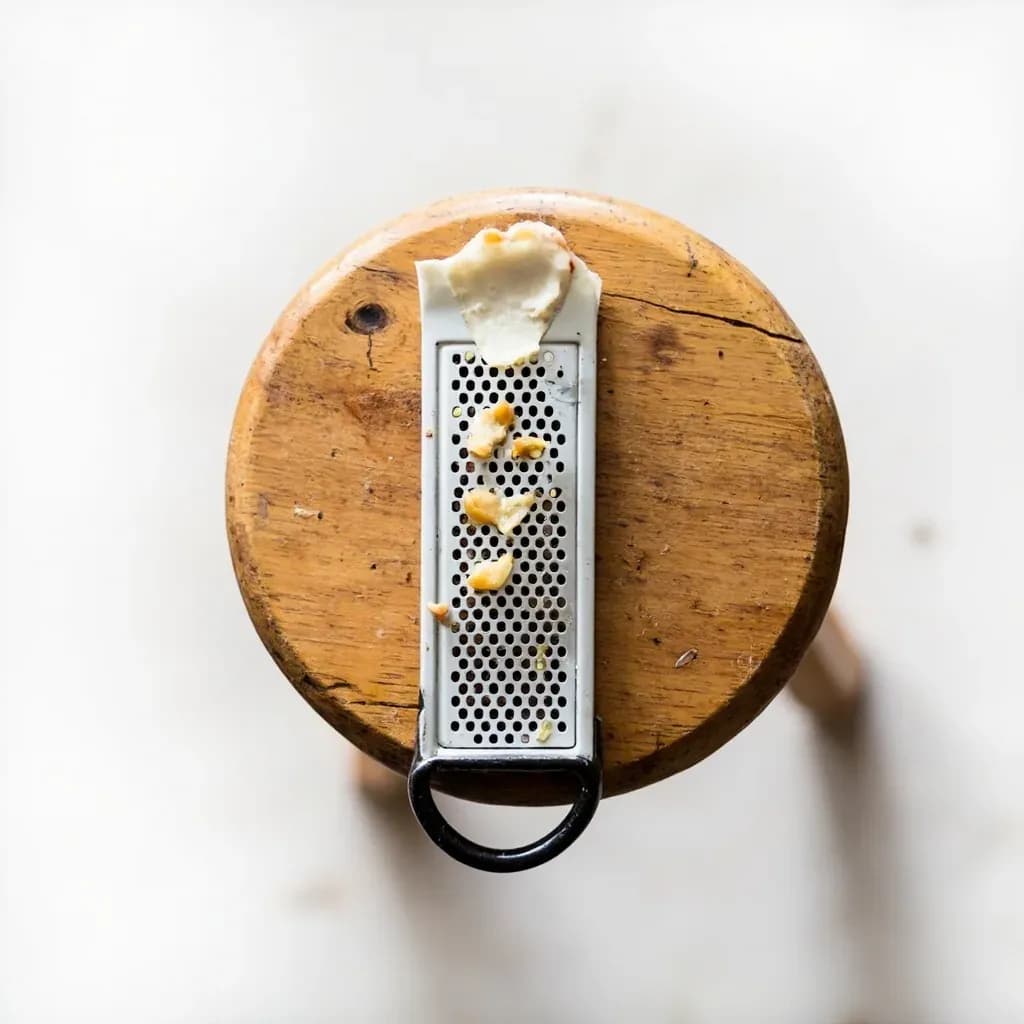
Prep Tools
Coconut Grater
A serrated scraping tool for shredding the white flesh from half coconuts.
A coconut grater is a tool with a serrated round or toothed blade used to scrape and shred the meat from inside a halved coconut. Traditional versions mount on a low wooden bench or stool that the cook sits on, scraping the coconut against the protruding blade into a bowl below. The fresh grated coconut is used for chutneys, curries, sweets, and for pressing coconut milk.
The coconut grater is a single-purpose prep tool built around one idea: a sharp, serrated blade fixed in place so a half-shell of coconut can be dragged across it. The classic form — found across South India, Sri Lanka, Bangladesh, and the Philippines — is a long wooden plank, usually 30 to 45 cm, with a half-moon or disc of serrated iron or steel mounted near one end and pointing upward. The cook holds a coconut half in both hands and pulls the cut face across the teeth, producing a fine, moist shaving of white meat.
That shaving is the whole point of the tool. Unlike the dry, sugary fluff of bagged shredded coconut or the wetter, coarser shreds a food processor typically leaves behind, the grater produces something close to a coarse cream: long, tender strands with enough moisture and surface area to release coconut milk under even light pressure. In kitchens that cook with fresh coconut daily, this is the texture that drives South Indian curries, Sri Lankan mallung, Bengali sweets, Filipino kutsinta and maja blanca, and the milk that seasons them all.
Because the tool is dedicated, it does its one job quickly. A practiced hand clears a full half-coconut in three to five minutes and beats every general-purpose substitute on speed, yield, and fineness of the grate. The trade-off is posture: traditional use is seated on the floor with the plank braced between the feet, an ergonomic choice that turns out to give the steadiest pressure and the cleanest scrape.
Alternatives
Types & varieties
A serrated half-moon blade fixed to a long wooden plank. Operated sitting on the floor with the plank braced between the feet; the half-shell is scraped against the blade. The classic South Indian, Sri Lankan, and Bangladeshi form.
A raised wooden or metal base that clamps or holds the coconut half upright, used on a counter while standing.
A smaller wooden block with an upward-facing serrated disc on top; the coconut half is rubbed back and forth across the disc.
A standalone serrated blade, sometimes a repurposed iron plate, used over a bowl; less efficient, more common in home kitchens.
A modernized version with a rotating serrated drum turned by a handle; less common but used in some commercial settings.
Substitutes and when they work
For cooks outside South and Southeast Asia who only need fresh coconut occasionally, a dedicated grater is rarely worth buying or storing. A box grater's medium holes produce a respectable, if coarser and drier, result when the coconut is well chilled, and a food processor fitted with a grating disc handles larger volumes with far less labor. The texture from either alternative is wetter and slightly more pulpy than a hand scrape — which means it milks well but lacks the dry, fluffy character that holds shape in sweets like laddoos or burfi.
- Box grater (medium holes): the best home substitute for small amounts; chill the coconut half first to reduce tearing and clogging.
- Food processor with grating disc: faster for several coconuts at once; produces a wetter pulp ideal for pressing milk.
- Stand-mixer grating attachment: handles volume for catering or batch cooking with a texture close to a food processor.
- Microplane or zester: only effective on very soft young coconut; tears the firm meat of mature nuts.
- Frozen pre-shredded coconut: convenient but drier and sweeter than fresh; not a true substitute in milk-heavy recipes.
Common uses
Tips & pitfalls
- Choose a fully mature, heavy brown coconut with audible water — younger nuts give soggy, unproductive grating.
- Drain the coconut water first, then crack it in half with a cleaver or machete and test the half on the plank before scraping.
- Apply firm, even downward pressure and use long strokes from the brown husk edge toward the white center so the blade keeps biting cleanly.
- Keep a small bowl of water nearby; if the meat is dry, dip the cut surface briefly so it releases as fine, moist shavings rather than dust.
- Stop scraping when you hit the brown inner skin — going further tints the gratings with bitter tannin.
- Clean the blade with a stiff brush, not your fingers, right after use; coconut milk residue sours quickly and corrodes the metal.
- Lightly oil the blade after drying to prevent rust in humid climates.
- If the blade has gone dull, replace or re-sharpen it — most traditional forged iron blades can be re-sharpened by a bladesmith, but cheap stamped discs cannot.
Good to know
- Also known as
- Coconut scraper, kurma (South India), kashni, kudkuran (Philippines)
- Traditional form
- Serrated iron or steel disc or blade mounted on a wooden plank or board
- Primary region of use
- South India, Sri Lanka, the Philippines, and other tropical South and Southeast Asian kitchens
- Power source
- Manual; operated by hand pressure
- Best coconut to use
- Fully mature brown coconuts (11–12 months) with thick, firm meat
- Time per coconut
- About 3–5 minutes for a full half-coconut of finely scraped flesh
- Cleaning
- Rinse immediately, scrub the blade with a stiff brush, then dry thoroughly to prevent rust
Also called
Coconut Scraper · Coconut Scraper Stool · Coconut Grating Stool
Related

Peeler
Swift blade for stripping skin off fruit and vegetables

Grater
Sharp-toothed surface for shredding cheese and vegetables

Microplane
Ultra-fine rasp for citrus zest, garlic, and hard cheese

Mixing Bowl
All-purpose bowl for combining, whisking, and tossing

Whisk
Looped wires that beat air into eggs, cream, and sauces

Spatula
Flat blade for flipping, lifting, and scraping

Slotted Spoon
Pierced spoon that lifts solids and drains the liquid behind

Wooden Spoon
Gentle, heat-friendly spoon for stirring anything