Prep Tools
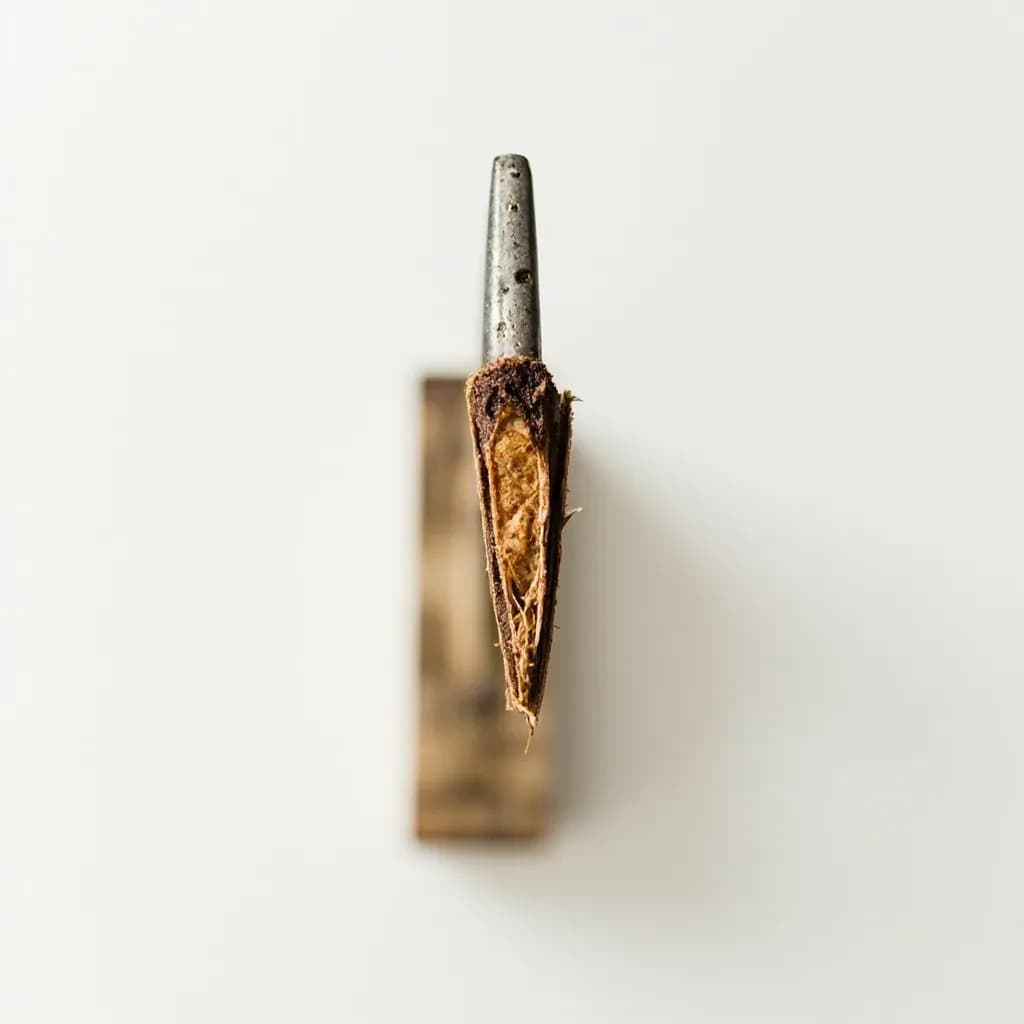
Coconut Husking Spike
A ground-anchored steel spike used to lever the fibrous husk off a whole coconut.
A coconut husking spike is a sharpened steel point fixed upright in the ground or a heavy base, used to tear away the thick fibrous husk of a coconut before the inner nut is cracked. The husk is driven onto the spike and twisted off in sections. It is a staple of tropical kitchens and copra processing where coconuts arrive whole and unhusked.
A coconut husking spike is a heavy, sharpened steel point anchored in the ground, a stump, or a workbench, built to do one job: strip the thick fibrous husk from a mature coconut so the hard brown shell underneath is exposed. In any operation that handles coconuts by the sack rather than by the piece, it is the single most important prep tool, because everything that follows (splitting the shell, extracting the water, scraping the meat, drying copra) depends on the husk being gone first. Mechanised dehuskers exist, but in the coastal regions where coconuts are grown the spike remains standard because it is cheap, hard-wearing, and fast in practiced hands.
The tool works on a simple principle of leverage and rotation. The operator drives the pointed end of the spike through the husk until it seats against the inner shell, then rotates the coconut while pulling outward. That combined shearing and tearing action parts the dense fibre cleanly, and a skilled user can fully dehusk a mature nut in under a minute. The spike is fundamentally different from the small hand-held 'coconut opener' sold in kitchen shops, which punches through the soft eye to drain the water and crack the shell; that tool cannot remove a full husk and is not a substitute for serious work.
For a home cook buying brown-shell coconuts at the market, the spike is irrelevant. It earns its place only where whole, fully husked nuts arrive by the bagful, and understanding it is mostly useful for recognising the work that has already been done by the time a clean coconut lands in your kitchen.
Alternatives
Types & varieties
The classic rural version: a long tapered spike driven into packed earth or set into a wooden post at a comfortable working height. The standard tool in copra and fresh-coconut operations.
Spike driven vertically into a hardwood stump or short log; portable within a yard, and less likely to work loose than a pure earth anchor.
Spike welded to a heavy steel base or bolted to a workbench; used in market stalls, small processing sheds, and teaching kitchens where both stability and portability matter.
Horizontal or near-vertical spike fixed to a post or wall so the operator pulls the coconut toward themselves; favoured where floor space is limited.
A short, heavy curved blade sometimes called a 'coconut bill' or 'coco knife', used to pare the husk off without a spike; the usual substitute where no spike is available.
How the spike actually works
The spike's job is not to cut the husk but to give the operator a fixed point to twist against. The sharpened point pierces the soft outer layer of fibre, then bites into the firmer pith, and finally seats against the hard inner shell with a definite 'thunk' the experienced operator feels through the coconut itself. Once seated, the husk is essentially locked between the operator's hands and the spike, and any twisting or pulling force is transmitted to the fibres rather than the shell. The shell stays whole; the husk comes off in strips and chunks.
- The spike bites into the husk at its thinnest point – the soft 'eye' end of the coconut – and the operator confirms it is seated by feel, not by sight.
- Twist first, then pull: rotation shears the long fibres of the mesocarp more cleanly than a straight outward pull, which tends to tear them raggedly.
- If a section of husk refuses to release, work around the equator of the nut first, then strip from pole to pole, rather than trying to peel it off in one piece.
- A dull or burred spike crushes the fibre instead of parting it, doubling the effort and leaving ragged strips that have to be cleaned up with a knife afterwards.
Naming and regional terms
The tool has no single standardised name, and an encyclopedia entry should treat the common English terms as synonyms rather than separate varieties. Local names appear in most coconut-growing regions but are rarely used in cooking literature.
Common uses
Tips & pitfalls
- Aim the spike at the soft 'eye' end of the coconut – it is the easiest point of entry and gives the most secure grip on the shell.
- Push the coconut firmly down onto the spike, then twist while pulling outward; rotation shears the husk fibres more cleanly than a straight pull.
- Wear cut-resistant gloves: the loosened husk strands behave like wire wool and can cut bare hands badly.
- Make sure the spike is fully seated and the base is solid before applying force; a loose spike is the most common cause of slipped coconuts and foot injuries.
- Keep the working area clear of bystanders – a released husk can spring off unexpectedly and a slipping coconut can drop onto a foot.
- Stop and regrind or replace the spike when the point becomes blunt or burred; a dull spike crushes husk rather than parting it, and is the most frequent cause of ragged, slow husking.
- Do not use the spike on already-dehusked (brown-shell) coconuts – the shell will simply split or splinter. Use a dedicated coconut cracker or cleaver for that step.
- Stand on stable, dry ground; husking works best when the operator can brace their weight against the pull.
Good to know
- Tool type
- Heavy, sharpened steel spike anchored in the ground, a wooden stump, or a metal base, designed to hold a whole coconut while the fibrous outer husk is levered off.
- Primary material
- Hardened carbon-steel point; mild or stainless shaft; mount of wood, concrete, or welded steel.
- Spike length
- Roughly 20–40 cm (8–16 in) of exposed spike above the mount, long enough to seat the nut but short enough to leave room to grip it.
- Where used
- South India, Sri Lanka, the Philippines, Indonesia, Malaysia, the Pacific Islands, the Caribbean, coastal West Africa, and parts of Latin America.
- Function
- Grips the inner shell of a mature, unhusked coconut so the operator can tear away the fibrous mesocarp by rotation and leverage.
- Throughput
- A practiced user can fully dehusk a mature coconut in under a minute.
- Skill level
- Low for an experienced farm or kitchen hand; takes practice to avoid slippage and lacerations from the husk fibres.
- Not used for
- Cracking the hard endocarp (shell) – that step requires a machete, cleaver, or a dedicated coconut opener.
Also called
Coconut Dehusker · Husking Spear
Related

Peeler
Swift blade for stripping skin off fruit and vegetables

Grater
Sharp-toothed surface for shredding cheese and vegetables

Microplane
Ultra-fine rasp for citrus zest, garlic, and hard cheese

Mixing Bowl
All-purpose bowl for combining, whisking, and tossing

Whisk
Looped wires that beat air into eggs, cream, and sauces

Spatula
Flat blade for flipping, lifting, and scraping

Slotted Spoon
Pierced spoon that lifts solids and drains the liquid behind

Wooden Spoon
Gentle, heat-friendly spoon for stirring anything