Prep Tools
Coconut Husking Stake
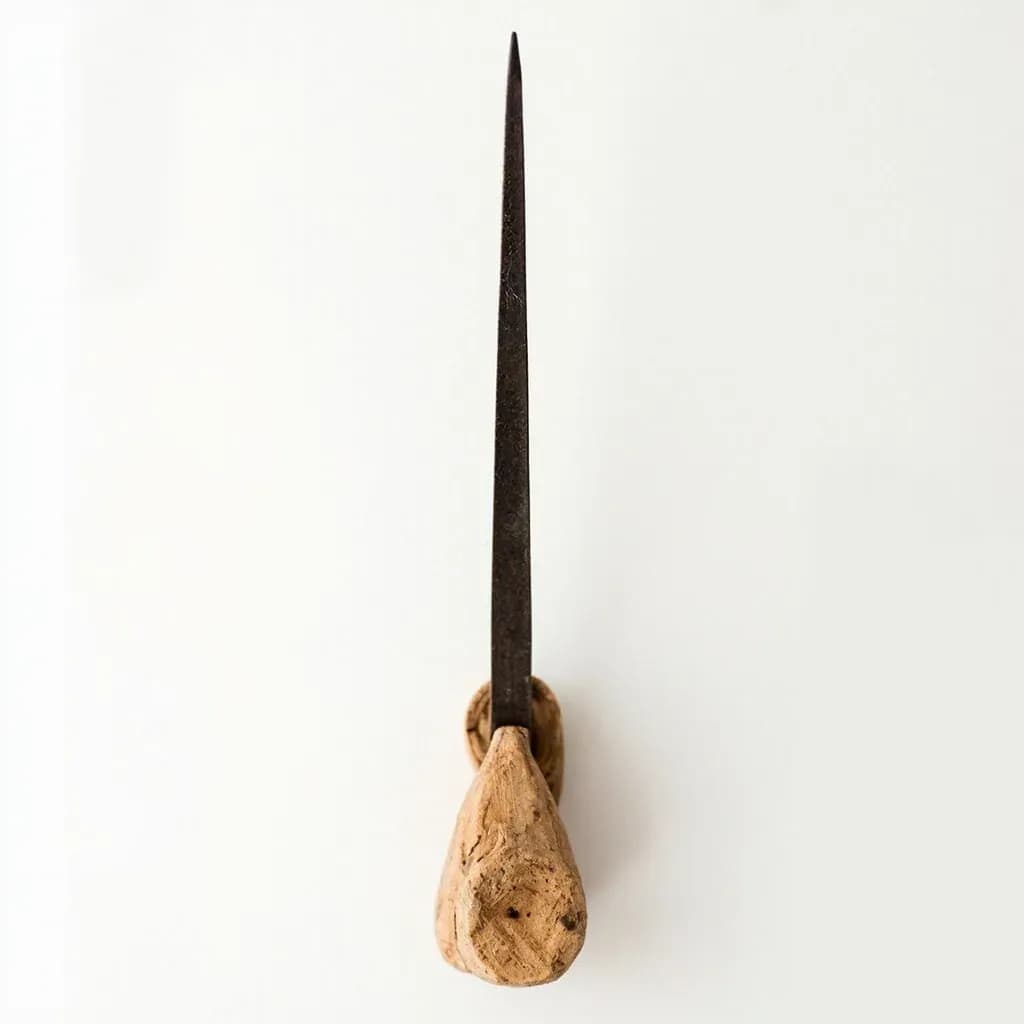
A pointed iron or wooden spike fixed in the ground used to tear the fibrous husk off coconuts.
A coconut husking stake is a sharp metal or hardwood spike anchored upright in the ground or a block. The whole coconut is driven down onto the point and levered to split and peel away the thick fibrous husk before the inner shell is cracked. It is a fast, traditional tool in coconut-growing regions where many nuts are processed by hand.
The coconut husking stake is one of the simplest and oldest food-prep tools still in active use, and it earns its place in a serious cooking reference because every tropical cook eventually faces a whole coconut in its husk and a knife that cannot begin to breach the fibrous outer layer. The tool is a single sharpened iron spike — 15–30 cm long, tapering to a 3–6 mm point — mounted at hip-to-waist height on a hardwood block, a tree stump, or a bench. Its genius lies not in brute force but in targeting the coconut's one anatomical weak spot: the germinal pore, the soft triangular eye at the end opposite the stem and the only one of the nut's three 'eyes' that will admit the spike before reaching the rock-hard endocarp.
Once seated, a quarter-twist in each direction snaps the husk's long fibers, and a downward lever peels it away in three natural lobes — a motion that converts the husk's great tensile strength into its weakness in shear. The stake is rarely needed in a home kitchen, but for anyone buying mature nuts in the husk from a market or a grove, understanding how the tool works explains why the husks come off in clean pieces and why the inner shell usually survives intact.
Alternatives
Types & varieties
A long iron spike driven into a hardwood stump or the ground; the classic South Asian smallholder tool, used standing while levering the nut downward.
A shorter spike bolted through a thick wooden block; the portable choice for market stalls and street vendors.
A pointed iron rod with a cross-handle, held in the hand and struck through the eye against a hard surface; used when no fixed stake is available.
A forked iron variant found in Sri Lanka and the Maldives; the twin prongs grip the husk after piercing, making leverage easier on very fibrous nuts.
Not a stake but the principal manual alternative — a curved, sickle-like blade that shaves the husk off in strips; safer for the inner shell but considerably slower.
Powered machine with a spinning toothed cone or drum; the modern replacement in copra and coconut-water plants, though it shreds the husk rather than stripping it intact.
How the Stake Beats the Husk
A mature coconut's outer husk is roughly 5 cm of densely packed, longitudinally aligned fibers — extraordinarily strong when you try to pull them apart, but easily sheared across their length. The stake exploits this by anchoring at a single point and rotating, snapping fibers along their weak axis. The three-lobed structure of the husk means a clean quarter-twist separates the layers along natural seams, and a sharp downward lever then peels each lobe away whole. A blunt knife, by contrast, has to cut every fiber individually, which is why even an experienced cook with a machete struggles to keep pace with a practiced stake user.
Safety and Setup
The spike sits low — its base only 10–20 cm off the ground — so the main foot-injury risk is stumbling onto the point, while a launched or split coconut can fly upward and strike the body or face. Treat the tool with the same respect you would give an axe: sturdy footwear, clear stance, and a sharp point.
- Wear closed leather boots or steel-toe footwear; sandals are genuinely dangerous.
- Stand with feet shoulder-width and slightly back from the stake so a flying coconut shell travels away from you.
- Keep the working area free of bystanders, especially children, who are drawn to the swinging motion.
- Inspect the spike weekly for hairline cracks; a sheared point becomes a projectile.
- Oil the iron with coconut oil or food-grade mineral oil after each session to prevent rust that can stain hands and contaminate the husk.
Common uses
Tips & pitfalls
- Always pierce through the soft eye — the spike will not penetrate the hard endocarp and will glance off dangerously if you miss or hit the stem end.
- After the spike seats, twist the nut a quarter-turn in each direction to snap the fibers before levering; pulling straight down shreds the husk and wastes force.
- Keep the point filed sharp; a dull spike crushes the eye area and can crack the inner shell, spoiling the water inside.
- De-stem the nut first — the dried stalk stub blocks the spike's entry and forces you off-target.
- Re-soak over-dry nuts in water for 30–60 minutes before husking to re-plasticize the fibers and prevent them from shattering into dust.
- If the inner shell cracks during husking, set the nut aside for immediate kitchen use — it will spoil within hours rather than weeks.
- Strip husks into clean piles if you want them for coir; a stake leaves them in intact lobes, a knife leaves shredded rags that fetch a lower price.
- For a small batch at home without a stake, score the husk deeply along its three lobes with a machete or heavy cleaver, then pry the sections apart with a flat tool — considerably slower, but achievable with patience.
Good to know
- Primary material
- Hardened iron or carbon steel spike, traditionally mounted on a dense hardwood block (teak, jackfruit, or other local dense timber) or driven into a stump or log.
- Spike dimensions
- 15–30 cm (6–12 in) above the mounting surface, tapering to a 3–6 mm point.
- Working height
- Base sits 10–20 cm off the ground so the point lands at waist-to-hip height for a standing user.
- Target point
- The germinal pore (the soft triangular eye at the end opposite the stem) — the only one of the three eyes that admits the spike before the hard endocarp.
- Origin and spread
- Used for centuries across the coconut belt of South and Southeast Asia (Kerala, Tamil Nadu, Karnataka, Sri Lanka, the Philippines, Indonesia), and independently in the Pacific Islands, the Caribbean, and coastal West Africa.
- Throughput
- A practiced hand processes 100–200 mature nuts per hour; mechanical rotary huskers reach 800–1,500+ per hour.
- Coconut condition
- Works best on fully mature, brown-husked nuts 1–3 months after fall; over-dry husks shatter, under-mature green husks are too fibrous.
- By-product
- The intact husk is the raw material for coir fiber, coir pith, and biomass fuel — the chief reason smallholders still dehusk on-farm.
Also called
husking spike · coconut dehusker
Related

Peeler
Swift blade for stripping skin off fruit and vegetables

Grater
Sharp-toothed surface for shredding cheese and vegetables

Microplane
Ultra-fine rasp for citrus zest, garlic, and hard cheese

Mixing Bowl
All-purpose bowl for combining, whisking, and tossing

Whisk
Looped wires that beat air into eggs, cream, and sauces

Spatula
Flat blade for flipping, lifting, and scraping

Slotted Spoon
Pierced spoon that lifts solids and drains the liquid behind

Wooden Spoon
Gentle, heat-friendly spoon for stirring anything