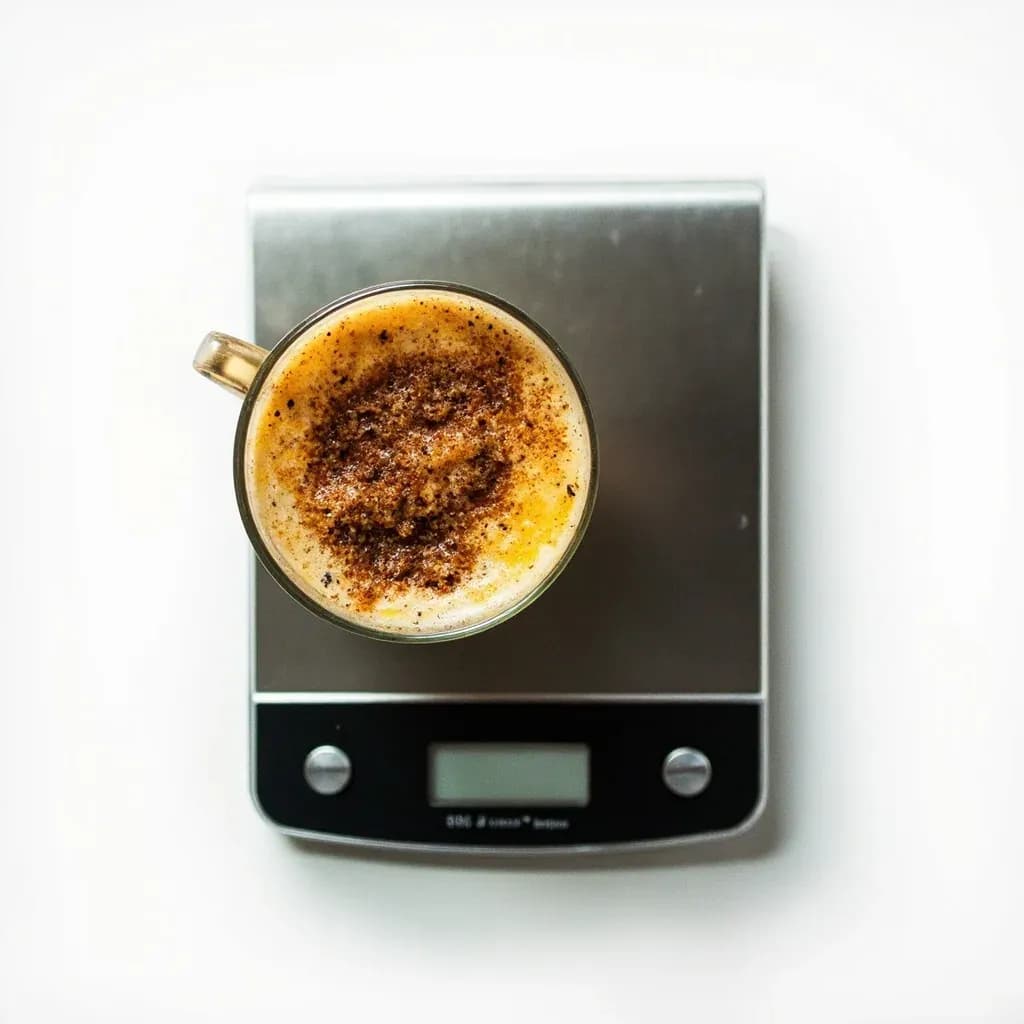
Prep Tools
Coffee Scale (with Timer)
A precise gram scale with a built-in timer for dialing in coffee brew ratios.
A coffee scale is a small, high-resolution scale, usually accurate to 0.1 gram, with a built-in stopwatch used to measure coffee dose and water during brewing. Baristas use it to hit a consistent brew ratio and track extraction time for pour-over, espresso and other methods. The timer lets you control bloom and total brew time alongside the weight readout.
A coffee scale with timer is a small, fast-responding digital scale, usually reading to 0.1 g and capped around 2 kg of capacity, with a built-in stopwatch designed to live underneath a brew vessel or espresso portafilter. Its job is to turn brewing from a feel-based ritual into a repeatable ratio: weigh the grounds, weigh the water as it pours, and time how long the two are in contact. That combination matters because good coffee is governed by two numbers at once — the coffee-to-water ratio (commonly 1:15 to 1:17 for filter coffee) and the brew time (around 2:30 to 3:30 for a V60 pour-over, 25 to 35 seconds for an espresso shot) — and chasing those by eye and a separate phone timer is how most home brews drift off-recipe.
What separates a coffee scale from a $15 kitchen gram scale isn't really the precision; it's the integration. The platform is sized to fit a V60 dripper, an AeroPress chamber, or an espresso portafilter, the load cell reads quickly enough to track a thin espresso stream without lagging, and on most modern models the timer auto-starts the moment liquid touches the platform. Premium scales stream weight over Bluetooth to a phone or espresso machine, letting the grinder or pump respond in real time. Outside of coffee, the same device works perfectly well as a general kitchen scale for yeast, salt, leaveners, and small baking quantities.
Alternatives
Types & varieties
Flagship pour-over oriented scale with auto-timer that starts when liquid hits the platform; Bluetooth; backlit LCD display widely considered the benchmark
Compact round scale designed to sit under an espresso portafilter with faster load-cell response
Espresso-focused with built-in flow-rate display in grams per second
Slim brewer's scale with bright OLED and reliable auto-tare and auto-timer
Accessible mid-range option with 0.1 g precision, rechargeable battery, and strong value
Japanese-made entry scale with built-in timer, minimalist design sold alongside Hario V60 gear
Premium scale with responsive load cell and customizable auto-timer modes
Built specifically for Decent Espresso machines and integrated into the machine's software
Cafe-grade commercial scale with very fast response; typically Bluetooth-capable but no built-in timer
Espresso vs. pour-over: why the specs matter differently
The same scale works for both brew styles, but the demands are not the same, and that explains why espresso-focused scales tend to cost more.
- For pour-over, 0.1 g resolution and a reliable timer are enough; a one-second lag in weight readout barely matters when the brew runs three minutes.
- For espresso, load-cell response is critical: a double shot finishes in 25–30 seconds, and a slow load cell reports the weight a beat late, so by the time the scale reads the target yield the pump has already pushed past it.
- Espresso scales are usually round or narrow to sit on a drip tray under a portafilter; pour-over scales are flat and wider to hold a server or carafe.
- Auto-timer triggering by weight change is more useful for pour-over (it captures bloom time automatically) than for espresso, where the brewer typically wants the timer to start at pump-on, not at first drip.
Brew ratios worth knowing
Most coffee recipes can be reduced to two numbers. Use these as starting points and adjust grind size to hit the target time.
- Pour-over (V60, Kalita, Chemex): 1:15 to 1:17 coffee-to-water, 2:30–3:30 total contact time
- AeroPress: 1:15 to 1:17, 1:30–2:00 total time, ~30 s press
- French press: 1:15, 4:00 steep
- Espresso: 1:1.5 to 1:2.5 brew ratio (e.g., 18 g in, 36 g out), 25–35 s shot time
- Cold brew concentrate: 1:4 to 1:8, 12–18 hours steep
Common uses
Tips & pitfalls
- Place the scale on a stable, level surface away from vibration; an espresso machine or grinder touching the counter can throw off readings mid-pour.
- Tare with the brewing vessel on the platform, not before, so the scale zeroes with the actual cup or portafilter it will brew into.
- Start the timer when water first contacts the grounds, not when you begin to lift the kettle; bloom time is part of the brew.
- For espresso, tare the portafilter after grinding and dosing, then tare again before pulling the shot so the timer reflects extraction time only, not grind time.
- Change one variable at a time, and keep the brew ratio constant, so you can actually tell what changed in the cup.
- Wipe pooled water off the platform; standing water on splash-resistant models can cause weight drift or trigger the auto-off.
- Recharge lithium-powered scales before they fully die; many will lose timer memory mid-pour if the cells cut out.
- Calibrate a few times a year with a known weight (a 100 g calibration mass or a verified coin); load cells drift with use.
- Remember that 1 g of water equals 1 mL, but this is only true for water; milk, syrups, and concentrated coffee weigh more or less per milliliter.
- On auto-timer scales, set the cup on the platform before turning on the kettle or grinder, or incidental contact can start the timer early.
Good to know
- Kind
- Digital precision scale
- Typical precision
- 0.1 g (lab-grade models read to 0.01 g)
- Typical capacity
- 2 kg / roughly 4.4 lb; some models 3 kg or higher
- Display
- LCD or OLED readout, usually backlit
- Power
- Rechargeable lithium via USB on most modern units; AAA batteries on entry-level scales
- Units
- Grams and ounces; some models also show milliliters of water
- Auto functions
- Auto-tare, auto-timer triggered by liquid contact, auto-off
- Connectivity
- Bluetooth on premium models, pairs with Acaia and third-party brewing apps
- Platform size
- 10–16 cm (4–6 in) wide; sized for portafilters and drippers
- Materials
- Aluminum or ABS plastic body, stainless weighing pan
- Water resistance
- Splash-resistant; not rated for submersion
- Origin
- Modern home-barista category developed largely after 2010 with third-wave coffee and home espresso; Acaia (Taiwan/USA design) is widely credited with defining the category
- Typical price range
- $25–50 entry, $60–120 mid-range, $140–220+ enthusiast/professional
Also called
Brewing Scale · Espresso Scale
Related

Peeler
Swift blade for stripping skin off fruit and vegetables

Grater
Sharp-toothed surface for shredding cheese and vegetables

Microplane
Ultra-fine rasp for citrus zest, garlic, and hard cheese

Mixing Bowl
All-purpose bowl for combining, whisking, and tossing

Whisk
Looped wires that beat air into eggs, cream, and sauces

Spatula
Flat blade for flipping, lifting, and scraping

Slotted Spoon
Pierced spoon that lifts solids and drains the liquid behind

Wooden Spoon
Gentle, heat-friendly spoon for stirring anything