Prep Tools
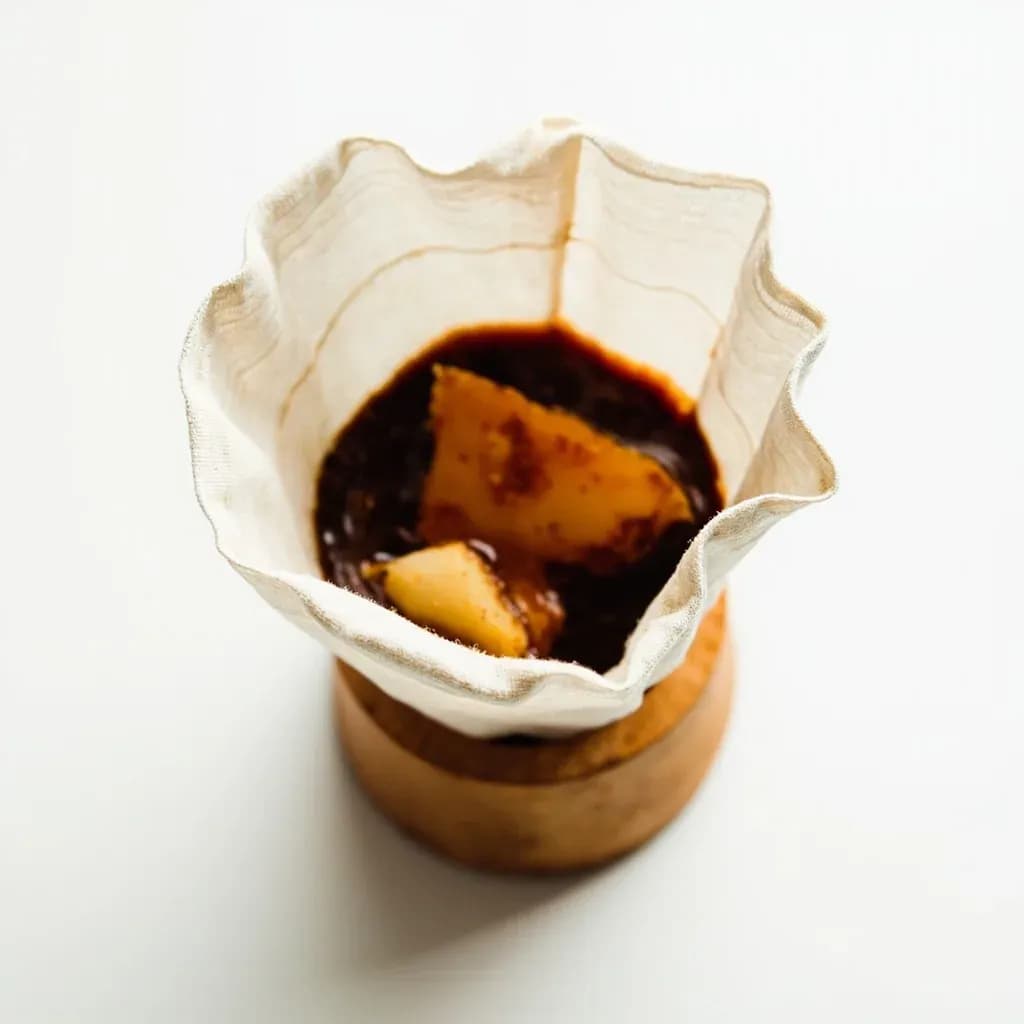
Cloth Coffee Sock Strainer
A reusable cloth filter, often on a ring or stand, that strains brewed coffee from the grounds.
A coffee sock is a cloth bag or pouch, usually held open by a wire ring or wooden stand, through which hot water is poured over grounds to drip-brew coffee. Widely used in Latin America, the Caribbean, and Southeast Asia, the Costa Rican chorreador and similar setups produce a clean, full-bodied cup. The fabric is rinsed and reused, making it economical, though it must be kept clean to avoid stale, rancid flavors.
A cloth coffee sock strainer is a reusable fabric filter — usually a sewn cotton bag shaped like an elongated pouch — that holds ground coffee while hot water passes through by gravity. Most modern versions are stretched over a wire ring, hoop, or wooden stand so the mouth stays open during brewing; traditional Asian styles hang from an attached string directly over a cup or pitcher. In every form the filter does the same work as a paper cone or metal mesh — separating grounds from brewed coffee — but the fabric's tight weave defines both the cup's character and the care the filter demands.
What a cloth filter gives you is a cup that sits between a paper pour-over and a French press: fuller-bodied and richer in oils than paper, but cleaner and brighter than an unstrained immersion brew. The weave holds back most sediment while letting the fine particulate and aromatic lipids that paper would catch pass into the cup, producing a rounder mouthfeel and a slightly heavier finish. Compared with paper, extraction also tends to be slower and more even because the damp cloth clings to the grounds and slows channeling; compared with a permanent metal mesh, the flow is gentler and the grit is far less.
The trade-off is maintenance. A cloth sock that is rinsed, never soaped, and stored wet can last two to three months of daily use and replace hundreds of paper filters, but neglect — soap residue, dried grounds, or a day or two unwashed — turns it stale or rancid by the next brew. It rewards the cook who treats it as a small piece of kitchen equipment with a routine, not a disposable.
Alternatives
Types & varieties
The classic form: a sewn cotton bag, often shaped like a sock, used with a ring, hoop, or wooden stand. The most common modern version.
A more durable, less flavor-retentive alternative; needs thorough pre-boiling to soften the fibers before first use.
A circular cloth disc sized to fit ceramic or glass drippers (Hario, Melitta, Kalita); replaces paper filters in the same hardware.
Traditional Asian style with an attached string for hanging over a cup or pitcher; sometimes weighted at the bottom with a small ring.
Thicker, felted cotton flannel; very fine filtration but the slowest flow, associated with older Japanese and Southeast Asian brewing styles.
Keeping a Cloth Filter Alive
A cloth sock is forgiving once it has a routine, but unforgiving without one. The two rules that govern its whole working life are simple: never use soap, and never let it dry with grounds inside. Everything else — the weekly boil, the wet storage, the gentle rinse — follows from those two habits.
- Once a week, simmer the filter in a pot of plain water with a tablespoon of baking soda for 3–5 minutes to strip accumulated oils, then rinse thoroughly.
- Store wet: in a small jar of water in the fridge, or sealed in a freezer bag. A cloth that dries stiff along its folds will crack and start leaking fine grounds.
- Replace the filter when the drip slows noticeably or the cup picks up a papery, stale note — usually after 40–100 brews, or two to three months of daily use.
- If you brew flavored coffees, keep a dedicated filter for them; the cloth holds aromatics far longer than paper and they will cross over into unflavored brews.
Common uses
Tips & pitfalls
- Always boil a new cloth filter for 5–10 minutes in plain water before first use; skip this and the first cups will taste of starch and look cloudy.
- Wet the filter thoroughly with hot water before adding grounds to preheat the vessel and seat the cloth flush against the sides, which evens extraction across the bed.
- Use a medium-coarse grind; fine grounds clog the weave and slow the drip to a crawl, and the resulting cup turns bitter from prolonged contact.
- After each brew, empty the grounds and rinse both sides under hot running water — never soap, which the cloth absorbs and taints later brews with a faint chemical note.
- Don't leave used grounds sitting in the filter after brewing — the oils oxidize quickly and will make the next cup taste rancid.
- Avoid wringing the cloth aggressively; gently pressing or squeezing it between the palms extends its working life and keeps the weave from stretching.
Good to know
- Type
- Reusable cloth filter in a bag or sleeve form, often mounted on a ring, hoop, or stand
- Material
- Cotton muslin is standard; hemp and flannel are also used
- Brewing method
- Pour-over or drip, gravity-fed
- Capacity
- 1 to 4 cups of brewed coffee, depending on size
- First-use prep
- Must be boiled 5–10 minutes in plain water to remove starch, sizing, and loose lint
- Brewed profile
- Heavier body, fuller mouthfeel, more oils, and a touch more fine sediment than paper-filtered coffee
- Lifespan
- Roughly 40–100 brews; replace when flow slows or the cup starts tasting papery
- Storage
- Kept wet in a sealed container in the refrigerator, or frozen in a zip bag
Also called
Coffee Sock (Bolsa de Café) · Cloth Coffee Strainer (Colador de Café) · Coffee Strainer · Coffee Sock Filter · Coffee Sock Strainer (Grèp) · Chorreador · Manual Juicer (Coador de Café)
Related

Peeler
Swift blade for stripping skin off fruit and vegetables

Grater
Sharp-toothed surface for shredding cheese and vegetables

Microplane
Ultra-fine rasp for citrus zest, garlic, and hard cheese

Mixing Bowl
All-purpose bowl for combining, whisking, and tossing

Whisk
Looped wires that beat air into eggs, cream, and sauces

Spatula
Flat blade for flipping, lifting, and scraping

Slotted Spoon
Pierced spoon that lifts solids and drains the liquid behind

Wooden Spoon
Gentle, heat-friendly spoon for stirring anything