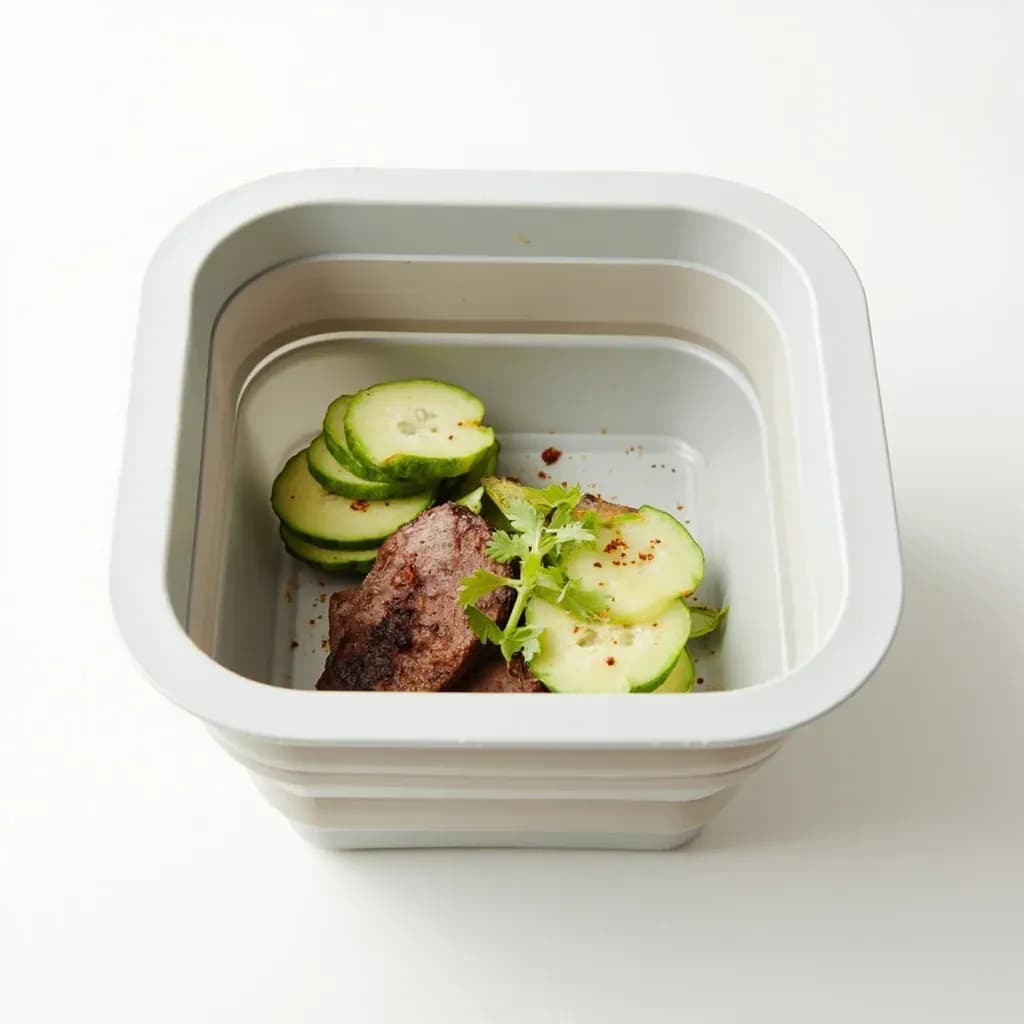
Prep Tools
Collapsible Wash Basin
A flexible silicone tub that folds flat for washing produce and dishes, then stores compactly.
A collapsible wash basin is a silicone or plastic tub with flexible sides that fold down to a thin disc for storage and pop up into a deep bowl for use. In the kitchen it holds water for rinsing produce, soaking dishes, draining pasta or hand-washing, and is popular where counter and cabinet space is tight. Many have a built-in colander or drain plug.
A collapsible wash basin is a flexible tub of food-grade silicone held open by a rigid rim — usually polypropylene, sometimes stainless steel — that folds or twists flat when not in use. The collapse is the point: where a traditional plastic wash bowl claims permanent shelf or drawer space, this one reduces to roughly the thickness of a placemat, freeing real estate in small apartments, RVs, sailboats, and van builds. The body is typically rated from about −40 °C to 230 °C (−40 °F to 446 °F), so it tolerates ice baths, cool-water thaws, and contact with blanched vegetables; the rim is almost always the limiting factor, usually topping out near 100–120 °C (212–250 °F).
In practice, the basin earns its keep during produce prep — washing leafy greens, soaking root vegetables, and giving mushrooms a quick rinse — and steps in for jobs a sink handles awkwardly, from thawing a whole chicken in a cool water bath to marinating a flank steak to catching trimmings during a long trim session. The flexible walls change how food moves: a flexed bowl can tip risen dough onto a floured counter, pour cleanly into a colander, or funnel chopped aromatics into a hot pan. Most versions are top-rack dishwasher safe and light enough to carry to a camp tap or a balcony garden hose.
A few honest limits: the rim is the weak point, and a half-extended basin can buckle under the weight of a full water load. Silicone is also soft enough to micro-scratch under abrasive scrubbers, and trapped moisture between folded walls will, given time, grow mildew. Treat it as a tool rather than a bowl, and it will repay the space it doesn't take up.
Alternatives
Types & varieties
The classic form, with a circular PP rim; the most common household size and the easiest to twist flat.
Square-cornered version sized to fit a standard sink, often with molded side handles for carrying.
Perforated base or side walls so it doubles as a drainer for produce, pasta, or rinsed beans.
Has a push-plug in the bottom that releases water without lifting the loaded basin — handy on a high counter or in a shallow sink.
Silicone or rope side handles for moving a water-filled basin to and from a tap.
A rigid lid that converts the basin into a prep station or covered storage container when not in use.
Thicker silicone, larger capacity, often with internal measurement marks; built for boats, RVs, and outdoor use.
Higher-temperature silicone that can hold blanched vegetables straight from the pot or sit on the counter as a trivet.
Choosing the right size and shape
Match the basin to the job you do most. A 5–7 L round bowl is the sweet spot for produce prep for one to four people; a 10–15 L rectangular dish pan suits dishwashing, defrosting a whole chicken, or bathing a large cut of meat. If you cook in a galley or RV, look for a drain-plug or strainer version so you can empty it without lifting. For a small apartment where every drawer matters, the round twist-down models collapse to the slimmest profile.
Care and cleaning
A soft sponge and dish soap handle 95% of cleanup. For stains from turmeric, beet, or curry, make a paste of baking soda and a little soap, leave it on the stain for 15–30 minutes, then scrub gently and sun-dry. Skip steel wool and rough green pads; they micro-scratch silicone and dull the surface over time. After every use, stand the basin open until it is dry inside and out — the single biggest reason collapsible silicone develops a musty smell is moisture trapped between the folded walls.
Pairings in a small kitchen
A collapsible wash basin plus a collapsible colander covers almost all produce prep without dedicating drawer space to rigid bowls. Pair it with a salad spinner: wash and soak in the basin, then lift the greens into the spinner basket. A rimmed sheet pan makes a good drying rack for washed produce, and a bench scraper is the right tool for scooping chopped ingredients out of the flexible bowl.
Common uses
Tips & pitfalls
- Always extend the rim fully and set the basin on a flat surface before filling — a partially collapsed rim can twist and let the bowl buckle under the weight of water.
- To wash leafy greens, fill with cold water, submerge and agitate, then lift the greens out rather than pouring the water off; sand and grit sink to the bottom and stay there.
- Dry the basin completely inside and out before collapsing it for storage; trapped moisture between folded walls is the leading cause of mildew and odor.
- For stains from turmeric, beet, or curry, apply a paste of baking soda and dish soap, leave it for 15–30 minutes, then scrub gently and sun-dry.
- Avoid abrasive scrubbers such as steel wool and rough green pads; a soft sponge is enough and will keep the silicone from dulling or micro-scratching.
- Salt-heavy or acidic marinades left for many hours can stain silicone; rinse the basin promptly after emptying.
- Resist direct stovetop or open-flame heat even on high-rated silicone — the rim is almost always plastic and will warp well before the body fails.
- When using the basin as an ice bath for blanching, set it inside the sink so the water it displaces drains away instead of overflowing onto the counter.
Good to know
- Material
- Food-grade silicone body with a reinforced rim of polypropylene (PP) or stainless steel; BPA-free in food-contact versions.
- Typical capacity
- 3–10 L (about 1–2.5 US gal) for household sizes; larger dish-pan styles run to 15 L or more.
- Open dimensions
- Commonly 30–42 cm (12–17 in) across and 10–15 cm (4–6 in) deep.
- Collapsed height
- Roughly 3–5 cm (1–2 in), depending on rim design.
- Temperature range
- Silicone body: about −40 °C to 230 °C (−40 °F to 446 °F); PP rims are usually limited to 100–120 °C (212–250 °F).
- Dishwasher safe
- Most models are top-rack dishwasher safe; confirm the rim material's heat limit with the manufacturer.
- Storage
- Folds or twists flat; must be fully dry before collapsing to prevent mildew and odor between folds.
- Origin
- Silicone collapsible kitchenware went mainstream in the 2010s alongside the small-space, RV, and van-life movements; Japanese and Scandinavian designs set the visual template.
Also called
Folding Wash Basin · Collapsible Tub
Related

Peeler
Swift blade for stripping skin off fruit and vegetables

Grater
Sharp-toothed surface for shredding cheese and vegetables

Microplane
Ultra-fine rasp for citrus zest, garlic, and hard cheese

Mixing Bowl
All-purpose bowl for combining, whisking, and tossing

Whisk
Looped wires that beat air into eggs, cream, and sauces

Spatula
Flat blade for flipping, lifting, and scraping

Slotted Spoon
Pierced spoon that lifts solids and drains the liquid behind

Wooden Spoon
Gentle, heat-friendly spoon for stirring anything