Knives & Cutting
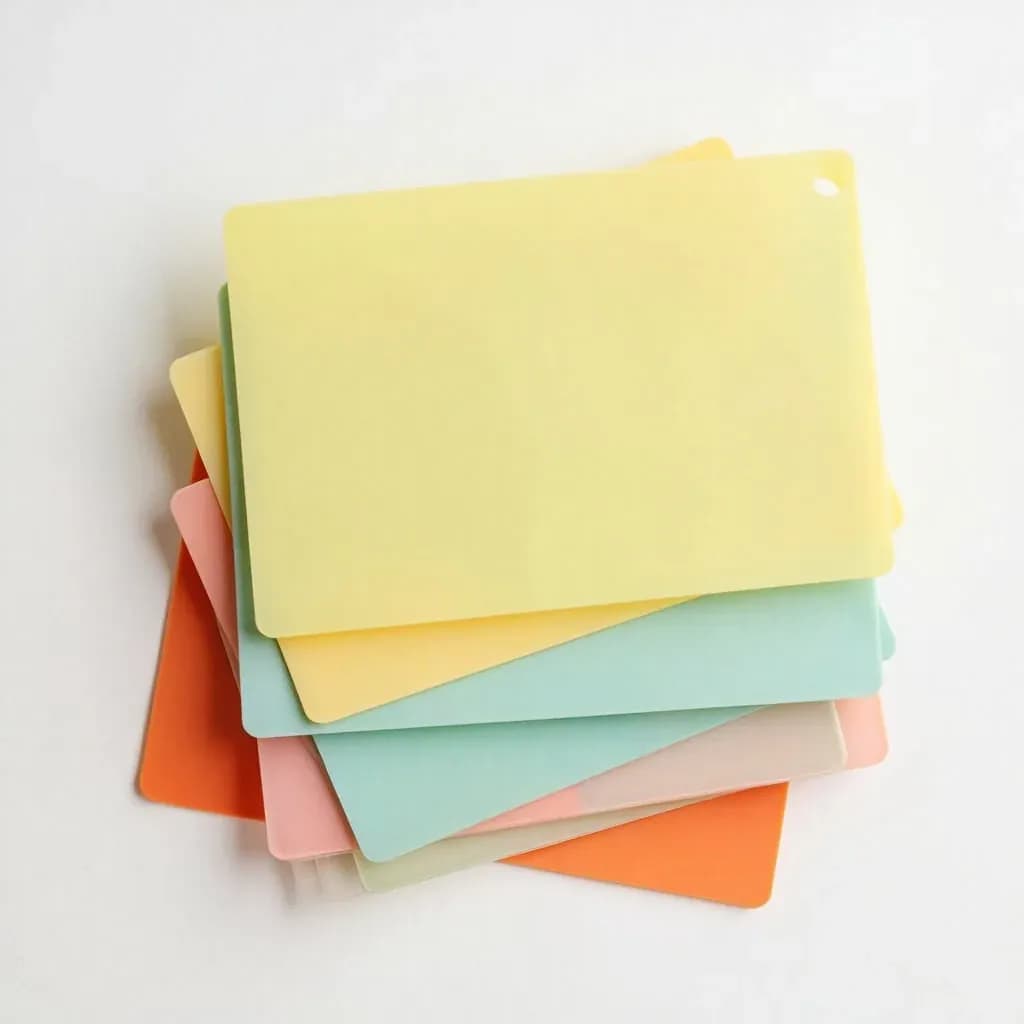
Color-Coded Cutting Board
A set of boards in assigned colors to keep raw meat, fish and produce separate and prevent cross-contamination.
A color-coded cutting board set assigns a different color to each food type, such as red for raw meat, blue for fish and green for vegetables, so kitchens avoid cross-contamination. The system is standard in professional and food-safety-conscious kitchens following HACCP practices. Using the right board for each task keeps allergens and raw-meat pathogens from spreading to ready-to-eat foods.
A color-coded cutting board is less a single tool than a visual system: a set of plastic cutting boards in distinct, assigned colors, each reserved for a category of food, so that a cook glancing across a prep line can tell at a moment's notice which surface has touched raw meat, which has handled produce, and which is safe for bread or allergens. The principle is simple — segregate foods that carry different contamination risks onto surfaces that never cross — but the power of the system is that it removes the need to remember. If a board is red, it has held raw protein; if it is green, it is implicitly safe for the salad going out in five minutes.
The boards themselves are almost always high-density polyethylene (HDPE), a dense, non-porous plastic that takes knife scores far more slowly than softer plastics and can be resurfaced with a bench scraper or sander. The plastic also accepts pigment evenly, so colors stay readable over the life of the board. Wood boards are gentler on knife edges and are widely used at home, but they cannot be reliably color-coded with food-safe dye, and many jurisdictions restrict wood for raw protein service on sanitation grounds, not because of color. HDPE boards are typically 1/2 to 1 inch thick to stay rigid on a prep table, and they live in commercial kitchens as matched sets of six to ten colors, hung on a wall rack so the color is the first thing you see when reaching for one.
The system has no single global standard. The UK Food Standards Agency, US HACCP-aligned programs, and various national codes all publish their own color charts, and they broadly agree on the big categories (red for raw meat, blue for raw fish, green for produce) but diverge on the rest. The system is effectively required in most regulated commercial kitchens, and a printed color chart taped to the wall is as much a part of the kit as the boards themselves. In a home kitchen it remains voluntary, but even three boards — red, green, and a neutral for bread and cheese — cut contamination risk dramatically without adding any real complexity to cooking.
Alternatives
Types & varieties
Raw red meat — beef, pork, lamb. The most universally agreed-upon color across systems.
Raw poultry — chicken, turkey, duck. Standard in UK FSA and US HACCP systems.
Raw fish and seafood. The most internationally consistent code.
Fruits, vegetables, and salad produce.
Cooked meat in the UK FSA scheme; sometimes used for raw root vegetables in other systems.
Dairy, bread, and general dry goods; also pastry and chocolate work in bakeries.
Allergen-free preparation — gluten-free boards, nut-free boards, dedicated boards for guests with severe allergies.
Raw poultry in some US systems (alternative to yellow), or raw fish variants in others.
Generic utility or wild game in some systems; also popular for front-of-house prep and display where staining would be unsightly on lighter boards.
The most commonly cited color charts
Because no single global standard exists, kitchens typically adopt one of two well-documented schemes and post it on the wall. Knowing which scheme a kitchen is running — and which colors are in play — is the difference between a working system and a confused one.
- UK Food Standards Agency: red/raw meat, yellow/raw poultry, blue/raw fish, green/vegetables and salads, brown/cooked meat, white/dairy and bread.
- US HACCP-aligned practice: red/raw meat, yellow/raw poultry, blue/raw fish, green/fresh produce, white/dairy and bread, with purple for allergens increasingly added. NSF/ANSI 2 certifies the boards as equipment rather than dictating the color chart itself.
- Purple-for-allergens is the fastest-growing category and is now standard in most allergen-aware commercial kitchens regardless of which other colors they use.
Common uses
Tips & pitfalls
- Sanitize boards between tasks with a 200 ppm chlorine solution or a quaternary ammonium sanitizer — soap and water alone doesn't reliably kill pathogens harbored in micro-scratches.
- Replace (or resurface) any board with deep knife grooves you can't feel with a fingernail. Bacteria colonize the bottoms of scores that scrubbing can't reach, and no amount of bleach rescues a scarred surface.
- Store boards upright and separated on a wall rack so air circulates and they dry fully. Flat-stacked wet boards grow biofilm at the contact points and will smell sour within days.
- Don't switch a color's meaning between stations. If red means raw meat at the hot line, red means raw meat at the garde manger too. Post the chart.
- For home use, three boards are enough: red (raw protein), green (produce), and white (bread, cheese, cooked food). That covers the highest-risk cross-contamination paths at minimal cost.
- Avoid glass, marble, or stone boards in any color-coded system. They destroy knife edges in a few passes and offer no real food-safety advantage over HDPE for everyday prep.
- Color-coding is a habit, not a guarantee. Even when switching between two raw proteins on the same color, wash and sanitize — the board is segregated by category, not disinfected by color.
- Buy boards as a matched set from one manufacturer. Colors vary subtly between brands, and a faded salmon-pink from one supplier and a bright magenta from another will confuse staff and undermine the whole system.
- Mark allergen boards with a printed or engraved label, not just paint — paint wears off with scrubbing and defeats the purpose.
Good to know
- Primary use
- Segregating food types to prevent cross-contamination in professional and home kitchens
- Standard material
- High-density polyethylene (HDPE); polypropylene also common
- Commercial certification
- NSF/ANSI Standard 2 (food equipment) required in most regulated commercial kitchens
- Common thickness
- 1/2 inch to 1 inch (12–25 mm)
- Standard sizes
- 12 x 18 in, 15 x 20 in, 18 x 24 in, 18 x 30 in commercial; 8–10 in boards for home use
- Dishwasher safe
- Yes, most HDPE boards rated to ~195 °F (90 °C); not for oven or open flame
- Typical weight
- 4–7 lb (1.8–3.2 kg) for an 18 x 24 in board, depending on thickness
- Lifespan
- Replace when deep scoring cannot be resurfaced; commercial kitchens typically replace every 3–12 months
- Allergen coding
- Purple boards are widely used (UK and increasingly US) to denote allergen-free prep
Also called
HACCP Cutting Boards · Colour-Coded Boards
Related

Knife
The fundamental cutting tool every kitchen is built around

Chef's Knife
The do-everything blade for chopping, slicing, and mincing

Paring Knife
Small, nimble blade for peeling and detailed in-hand work

Serrated Knife
Saw-toothed blade that slices crusty bread without crushing

Cleaver
Heavy broad blade for chopping through bone and bulk prep

Cutting Board
The stable surface every cut starts on

Mandoline
Adjustable blade for paper-thin, perfectly even slices

Kitchen Shears
Heavy-duty scissors for poultry, herbs, and packaging