Prep Tools
Copper Serving Tray
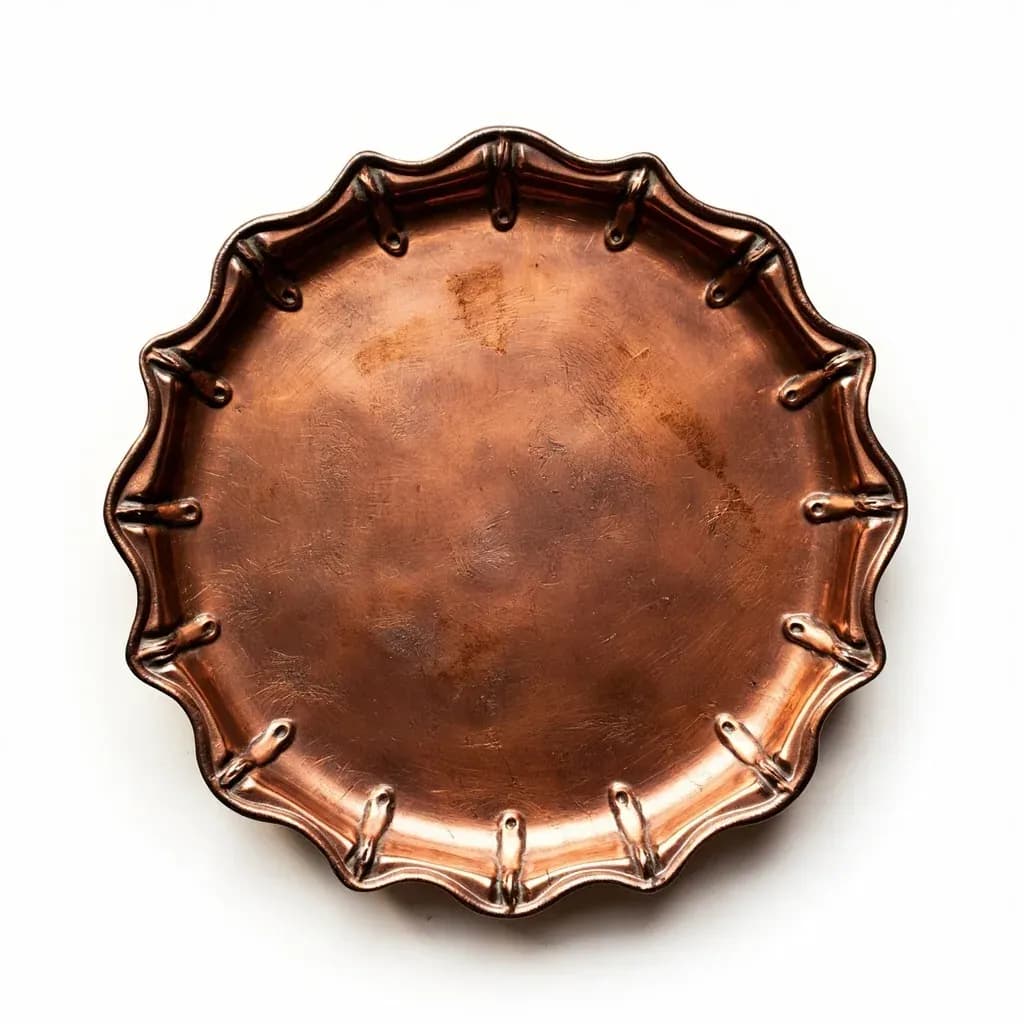
A decorative copper tray (Korean traem) for presenting and carrying food and drinks.
A copper serving tray is a flat, often round or ornately rimmed metal tray used to carry and present dishes, teaware, or drinks. In Korean tradition the traem is a prized brass-or-copper tray brought out for hospitality and formal service. Beyond looks, the metal is durable and easy to wipe clean between courses.
The copper serving tray (쟁반, jaengban) is one of the most expressive pieces of Korean tableware, a metal platform whose weight, warmth, and quiet gleam have shaped how a meal is presented since the Goryeo and Joseon dynasties. Copper has high thermal conductivity, so the tray quickly takes on the temperature of the room or the food it holds, and once warmed, its mass keeps dishes from chilling as fast as they would on wood or lacquerware. Copper also offers oligodynamic antibacterial properties on contact surfaces, and its visual weight anchors an arrangement of small dishes.
What separates a usable jaengban from a purely decorative one is almost always the lining. Food-grade copper reacts with sulfur compounds in eggs, garlic, kimchi, and brassicas, producing gray-green discoloration and a flat metallic off-flavor, so traditional and well-made modern trays carry a thin tin (occasionally silver) lining on every surface that touches food. A bare or unlined tray is fine for dry breads, dry tteok, or purely decorative work, but for everyday banchan service — where vinegar, soy, and ferment-driven acidity are routine — a tin lining is non-negotiable.
In the kitchen, the tray's weight is a feature as much as a constraint. A 35 cm copper tray runs 1–1.5 kg, which slows fast-paced restaurant plating but rewards the deliberate, ceremonial pace of a home meal, a jesa offering, or a royal-court (궁중) tasting where each small bowl is placed with intention. Treated well, the surface develops a warm brown patina over years of use; polished bright, it reflects candlelight and the color of the food on it; either way, it ages into the kitchen rather than out of it.
Alternatives
Types & varieties
The everyday workhorse; flat or with a low turned rim; the standard surface for arranging multiple banchan bowls
Long format for carrying soju and shot glasses, tea cups, or a row of banchan in line
Taller upturned edge for royal-court (궁중) settings and ancestral rites (jesa, 제사), where spillage must be prevented
Hand-hammered finish with visible dimples from the smithing process; traditional craft technique, more decorative
Polished to a mirror finish; common in modern Korean kitchens and restaurants and easier to wipe clean
Smaller tray with side handles, designed for carrying tea cups or a makgeolli/soju service to the table
Decorative or for dry foods only — breads, dry tteok, display; not safe for direct contact with acidic banchan unless re-tinned
The Yugi Tradition: Tray as Table
The most distinctive Korean use of the copper tray is as the base of a yugi (유기) — a matched set in which a large jaengban is fitted with several small brass bowls (놋그릇) that nest into shallow depressions or simply sit in a precise arrangement. A yugi turns the tray into a single composed serving: four, six, eight, or twelve small dishes presented together rather than carried individually. This is the form most associated with royal-court cuisine (궁중요리) and with elaborate home meals where banchan are numerous. If you are building toward one tray-and-bowl set rather than accumulating individual pieces, the yugi form is the most expressive choice and the one with the deepest Korean lineage.
- The term yugi is often translated as 'oil vessel set,' though it now refers broadly to any composed tray-and-bowl arrangement for serving multiple banchan at once
- Sets were traditionally brass-bowl-on-copper-tray, with bowls sitting in shallow hammered depressions so each dish stays in place when the tray is lifted
Why Tin Lining Matters
The lining is the single technical decision that determines whether a copper tray is safe for daily Korean cooking. Copper is reactive: it readily forms salts with acids and dark sulfides with sulfur compounds, and both reactions leach copper into food at concentrations that taste metallic and discolor pale ingredients. Joseon-era metalworkers addressed this by tinning the food-contact face — a thin bonded layer of tin that is non-reactive, food-safe, and easy to re-applied when worn. A lined tray will outlast several polishings and decades of hand washing; an unlined one is decorative-only.
- Kimchi, pickled radish (mu-saengchae), vinegar-based namul, soy glazes, and citrus all react with bare copper
- Eggs, garlic, onion, and brassicas turn gray-green on unlined copper within minutes
- If you see copper showing through the bright tin surface inside the tray, have it re-tinned by a metalsmith before food contact
- Unlined trays are acceptable for dry items: plain tteok, breads, dry jeon, decorative displays
Care, Patina, and Aging
Copper behaves unlike any other material in the Korean kitchen, and the way you care for it is largely a matter of taste. A polished tray reflects light and reads as formal; a patinated tray reads as lived-in and warm. Both are correct, and the material moves between the two states over years. The mistake is treating the patina as dirt — it is a stable oxide layer that protects the metal beneath, and scrubbing it off every week will wear the surface unnecessarily.
- Hand wash with mild soap and a soft cloth; rinse and dry immediately to prevent water spots
- Polish only when you want brightness — use a commercial copper cleaner or a lemon-and-salt paste, then rinse and dry thoroughly
- To slow oxidation on a polished tray, rub a thin film of food-grade mineral oil over the surface after final drying
- Store stacked trays with felt or cloth between rims to prevent scratching
- A worn tin lining (visible copper patches on food-contact surface) is the signal to send the tray for re-tinning, not to throw it away
Common uses
Tips & pitfalls
- Choose a tin-lined tray for any kitchen that will place acidic foods on the surface — bare copper will both discolor food and pick up a metallic off-flavor from kimchi, vinegar, and citrus.
- Hand wash only — dishwasher detergent strips patina quickly and can pit the tin lining over time.
- Dry the tray immediately with a soft cloth after washing; copper develops hard water spots that are tedious to remove once set.
- Lift the tray rather than slide it across a table — the copper rim will scratch lacquer, stone, and wood in a single motion.
- Stack trays with felt or a soft cloth between rims to keep edges from marking each other in storage.
- Re-tin the food-contact surface at a metalsmith the moment you see copper showing through the bright tin — this is normal wear, not a defect, and a good re-tinning adds decades of life.
- Do not cut or chop on the tray; treat it strictly as a presentation and carrying surface, not a prep surface.
- To keep warm food warm at the table, rinse the tray briefly with hot water, dry it, and set the dish on it just before serving — the thermal mass will slow cooling for several minutes.
- If you prefer a bright polished look, finish each cleaning with a thin rub of food-grade mineral oil to slow re-tarnishing; if you prefer patina, simply wash and dry without polishing.
Good to know
- Korean name
- 쟁반 (jaengban)
- Material
- Copper body, traditionally tin-lined (주석) on food-contact surfaces
- Typical sizes
- Small ~20 cm (individual), medium ~30 cm (table), large ~40 cm (family banchan), ceremonial 60 cm+
- Weight
- A 35 cm tray typically weighs 1–1.5 kg
- Thermal behavior
- High conductivity — warms quickly to food/room temperature; pre-warmed, the tray's mass slows chilling of warm dishes for several minutes
- Lining
- Tin (or occasionally silver) prevents reaction with acidic and sulfur-rich foods
- Antimicrobial
- Copper surfaces suppress E. coli, Salmonella, and Listeria on contact
- Care
- Hand wash with mild soap, dry immediately; never dishwasher or abrasive scrub
Also called
traem · copper tray · brass serving tray
Related

Peeler
Swift blade for stripping skin off fruit and vegetables

Grater
Sharp-toothed surface for shredding cheese and vegetables

Microplane
Ultra-fine rasp for citrus zest, garlic, and hard cheese

Mixing Bowl
All-purpose bowl for combining, whisking, and tossing

Whisk
Looped wires that beat air into eggs, cream, and sauces

Spatula
Flat blade for flipping, lifting, and scraping

Slotted Spoon
Pierced spoon that lifts solids and drains the liquid behind

Wooden Spoon
Gentle, heat-friendly spoon for stirring anything