Prep Tools
Corkscrew
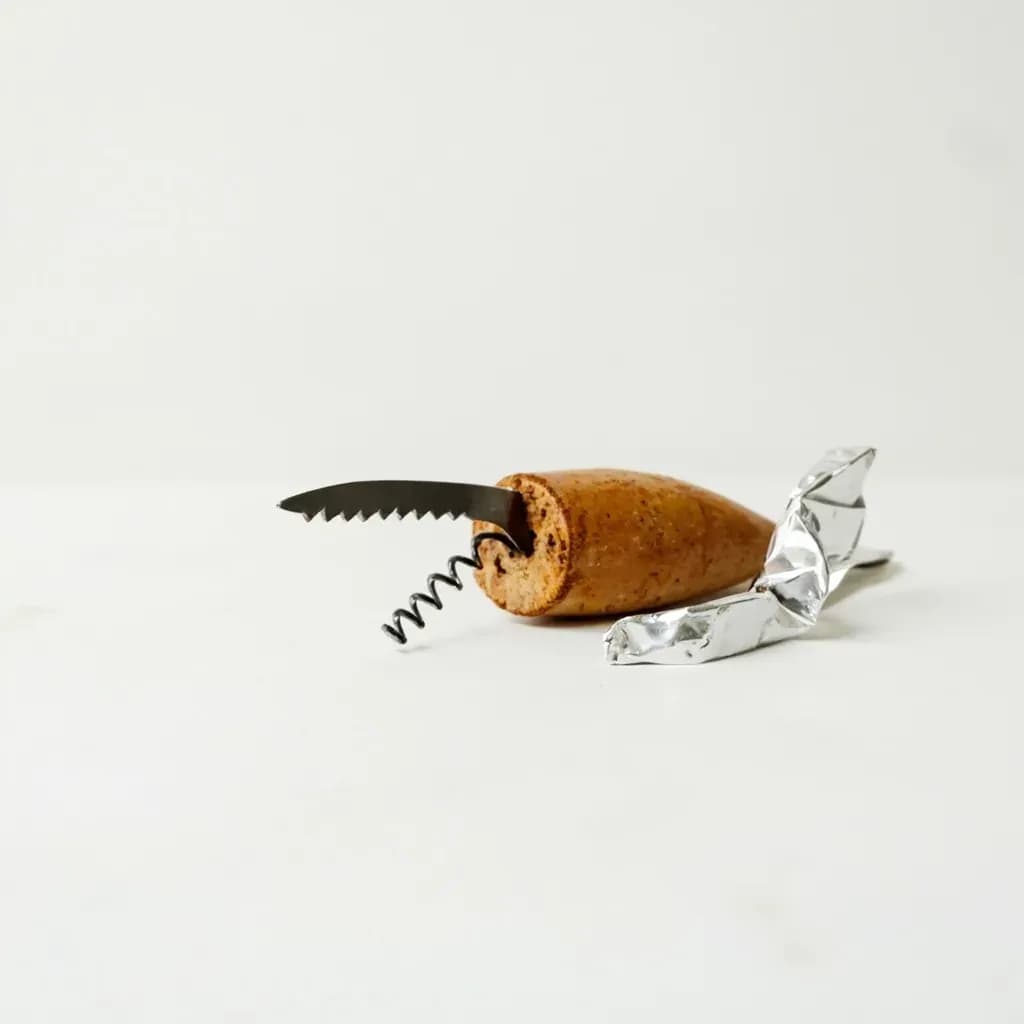
A handheld tool with a helical worm that pulls corks from wine bottles.
A corkscrew has a pointed metal spiral, the worm, that screws into a cork so it can be levered or pulled out of a bottle. It is the everyday tool for opening wine and other corked bottles, with styles from the waiter's friend folding lever to winged and lever-action pulls. The waiter's friend version also carries a small foil knife and a bottle-cap opener.
A corkscrew is a handheld tool built around a helical metal worm — a tapered spiral that bores into a cork and pulls it out of the bottle neck. The spiral geometry is what makes the tool work: as the worm turns into the cork, each coil becomes a thread that grips the cork's full thickness, and that grip is what lets you draw the cork out in one piece rather than tearing it. The design dates to 1795, when the English clergyman Samuel Henshall patented a screw-style extractor with a flat endcap (the so-called Henshall button) that stopped the cork from being pulled straight through. Earlier bottle openings used boot-tong-style pullers, but as bottled wine overtook cask wine through the 19th century, the screw worm became the standard.
Corkscrews matter in the kitchen not because opening a bottle is glamorous, but because a bad pull ruins the wine in front of you: a torn cork drops crumbs into the glass, an angled entry pushes cork sideways into the bottle, and an over-driven worm pierces the cork's base and can drop fragments into the wine. The trade-off between models is essentially between control and effort. The waiter's friend (sommelier knife) demands the most skill but gives the operator complete control over angle, depth, and lift. Wing, lever, and electric models trade some of that finesse for mechanical advantage. Match the tool to the cork and to the setting: restaurants favor the folding waiter's friend because it disappears into an apron, while home bars often prefer a wing or lever model for one-handed ease.
Alternatives
Types & varieties
Folding pocket corkscrew with a hinged fulcrum and built-in foil cutter; the restaurant and sommelier standard.
Two-lever frame that rises as the worm turns, lifting the cork with a squeeze; needs less wrist effort than a waiter's friend.
Vertical double-lever design patented in the 1930s and popularized in the 1970s–80s; one motion drives the worm, the other lifts the cork.
Simple T- or round-handled spiral with no lever; relies entirely on the user's hand strength to extract the cork.
Two flat metal prongs slipped between cork and bottle neck; the right tool for old, brittle, or crumbly natural corks.
Battery-powered, often with foil cutter; one button drives and retracts the worm.
Specialized two-prong tool for mushroom-shaped corks under pressure.
Tabletop, sometimes wall-mounted, using a vertical lever rather than a twisting motion.
Choosing the right corkscrew for the job
The model you reach for should match the cork, the bottle, and the setting. A waiter's friend is the most forgiving tool in trained hands because the operator controls every variable — entry angle, depth, and the speed of the lift. Wing and lever models are more forgiving of weak wrists and unsteady hands but offer less fine control, which is why restaurants still hand sommeliers the folding knife. Bench and electric models suit high-volume service or a home bar where one-handed operation matters.
- Waiter's friend: best for restaurants, dinner service, and any setting where you want a single pocket tool with a foil cutter.
- Wing or lever: best for home bars, older users, or anyone who struggles with the wrist torque of a sommelier knife.
- Ah-So: keep one on hand for older bottles, natural corks that have dried out, or any closure you suspect may crumble.
- Electric or Screwpull: best for high-volume service or as a host's gift; they trade romance for consistency.
- Champagne corkscrew: only for sparkling wine; a standard worm will shred a mushroom cork.
When the cork goes wrong
A broken, crumbly, or pushed-in cork is the most common bottle-opening failure, and the wrong tool makes it worse. The fix is almost always to switch tools mid-extraction rather than to keep twisting. An Ah-So can recover a cork the worm has already started to crumble, and the same prongs can lift a cork that has snapped off partway. Forcing a damaged cork with the same worm usually drives fragments into the wine.
- If the cork crumbles on entry, stop twisting and switch to the Ah-So prongs.
- If the cork breaks halfway out and stays in the neck, slide the Ah-So down beside it and lever it up.
- If the cork falls into the bottle, decant slowly through a coffee filter or cheesecloth — a standard fine-mesh strainer will let cork fragments through.
- If the cork is stuck tight in an old bottle, run hot water over the neck for a minute to expand the glass slightly; this can loosen a stubborn cork before you pull.
Common uses
Tips & pitfalls
- Cut the foil cleanly just below the bottle's lip with a foil cutter — a torn edge tears the cork and blocks a clean re-cork later.
- Aim for the exact center of the cork; even a slight angle snaps the cork or pushes it sideways into the bottle.
- Re-insert the worm only as deep as needed — the last full turn is the most important for grip without piercing the base.
- On a waiter's friend, plant the bottle against your thigh or hip and pull the lever straight up, not toward your face.
- For an old or fragile cork, switch to an Ah-So before the worm has a chance to crumble it.
- Keep the worm dry between uses — moisture oxidizes the steel and can stain the next cork (and the next glass).
- If the cork breaks, fish it out with the Ah-So prongs rather than fishing blind with the worm, which usually drives fragments deeper.
- Avoid pocket storage: body moisture and lint corrode the steel and dull the foil-cutter blade.
Good to know
- First patent
- Samuel Henshall, English clergyman, 1795
- Worm material
- Hardened steel, often spiral-cut; some are non-stick coated
- Worm length
- Roughly 2–2.5 in (5–7 cm), enough to penetrate without piercing the cork's base
- Worm geometry
- Helical spiral with a tapered, often slightly barbed tip for grip
- Frame materials
- Stainless steel, zinc alloy, or brass
- Designed for
- Standard wine closures (~24 mm mouth, ~45 mm cork); specialty versions exist for champagne and synthetic stoppers
- Common companion
- Built-in foil cutter on most waiter's-friend models
- Maintenance
- Keep the worm dry; a light mineral-oil rub protects wooden handles
Also called
Tire-Bouchon · Wine Opener · Waiter's Friend · Bottle Screw
Related

Peeler
Swift blade for stripping skin off fruit and vegetables

Grater
Sharp-toothed surface for shredding cheese and vegetables

Microplane
Ultra-fine rasp for citrus zest, garlic, and hard cheese

Mixing Bowl
All-purpose bowl for combining, whisking, and tossing

Whisk
Looped wires that beat air into eggs, cream, and sauces

Spatula
Flat blade for flipping, lifting, and scraping

Slotted Spoon
Pierced spoon that lifts solids and drains the liquid behind

Wooden Spoon
Gentle, heat-friendly spoon for stirring anything