Prep Tools
Curd Rake
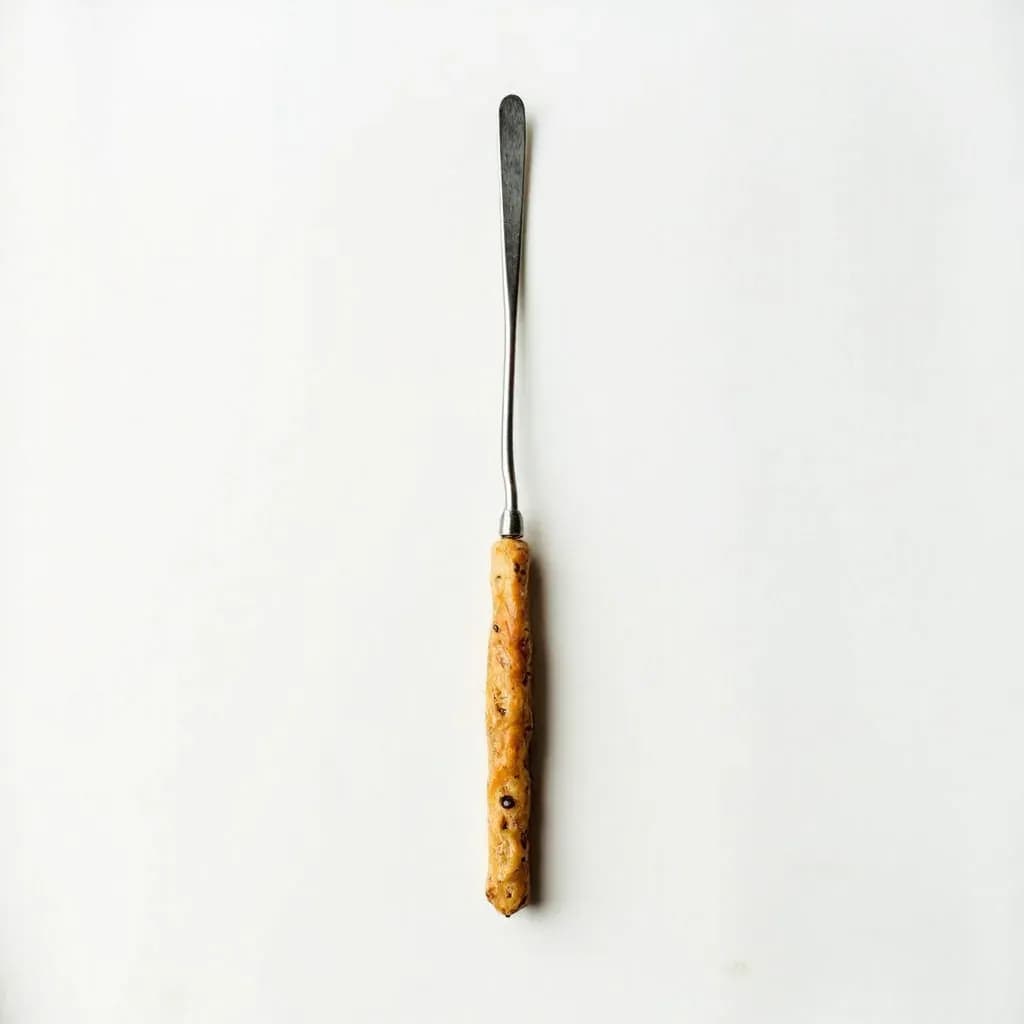
A long-toothed rake for cutting and stirring cheese curds in the vat.
A curd rake is a long-handled tool with widely spaced tines used in cheesemaking to cut the set curd and gently stir it in the whey. Cutting the curd controls how much moisture it releases, which sets the texture of the final cheese. The rake's wide spacing avoids shattering the delicate curds while keeping them moving evenly.
A curd rake is a long-handled tool with a row of vertical blades, designed to do two distinct jobs in the cheese vat: cut the rennet-set gel into uniform cubes and then stir those curds gently through the cook phase. The handle — typically 80 to 120 cm — lets the cheesemaker reach the bottom of a deep vat filled with curd and hot whey without ever lowering an arm into the liquid. That separation matters as much as the cut itself: whey at scalding temperatures will burn skin, and any contaminant from a hand or sleeve compromises the batch.
The size of the cut and the gentleness of the stir are two of the most important variables in cheesemaking. Smaller curds expel more whey and yield a drier, denser cheese — the route to aged cheddars and grana-style hard cheeses. Larger, less-stirred curds hold their moisture and stay supple, the foundation of washed-rind wheels and bloomy-rind styles. A curd rake is the simplest, most controllable instrument for shaping those outcomes, which is why it has remained standard equipment from farmhouse kitchens to industrial creameries.
In practice, the rake's vertical blades slice cleanly when drawn perpendicular through the gel; tilted at an angle, the same head lifts and folds curds without crushing them. Stainless steel dominates because it is non-reactive with milk acids and minerals, and because a smooth metal surface is straightforward to sanitize between batches. Wooden handles survive on tradition and feel, but most production rakes now ship with all-metal or food-polymer construction for cleaning ease.
Alternatives
Types & varieties
The classic farmhouse and small-creamery style: a flat head with several vertical blades, used for both the initial cut and the stirring that follows.
A frame strung with parallel wires rather than solid blades. Produces very uniform cubes but is used mainly for the initial cut, not for stirring — a distinct tool often grouped with the curd rake.
Staggered tines that cut more curds per stroke; useful on firm gels in larger vats where speed matters.
Lightweight and gentle on delicate soft curds; favored in some artisan setups for cheeses that bruise easily.
European farmhouse design with a weighted metal head and an ergonomic wood grip — comfortable but harder to sanitize than all-metal.
An open, whisk-like variant used only for stirring during the cook phase; does not cut a set gel cleanly.
Anatomy of a Curd Rake
A typical curd rake has three parts working together: a horizontal head that holds the cutting and stirring blades, a row of vertical tines set into that head, and a long handle connecting the cheesemaker to the vat. The head is usually 20 to 40 cm across to match standard vat widths, and it sits perpendicular to the handle so that a single pull of the arm draws the tines through the curd in a clean line. Weight matters more than most buyers expect: a heavy head sinks into the curds under its own mass and cuts without forcing, while a light head has to be pushed, which tends to crush rather than slice. The handle attaches near the center of the head for balanced strokes and is often set at an angle rather than straight up, which gives the cheesemaker a clearer view of the blade row during the cut.
Matching Tine Spacing to Cheese Style
The distance between blades is the single most important variable on a curd rake, because it sets the maximum cube size and therefore the moisture of the finished cheese. Cheesemakers often own two or three rakes with different spacings and switch by style.
- 6–10 mm spacing: hard aged cheeses such as cheddar, parmigiano, and other grana-style — small curds, low moisture, long aging potential
- 8–15 mm spacing: semi-hard cheeses like gouda, manchego, raclette, and tomme — a balanced middle path
- 15–25 mm spacing: washed-rind cheeses such as taleggio, reblochon, and pont-l'évêque — large moist curds that retain whey
- 10–20 mm spacing: bloomy-rinds like brie and camembert, which need gentle handling but still relatively small curds to drive off enough whey for a stable rind
Cutting and Stirring Technique
The same rake does two jobs that look similar but call for different body mechanics. The cut wants long, even strokes perpendicular to the curd surface; the stir wants slow, angled lifts that move curds without breaking them. Mixing the two — stabbing down or stirring during the cut — is one of the most common mistakes in cheesemaking.
- For the cut: draw the rake in long parallel lines across the vat, then rotate 90° and repeat to produce a grid of roughly cube-shaped pieces
- For the first-cut rest: hold the rake just under the surface and draw it gently across the vat every minute or two, preventing the cut faces from re-fusing while the gel firms up
- For the cook: tilt the rake 30–45° and pull curds up and over with each stroke, mixing top and bottom layers so all curds see the same heat
- Ease off stirring once the curds show a clean break when pressed between the fingers — overworking at this stage is a common cause of dry, crumbly texture and excess fat loss into the whey
Common uses
Tips & pitfalls
- Match tine spacing to your cheese style — finer tines produce smaller curds and drier aged cheeses, while wider tines hold moisture for washed-rind and softer styles.
- Cut slowly and deliberately; violent stirring shatters curds and drives fat into the whey, lowering yield and dulling flavor.
- Let the gel rest a minute or two after the first cut before you begin stirring. The cut surfaces need to firm up, and rushing produces crumbling and fines in the whey.
- Hold the rake at a slight angle rather than straight down — angled strokes slice cleanly, while straight-down plunges tear and crush.
- Sanitize every tine gap thoroughly; trapped curd residue harbors bacteria that can contaminate the next batch.
- Keep the rake head fully submerged as you move it through the vat — lifting it into the air splashes hot whey and risks contamination from above.
- Choose a handle length that lets the head reach the vat bottom with your hand still above the rim, protecting against burns and keeping sleeves out of the milk.
- Replace wooden-handled rakes when the wood darkens, cracks, or stays damp — crevices in weathered wood become sanitation liabilities that no scrubbing will fix.
Good to know
- Tool type
- Long-handled rake with vertical tines for cutting and stirring cheese curds in the vat
- Also called
- Cheese rake, curd stirrer; French 'tranche-caillé' or sometimes 'lyre à caillé' (the lyre being a related wire harp)
- Primary materials
- Food-grade stainless steel tines; handle in wood, stainless steel, or food-safe polymer
- Tine count and spacing
- Typically 6–12 vertical blades per row; spacing ranges from about 6 mm (fine) to 25 mm (wide) depending on cheese style
- Handle length
- Roughly 80–120 cm (32–48 in) so the head can reach the vat bottom with the cheesemaker's hand above the rim
- Working width
- Head usually 20–40 cm across, matched to standard vat widths
- Used by
- Artisan farmhouse cheesemakers through industrial creameries; modern mechanized descendants include automated cutting frames and motorized paddle agitators
- Cleaning
- Sanitized like all dairy equipment with hot water and a dairy-safe sanitizer; trapped residue in tine gaps must be removed each cycle
Also called
cheese curd rake · curd cutter
Related

Peeler
Swift blade for stripping skin off fruit and vegetables

Grater
Sharp-toothed surface for shredding cheese and vegetables

Microplane
Ultra-fine rasp for citrus zest, garlic, and hard cheese

Mixing Bowl
All-purpose bowl for combining, whisking, and tossing

Whisk
Looped wires that beat air into eggs, cream, and sauces

Spatula
Flat blade for flipping, lifting, and scraping

Slotted Spoon
Pierced spoon that lifts solids and drains the liquid behind

Wooden Spoon
Gentle, heat-friendly spoon for stirring anything