Prep Tools
Curd Skimmer Ladle
A perforated or slotted ladle for lifting curds, dumplings, or solids out of hot liquid while draining.
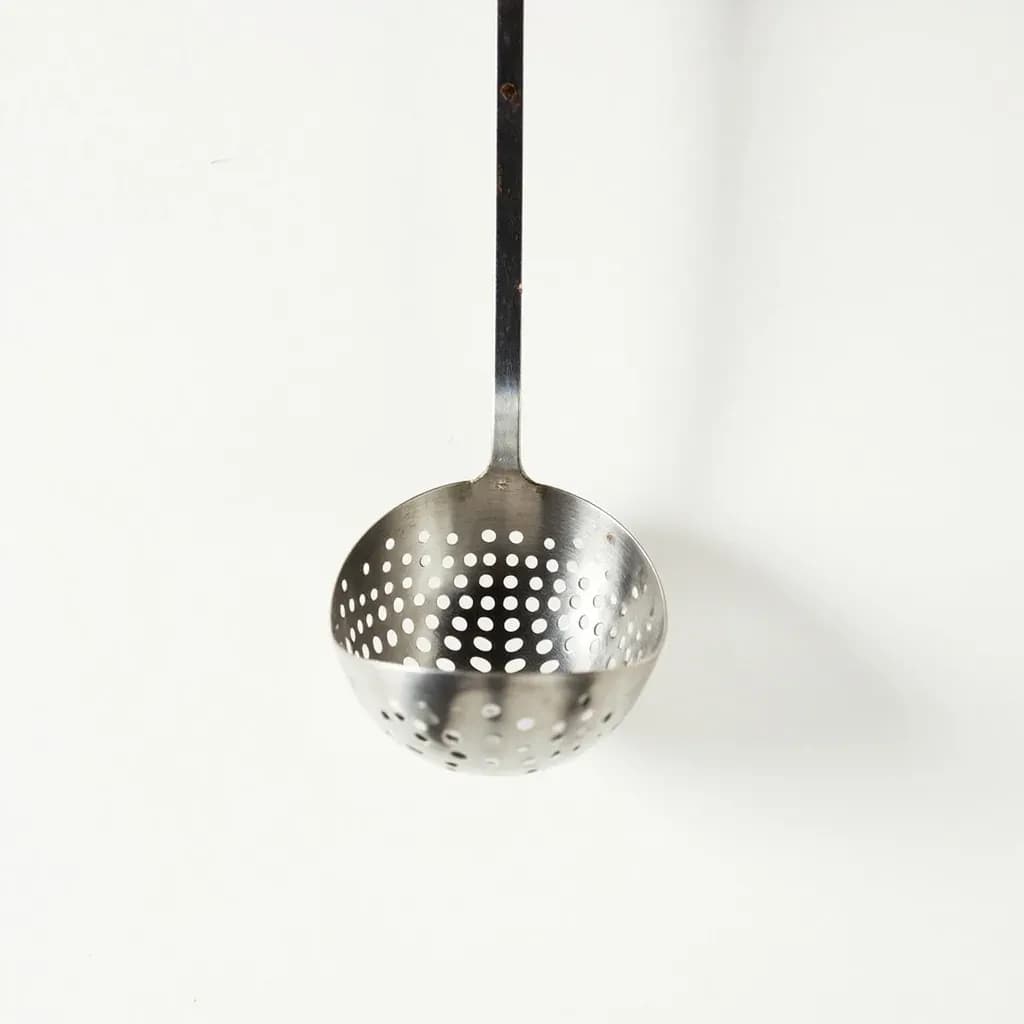
A curd skimmer ladle is a shallow ladle with holes or slots that scoops solids from liquid while letting the liquid drain back. In cheesemaking it transfers curds from whey to molds gently; in general cooking it lifts dumplings, poached foods, and skims foam from stocks. The perforations distinguish it from a solid ladle used to portion soups.
The curd skimmer ladle is a deep, perforated ladle on a long handle, built for the specific job of lifting soft, fragile solids — most often cheese curds — out of a hot liquid and letting the liquid drain away as the solids are transferred. The defining features that separate it from a common slotted spoon are the depth of the bowl (which scoops a meaningful volume in one pass) and the length of the handle (which keeps the cook's hand clear of steam and out of a deep vat). Perforations are typically round holes punched or drilled through stainless steel, sized so that whey passes freely but cut curds are retained.
In cheesemaking, the tool is essential once the milk has been set, cut, and gently cooked: the cheesemaker scoops the curds out of the whey and into draining molds, working quickly while the curds are still warm and pliable. Outside the cheese vat, it behaves exactly like any long-handled perforated skimmer — useful for blanched vegetables, boiled potatoes, dumplings, and poached eggs — making it a quietly versatile piece of equipment for any cook who regularly lifts solids from a deep pot.
In practice, a home cook reaches for a curd skimmer ladle when a slotted spoon is too shallow to carry enough material or too short to clear the rim of a stockpot. The trade-off is precision versus volume: the deep bowl means less fine control than a spider or skimmer, but a single lift can move a large batch of curds or vegetables that would otherwise require many trips with a smaller tool.
Alternatives
Types & varieties
The classic curd skimmer — rounded bowl with many small round holes; carries the most curds per scoop and the standard tool for farmhouse cheesemaking.
Shallower, slotted rather than holed; useful for lifting dumplings, potatoes, and blanched vegetables where larger openings speed draining.
Coarse wire-mesh basket on a long handle; well suited to pasta and fried foods, but the open mesh is too coarse for delicate curds, which slip through.
Domed skimmer borrowed from Asian kitchens, with very small holes; works for very fine soft-curd cheeses and for skimming impurities from stocks.
Traditional European farmhouse version with a turned wooden grip; harder to fully sanitize and largely replaced by stainless in modern dairies.
Commercial-dairy style with a flat front edge for scraping against the vat wall; typically 16–20 inch handle, used in small-to-mid-scale cheese production.
Choosing the right perforation size
Perforation size is the single most important variable in a curd skimmer, because it sets the boundary between what drains away and what gets carried. Match hole size to curd size: fine-curd cheeses such as ricotta, chèvre, and fresh lactic cheeses need very small holes — roughly 1/16 inch (1.5 mm) — or a fine chinoise-style skimmer, otherwise the cut curds slip through with the whey. Firmer cut curds for cheddar, gouda, and similar pressed cheeses hold together well and drain easily through 1/8 inch (3 mm) holes, which is the standard size on most stainless curd skimmers. If curds are escaping the bowl mid-lift, the holes are too large for the cut; either switch tools or allow the curd to set a few minutes longer so the cubes firm up before scooping.
- 1/16 in (≈1.5 mm) holes — ricotta, chèvre, paneer, fresh lactic cheeses
- 1/8 in (≈3 mm) holes — cheddar, gouda, monterey jack, farmhouse hard cheeses
- Larger slots or wire mesh — vegetables, dumplings, pasta; not suitable for fine curds
Curd skimmer vs. slotted spoon vs. spider
A curd skimmer is essentially a long-handled, deep-bowl slotted spoon, and the three tools overlap in purpose. A standard kitchen slotted spoon has a shallow bowl and a short handle, which is fine for shallow pans and small portions but limiting in a deep stockpot or cheese vat. A spider (wire-mesh basket skimmer) drains almost instantly and excels at lifting pasta or fried food from oil, but the open mesh is too coarse to retain fine curds. A curd skimmer sits between them: deeper than a slotted spoon, finer than a spider, and long enough for serious volume work.
- Slotted spoon: shallow, short handle; best for small portions in shallow pans
- Curd skimmer ladle: deep bowl, long handle, fine perforations; built for volume and depth
- Spider: open mesh; fastest draining, but loses small or soft items
Care and sanitation
Stainless curd skimmers tolerate the dishwasher, but a quick cold rinse immediately after use prevents milk residue from baking onto the steel. Avoid aluminum versions for any cheesemaking task: the acid in whey reacts with aluminum, pitting the metal and tainting the cheese with a metallic note. Wooden-handled traditional models need to be hand-washed, dried promptly, and never soaked, since the joint between wood and metal harbors moisture and bacteria. For a kitchen that uses the same tool for cheese and for vegetables, a thorough wash with unscented detergent — or a brief sanitize in hot water — is enough to prevent off-flavors crossing over.
- Rinse cold, then wash hot; never let milk residue dry on the bowl
- Skip aluminum — acid in whey pits the metal and ruins the cheese
- Wooden handles: hand-wash, dry upright, never soak
Common uses
Tips & pitfalls
- Match perforation size to curd size: roughly 1/16 inch holes for ricotta and chèvre, 1/8 inch for cheddar and other pressed cheeses.
- Hold the ladle at a slight forward tilt as you lift so whey drains through the back perforations while curds stay in the bowl.
- Use the flat front edge of a commercial-style scoop to push and pack the curd mat, then slide the ladle underneath — do not dig straight down, which tears the curds.
- Choose a handle long enough to keep your knuckles out of the steam: 14 inches minimum for a home stockpot, 18 inches or more for a cheese vat.
- Rinse with cold water right after use; dried milk residue bakes onto stainless and becomes surprisingly hard to remove.
- If curds are slipping through the holes, your cut is too fine or your skimmer is too coarse; let the curd set longer or switch to a finer skimmer.
- Keep a dedicated curd skimmer for cheesemaking if possible — residual detergent on a multi-use spoon can transfer off-flavors to a fresh batch.
Good to know
- Also called
- Cheese skimmer, curd ladle, perforated skimmer ladle, slotted cheesemaker's ladle
- Primary function
- Lifting and draining curds from whey during cheesemaking
- Typical bowl diameter
- 5 to 6 inches (12–15 cm)
- Typical handle length
- 14 to 18 inches (35–46 cm) to reach into deep pots and cheese vats
- Perforation size
- Usually 1/8 inch (3 mm) round holes; smaller for soft or fine-curd cheeses
- Material
- Stainless steel bowl and shaft; some traditional versions have wooden handles
- Origin
- Long-standing farmhouse cheesemaking tool in Europe and New England; the modern stainless version is the workhorse of small-scale cheese production
- Care
- Dishwasher safe when all-stainless; rinse with cold water before residue dries on
Also called
Skimmer Ladle · Skimming Ladle · Slotted Ladle
Related

Peeler
Swift blade for stripping skin off fruit and vegetables

Grater
Sharp-toothed surface for shredding cheese and vegetables

Microplane
Ultra-fine rasp for citrus zest, garlic, and hard cheese

Mixing Bowl
All-purpose bowl for combining, whisking, and tossing

Whisk
Looped wires that beat air into eggs, cream, and sauces

Spatula
Flat blade for flipping, lifting, and scraping

Slotted Spoon
Pierced spoon that lifts solids and drains the liquid behind

Wooden Spoon
Gentle, heat-friendly spoon for stirring anything