Prep Tools
Dairy Thermometer
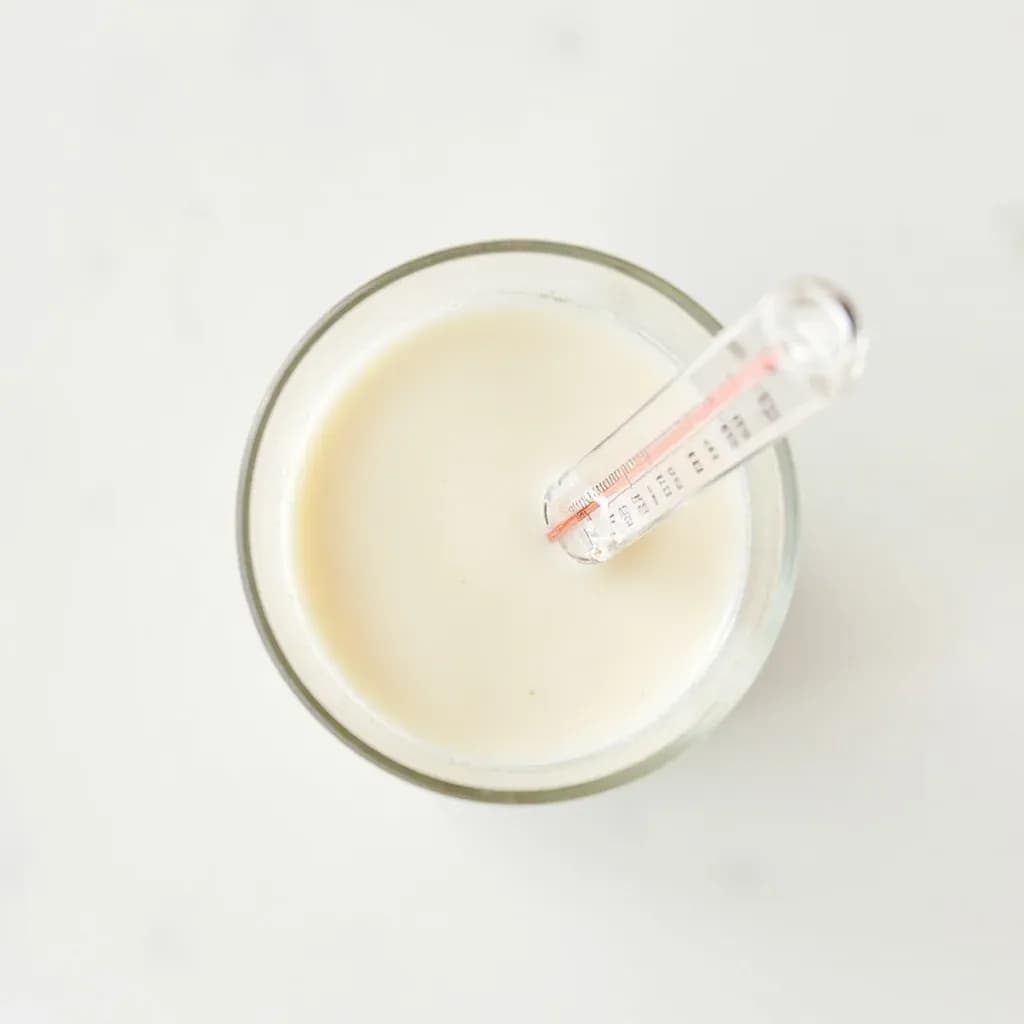
A floating or clip thermometer for hitting precise milk temperatures in cheese, yogurt, and pasteurizing.
A dairy thermometer reads the temperature of milk and cream accurately across the moderate range used in dairy work. Cheesemakers, yogurt makers, and home pasteurizers rely on it to hold milk at exact set points for culturing, ripening, or killing pathogens. Floating models bob in the pot while clip versions attach to the rim for hands-free reading.
A dairy thermometer is a narrow-range temperature gauge designed to live in a pot of milk or cream, reading the 70–185 °F window where almost all dairy cooking happens — scalding, culturing, renneting, and pasteurizing. Its job is deceptively simple: tell you, with two or three degrees of accuracy, exactly what your milk is doing at the moment a culture goes in or rennet is added, because those few degrees decide whether a rennet sets cleanly, a yogurt incubates without fail, or a vat pasteurization actually meets its time-and-temperature standard. Unlike a candy or deep-fry thermometer, it is built for low, sustained heat and contact with milk, often with a clip or weighted bulb that holds the sensing tip at mid-depth in the liquid rather than against the pot wall or bottom. The right tool is a quiet one — used for a glance, a note, a decision — but on it rests the texture of a mozzarella, the tang of a yogurt, and the safety of home-pasteurized milk.
Alternatives
Types & varieties
Sealed glass tube with a weighted bulb; sits freely in the milk, popular in open-vat cheesemaking. Highly visible and fast-reading, but fragile and prone to cracking if plunged into very hot liquid from cold.
Stainless or aluminum clip grips the pot wall with the probe tip suspended in the liquid. The stovetop workhorse for cheese, yogurt, and custard.
Wire probe clipped to the pot, readout on a remote display that sits on the lid or counter. Ideal for long holds like yogurt incubation where you cannot open the pot.
Handheld, no clip, with a 2–4 second read. Accurate and versatile, but requires lifting the lid and inserting the tip each time you check.
Reads surface temperature only. Not recommended for liquid dairy — foam and steam at the surface do not reflect the temperature of the milk body below, and a single spot reading is a poor stand-in for the whole pot.
Choosing the right dairy thermometer
Most home cooks do well with two thermometers: a clip-on dial for active stovetop work where you are stirring and watching the milk, and a probe-digital with a remote display for unattended holds like yogurt. Serious cheesemakers often add a sealed floating thermometer for the cheese vat, where its high visibility and fast response justify the fragility. Match the stem length to your pot — 5 to 8 inches covers most saucepans and stockpots, while taller milk cans need longer probes.
- Stovetop cheesemaking and yogurt: clip-on dial, easy to read at a glance, no batteries.
- Long incubations and overnight holds: probe digital with alarm and remote display.
- Open cheese vats: floating glass thermometer for visibility across the surface.
- Skip infrared for liquid dairy; it reads foam and steam, not the milk body.
Temperature targets for common dairy tasks
These are the working temperatures most home dairy cooks will reach for. Adjust for altitude above 1,000 feet (boiling drops roughly 1 °F per 500 feet) and remember that carryover heat will carry milk up another 3–5 °F after you pull it from the burner.
- Yogurt incubation: 110–115 °F, held 6–12 hours.
- Mesophilic starter (Brie, Camembert, fresh chèvre): 86–90 °F for culturing and renneting.
- Thermophilic starter (Parmesan, Mozzarella, Swiss): 100–105 °F for culturing and ripening curds. Mozzarella pasta filata is stretched in 160–180 °F water, well above the dairy thermometer's main window.
- Vat pasteurization of raw milk: 145 °F held 30 minutes.
- HTST-style pasteurization: 161 °F held 15 seconds.
- Scalding for custards and panna cotta: 180–185 °F, just below a simmer. Milk scalded for enriched doughs is then cooled to 105–115 °F before adding yeast.
Common uses
Tips & pitfalls
- Calibrate every few months: stir crushed ice and water, insert the probe, adjust to 32 °F, then verify at a rolling boil (212 °F at sea level, less at altitude).
- Clip the probe so the tip is suspended in the liquid at mid-depth — touching the pot bottom reads 5–10 °F high and will quietly ruin a cheese.
- Account for carryover: milk can climb 3–5 °F after you pull it from heat, so remove it 2–3 °F shy of your target.
- For yogurt, a probe digital with an alarm lets you cycle a heating mat on and off without lifting the lid and losing warmth.
- Sanitize between batches with a 70% isopropyl wipe or a dip in boiling water, and keep a dedicated unit for dairy — do not share with a thermometer used on raw meat.
- Read analog thermometers at eye level; the printed scale introduces parallax error if you look down at it from above.
- Pre-warm a glass floating thermometer in a cup of hot water before dunking it into hot milk, or the thermal shock can crack the tube and the separated alcohol column will give false readings for good.
- Do not substitute a candy thermometer — its scale typically starts at 100 °F and the gradations are too coarse for the low, sensitive work dairy requires.
Good to know
- Type
- Probe-style or floating temperature gauge for milk and dairy liquids
- Typical range
- 0 to 220 °F (–18 to 104 °C); most dairy work falls between 70 and 180 °F
- Display
- Analog alcohol-filled glass tube or digital with stainless probe
- Reading accuracy
- Quality analog units ±2 °F; digital units ±0.5 to ±1 °F
- Key target temperatures
- Yogurt incubation 110–115 °F; mesophilic cheesemaking 86–90 °F; thermophilic cheesemaking 100–105 °F; vat pasteurization 145 °F for 30 min; HTST 161 °F for 15 sec; scalding 180–185 °F
- Calibration
- Two-point: ice bath (32 °F / 0 °C) and boiling water (212 °F / 100 °C at sea level)
- Sterilization
- Wipe with food-safe sanitizer, or hold in boiling water 1–2 min; do not submerge electronic heads unless rated
- Also called
- Milk thermometer, cheesemaking thermometer, pasteurization thermometer
Also called
Floating Dairy Thermometer · Milk Thermometer · cheese thermometer
Related

Peeler
Swift blade for stripping skin off fruit and vegetables

Grater
Sharp-toothed surface for shredding cheese and vegetables

Microplane
Ultra-fine rasp for citrus zest, garlic, and hard cheese

Mixing Bowl
All-purpose bowl for combining, whisking, and tossing

Whisk
Looped wires that beat air into eggs, cream, and sauces

Spatula
Flat blade for flipping, lifting, and scraping

Slotted Spoon
Pierced spoon that lifts solids and drains the liquid behind

Wooden Spoon
Gentle, heat-friendly spoon for stirring anything