Prep Tools
Dal Masher (Ghotni)
A wooden or metal churning stick for mashing cooked lentils to a smooth dal.
A ghotni is a hand churn with a notched or splayed head, rolled between the palms to mash cooked lentils, vegetables and pulses directly in the pot. It breaks down dal into a creamy, uniform texture without a blender. Common across Indian kitchens, it is also used to froth buttermilk and emulsify simple gravies.
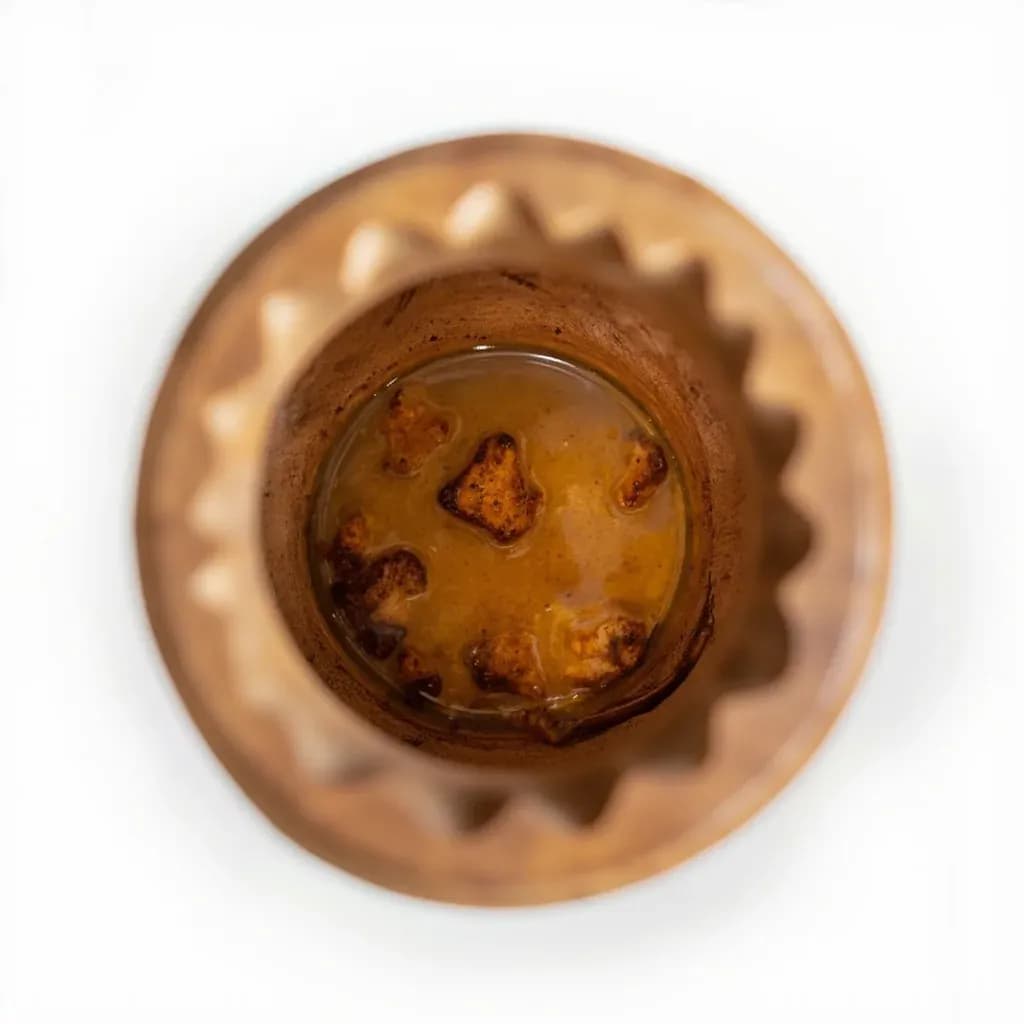
The ghotni (also called ghoti or dal-mashing stick) is a long, slender kitchen tool that ends in a flattened, grooved disc or shallow dome. That ribbed bottom is its defining feature: the grooves catch and crush soft solids rather than pushing them around, which is why a plain wooden spoon won't do the same job. Traditional versions are carved from neem or sheesham wood and measure roughly 8–12 inches end to end, with a mashing head about 2–3 inches across. It's a one-task tool, but it does that task with a control no other utensil quite matches.
What makes the ghotni worth owning in a modern kitchen is what it doesn't do. Unlike an immersion blender, a ghotni breaks down soft legumes without whipping air into them or aggressively emulsifying the surface fat. That matters in dishes like dal tadka, where you want a silken, gravy-like body rather than a foamy purée, or in dal makhani, where the cream and butter are often pooled on top and stirred in at the table. A blender homogenizes; a ghotni texturizes. The result is a rustic, slightly grainy creaminess — closer to what restaurant kitchens call a "hand-mashed" finish — that holds structure on the plate and absorbs tempering oil beautifully.
In practice, the tool behaves like a small, manual purée paddle. You press the ribbed disc into hot, fully cooked dal and work it in slow circles, letting the grooves do the cutting while you provide downward pressure. It works best on dal that has cooked past softness into a near-stew consistency, and it can also tackle soft-cooked vegetables, khichdi, and yogurt-based gravies like kadhi. It cannot break down undercooked or al dente lentils — they slide under the disc — so timing the cook is part of the technique.
Alternatives
Types & varieties
Traditional lightweight choice; won't scratch brass or steel pots and develops a patina with use
Denser and more durable than neem; the workhorse of many North Indian kitchens
Modern, dishwasher-safe variant with an aggressive ribbed disc; good for thicker dals
Heavier heirloom style, often with a fluted bottom; prized in Rajasthani households
Shorter, stubbier handle with a broader mashing end, suited to thick preparations like dal makhani
Why a Ghotni Beats a Blender for Dal
An immersion blender is faster, and a countertop blender is silkier — so why bother with a stick? Three reasons keep the ghotni in serious home and restaurant kitchens.
- It controls texture. A ghotni leaves the dal slightly rustic and grainy, which absorbs tempering spices and ghee better than a fully homogenized purée.
- It doesn't aerate. Blenders whip air into the dal, producing a foamy surface that dissipates slowly and dulls the look of a finished tadka.
- It doesn't emulsify aggressively. In dishes like dal makhani, where cream and butter are often pooled on top until stirred in, a blender breaks that separation instantly.
Common uses
Tips & pitfalls
- Hold the pot steady with a folded kitchen towel draped over the rim — it absorbs splashes and gives you a grip on hot steel
- Use gentle circular pressure rather than pounding; the ribbed disc is designed to catch and crush, so let it work
- Tilt the ghotni against the side of the pot to scrape the creamy layer off the walls back into the dal
- For the silkiest finish, mash while the dal is still very hot and slightly thin — it thickens as it cools
- Season a new wooden ghotni by rubbing it with a thin coat of food-grade oil and letting it dry overnight before first use
- If the dal is too thick to mash, splash in 2–3 tablespoons of hot water rather than forcing the disc through — much easier on your wrist and the tool
- Common mistake: putting a wooden ghotni in the dishwasher. The heat and detergent will dry the wood and crack the handle within a few cycles
- Common mistake: trying to mash undercooked lentils. They slide under the disc and stay whole; cook until fully broken down before mashing
- Common mistake: skipping the final strain. If you want truly smooth restaurant-style dal, pass the mashed result through a fine mesh strainer and discard the fibrous solids
- Store upright in a utensil crock so the handle stays dry and the mashing end gets airflow
Good to know
- Other Names
- Ghotni, ghoti, bhamni (Maharashtra), ghota (Punjab); generically called a dal-mashing stick
- Origin
- Indian subcontinent — used for centuries in home kitchens across Maharashtra, Punjab, Gujarat, and Rajasthan
- Primary Material
- Wood (neem, sheesham/rosewood, teak); modern versions in stainless steel; brass made as heirloom option
- Dimensions
- 8–12 in (20–30 cm) total length; mashing disc 2–3 in (5–7.5 cm) across
- Heat Tolerance
- Wood tolerates direct contact with hot dal; stainless steel tolerates higher heat
- Best For
- Fully cooked toor, moong, and masoor dal; also soft-cooked vegetables and yogurt gravies
- Skill Level
- Beginner — gentle circular pressure is the only real technique
- Cleaning
- Hand-wash in warm water, air-dry upright; never soak wood or run through a dishwasher
- Storage
- Dry location, away from moisture; occasional food-safe oil rub on wooden handles prevents cracking
- Time
- 2–4 minutes to fully mash 2–4 cups of cooked dal
- Yield
- Produces a textured, slightly rustic purée; for silk-smooth dal, strain after mashing
Also called
ghotni · lentil masher · mathani
Related

Peeler
Swift blade for stripping skin off fruit and vegetables

Grater
Sharp-toothed surface for shredding cheese and vegetables

Microplane
Ultra-fine rasp for citrus zest, garlic, and hard cheese

Mixing Bowl
All-purpose bowl for combining, whisking, and tossing

Whisk
Looped wires that beat air into eggs, cream, and sauces

Spatula
Flat blade for flipping, lifting, and scraping

Slotted Spoon
Pierced spoon that lifts solids and drains the liquid behind

Wooden Spoon
Gentle, heat-friendly spoon for stirring anything