Prep Tools
Dhal Ghotni
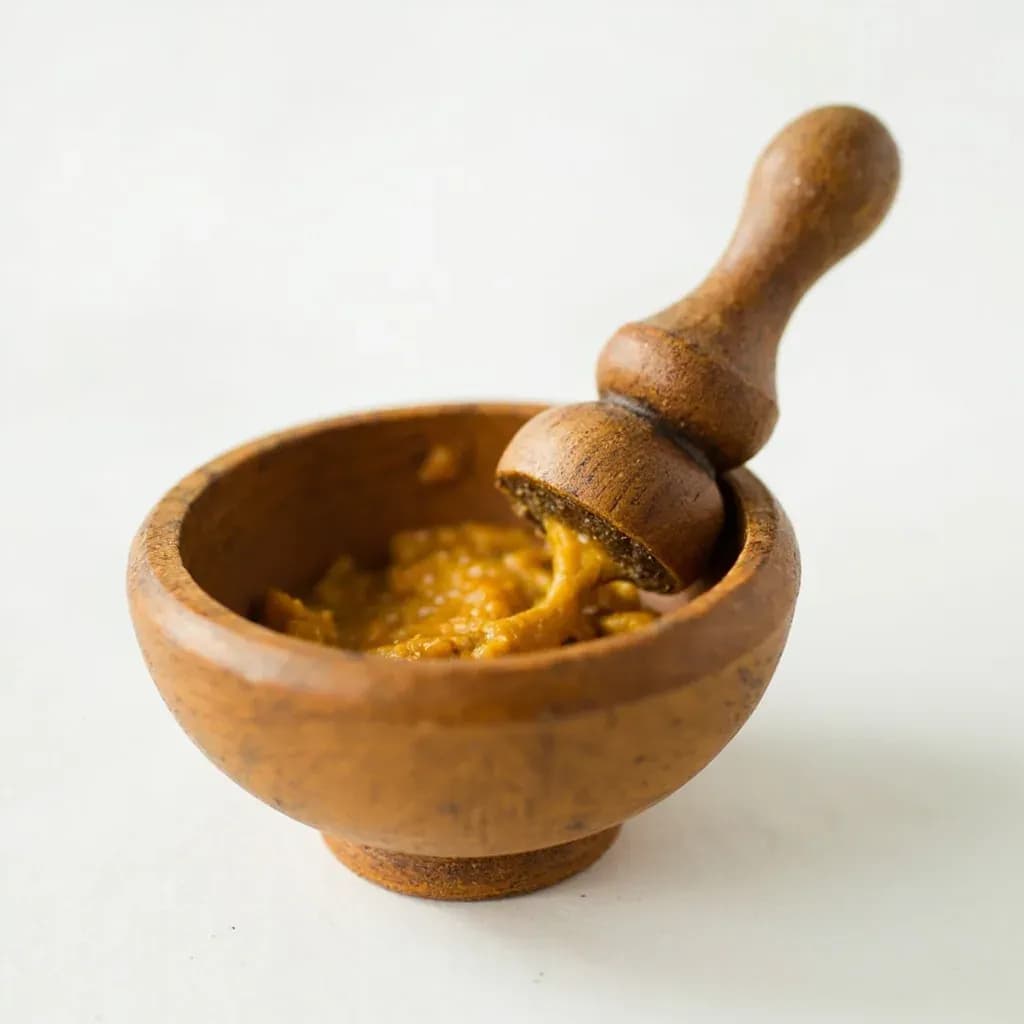
A wooden hand churner used to mash and smooth simmered lentils into creamy dal.
A dhal ghotni is a traditional Indian wooden tool, usually a carved spindle with a fluted or star-shaped head, used to mash and churn cooked lentils. Spinning it between the palms inside the pot breaks down the dal into a smooth, homogeneous texture while it simmers. It is also used to whip lassi and other liquids.
The dhal ghotni is a long-handled hardwood mashing and whipping stick used across the Indian subcontinent to finish cooked lentils. A typical example runs 30–45 cm from grip to working end, and the working end itself takes several forms: a flat disc, a perforated disc, a rounded knob, or a small churn-paddle. The handle is deliberately long so the cook's hand stays well clear of the steam and the erupting surface of a simmering pot, and the wood is almost always a dense Indian hardwood — teak (sagwan), neem, sheesham, or seasoned mango — chosen because softer timbers chip against the heavy metal rim of a traditional cooking pot.
What distinguishes the ghotni from an immersion blender or a metal potato masher is the texture it produces. The disc or knob crushes the soft cotyledon of the lentil while leaving a meaningful fraction of the skins and broken grains intact, so the finished dal reads as silky but with subtle, pleasing grain — the body of a homestyle Maharashtran varan or Punjabi dal makhani rather than the uniform, sometimes gummy puree a blender delivers. A perforated disc, in particular, partly whips as it mashes, aerating thinner dals into a faintly frothy, emulsified consistency that holds a gloss of fat on the surface.
In practice the tool is an extension of the cook's hand: a rhythmic vertical pounding against the bottom of the pot to rupture the grains, followed by a final brisk circular whip once the tadka is poured in. It has no moving parts, needs no electricity, treats the cookware gently, and rewards thirty seconds of care after washing with decades of service. That combination is why the ghotni has survived four generations of Indian kitchens and is now quietly migrating into South Asian–adapted restaurant lines.
Alternatives
Types & varieties
A flat circular disc at the working end; the most common form, equally good for mashing and stirring.
Disc pierced with holes; partly whips as it breaks lentils down, aerating thinner dals like moong into a faintly frothy finish.
A rounded ball-like tip; used more for gentle stirring than aggressive mashing, common for kadhi or thin lentil soups.
A broader, flatter blade resembling a small churn dasher; used in Maharashtra and parts of the South for thicker dal preparations.
A metal counterpart found in some Marathi kitchens; heavier and more aggressive, used when a wooden one is unavailable.
Geometry is everything
The single biggest variable on a ghotni is the shape of the working end, and it is what the cook is really choosing between. A wide, thin disc behaves like a small tamper: it smashes lentils cleanly against the bottom of the pot and is the right tool for thick dals where you want broken grains and full starch release — dal makhani, mah ki dal, or a heavy urad. A perforated disc, by contrast, acts as a coarse whisk on every downstroke, dragging the liquid through the holes and folding air into it; this is the geometry to reach for with moong, masoor, or any thin dal you want to finish with a sheen of fat riding on a lightly aerated surface. A knob or bulb-end is closer to a wooden spoon: it stirs and nudges rather than crushes, which is the right amount of force for kadhi, for dals you have already partially blended, or for incorporating a tempering without breaking the last whole grains. Many home cooks own two — usually a flat disc plus a perforated disc — and switch mid-recipe.
- Wide, thin disc: smashes; best for thick dals and full starch release.
- Perforated disc: whips as it mashes; best for thin dals and a glossy fat layer.
- Knob or bulb: stirs and nudges; best for kadhi and delicate dals.
- Paddle/dasher: broad surface for churning larger volumes and thicker preparations.
The mashing motion
How a ghotni is moved matters as much as its shape. The classic technique is a firm, rhythmic up-and-down pounding rather than a stir, with the disc kept roughly vertical so it strikes the bottom of the pot flat. The lentils rupture against the metal floor, and the released starch instantly thickens the surrounding liquid. For the silky-but-grainy body of restaurant-style dal makhani, lean the disc against the side of the pot at roughly 30° and drag: the grains are sheared against the metal wall rather than crushed, which breaks cotyledons while leaving more skins intact. The final step, in almost every dal, is a brisk circular whip with the ghotni just after the hot tadka is poured in; this is what emulsifies the fat into the starch and gives the surface its characteristic gloss. A low simmer is the right moment to begin — boiling dal erupts more violently and increases the chance of the disc chipping against the rim.
Care and longevity
A ghotni is treated the way any good wooden cooking tool is treated: it is washed, rinsed, towel-dried immediately, and stood upright in open air so both ends can breathe. It is never soaked — the end grain at the working face drinks in water, swells, and eventually splits along the grain. A dishwasher is the fastest way to ruin one. Once a month, or whenever the surface looks dry, the wood benefits from a light rub of food-grade oil — mustard oil in the northern and eastern tradition, ghee in many western and southern homes — left to soak in overnight, then wiped (not flooded) before the next use. A freshly oiled ghotni should not go straight into very hot dal: the surface oil can flash and flavor the dish. Wipe it down first. Replace a ghotni when the disc shows deep cracks or the handle begins to feel loose in its socket; wood fragments in food are a real hazard.
Common uses
Tips & pitfalls
- Start mashing at a low simmer — boiling dal erupts more violently and the wood is more likely to chip against the pot rim.
- Hold the ghotni vertically and use a firm, rhythmic up-and-down (pounding) motion rather than stirring in circles; this ruptures lentils faster.
- For a restaurant-style dal makhani finish, lean the disc against the side of the pot at about 30° and drag — the grains shear against the metal wall instead of being crushed flat.
- Wood is non-reactive and non-scratching, so it is safe on steel, brass, and copper — unlike a metal whisk or immersion blender head.
- Always finish with a brisk circular whip of the ghotni after the tadka goes in; this is what produces the characteristic sheen on the surface.
- Common mistake: soaking the ghotni in water after use. Wood absorbs water, swells, and splits along the grain — wash, rinse, and dry it upright.
- Common mistake: putting a freshly oiled ghotni into very hot dal. The seasoning oil can flash and flavor the dish; wipe, don't flood, when seasoning.
- Common mistake: substituting a metal potato masher. It works, but it scratches cookware and can over-pulverize, giving a gluey rather than silky texture.
- If the ghotni feels too short for the pot, grip higher up the shaft and let the disc do the work — the long lever is intentional, not decorative.
- Replace the ghotni when the disc shows deep cracks or the handle feels loose in its socket; fragments in food are a real hazard.
Good to know
- Origin
- Indian subcontinent; used wherever dal is a daily staple — Maharashtra, Gujarat, Punjab, the South, Bengal, Uttar Pradesh.
- Other names
- Dal ghotni, dalghotni, ghotni, ghotna, varoon (some regions), wooden dal masher.
- Material
- Dense Indian hardwood — teak (sagwan), neem, sheesham (Indian rosewood), or seasoned mango. Softwoods splinter against a heavy pot.
- Length
- Roughly 30–45 cm (12–18 in) handle, so the hand stays above steam and bubbling dal.
- Working end
- Flattened disc, perforated disc, rounded knob, or small churn-paddle — geometry chosen for smash vs. whip behavior.
- Primary function
- Mechanically ruptures cooked lentil cell walls to release starch, producing the glossy, emulsified body of a finished dal.
- Heat tolerance
- Used in hot, simmering dal; not designed for deep-frying or direct flame contact.
- Care
- Hand-wash, towel-dry immediately, store in open air; never soak or run through a dishwasher — the grain swells and cracks.
- Seasoning
- Tradition is to rub a new ghotni with a little mustard oil or ghee and rest it overnight to condition the wood before first use.
- Approximate price
- Handmade hardwood examples: roughly ₹150–₹600 in India; USD 5–20 in diaspora markets.
Also called
Dhal Swizzle Stick · dal ghotni · mathani · madani
Related

Peeler
Swift blade for stripping skin off fruit and vegetables

Grater
Sharp-toothed surface for shredding cheese and vegetables

Microplane
Ultra-fine rasp for citrus zest, garlic, and hard cheese

Mixing Bowl
All-purpose bowl for combining, whisking, and tossing

Whisk
Looped wires that beat air into eggs, cream, and sauces

Spatula
Flat blade for flipping, lifting, and scraping

Slotted Spoon
Pierced spoon that lifts solids and drains the liquid behind

Wooden Spoon
Gentle, heat-friendly spoon for stirring anything