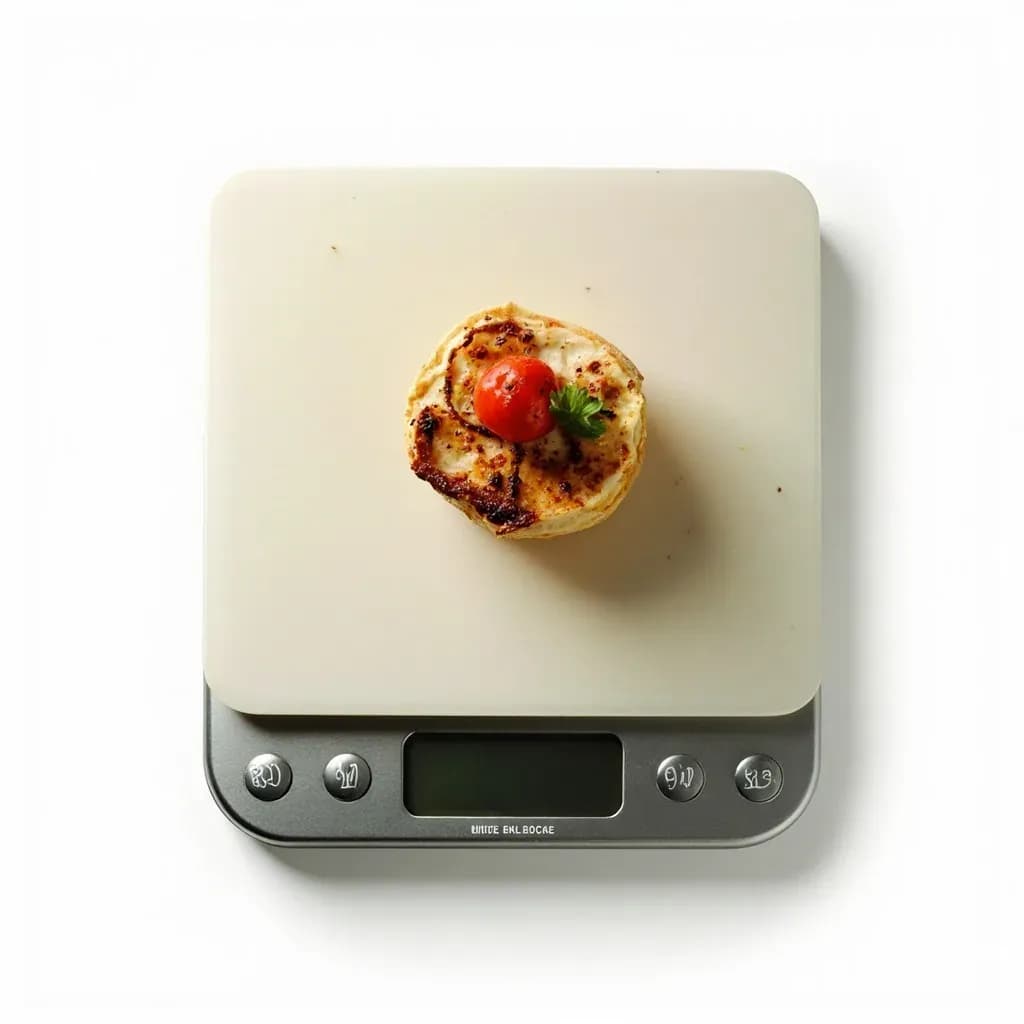
Prep Tools
Digital Scale
An electronic scale that weighs ingredients precisely for accurate, repeatable cooking.
A digital scale is an electronic kitchen scale with a flat platform and a numeric display that weighs ingredients to the gram or fraction of an ounce. It is the most accurate way to portion ingredients, essential for baking, bread, pastry, and consistent recipe scaling. A tare function lets the cook zero out a container's weight so only the added ingredient is measured.
A digital kitchen scale is an electronic balance that measures the mass of whatever you set on its platform, displaying the result in grams or ounces on a small readout. Inside, a metal element called a strain-gauge load cell flexes microscopically under the weight; that flex changes the element's electrical resistance, and the circuitry converts the change into a number. What this means in practice is that an inexpensive countertop pad can give you a reading to the gram in under two seconds — precise enough to change how you bake, brew coffee, season food, and scale recipes.
For cooking, a scale is the single most reliable bridge between a written recipe and what actually lands on the plate. Volume measures (cups, tablespoons) are inconsistent by nature: a cup of flour can weigh anywhere from about 110 g to 160 g depending on how it was scooped, while 125 g on a scale is always 125 g. That reproducibility matters most in baking, where ratios of flour to water to leavening govern the final crumb, and in coffee, where a few grams of dose or yield shift extraction noticeably. A scale also lets you scale a recipe up or down proportionally without losing the balance that makes the dish work.
The category now spans everything from a basic flat pad good for general cooking to specialty pour-over scales with timers, flow-rate readouts, and Bluetooth. Choosing among them is mostly a question of resolution (the smallest increment the scale can display), capacity, and how much you value repeatability in your cooking.
Alternatives
Types & varieties
The modern standard: a slim pad with a digital readout, used with any bowl or plate set on top.
Comes with a fitted mixing or weighing bowl that locks to the platform, useful for liquids and messy prep.
Slim profile that stores flat in a kitchen drawer; trade-off is a smaller platform and lower capacity.
0.1 g resolution, built-in timer, fast response, often a silicone heat pad; many show flow rate during the pour.
A small high-resolution platform nested inside a larger one so you can weigh portafilter or cup and brew vessel at once.
A handheld scoop with a built-in load cell, typically 0.01–0.1 g resolution; designed for spices, yeast, salt, and small-batch baking.
A hook-and-strain-gauge design for weighing odd-shaped items or liquids in a suspended container; uncommon in home kitchens.
Pairs with an app to log weights, scale recipes, build shopping lists, or guide step-by-step cooking.
High-precision (0.01 g) units borrowed by serious bakers for ingredient development and sourdough trials.
Why weight beats volume
Volume measures are approximations; weight is the recipe. The same '1 cup' of flour, brown sugar, or chopped walnuts can vary by 30% or more depending on how densely it was packed, how finely it was milled, and how humid the day is. A recipe written in grams removes that ambiguity entirely. This is why professional baking is built on weight, why bread formulas are expressed as baker's percentages (every ingredient as a percentage of flour weight), and why two home bakers following the same cup-measured recipe can end up with very different loaves.
- A 'cup' of all-purpose flour ranges from roughly 110 g (sifted, spooned) to 160 g (packed).
- Brown sugar varies from about 180 g to 220 g per cup depending on how firmly it's pressed.
- Butter is the rare exception where volume works well: 1 stick = 113 g = 1/2 cup, consistently.
- Honey and molasses cling to measuring cups; weighing them is faster and more accurate.
Choosing the right resolution
Resolution is the smallest increment the scale can display, and it determines what the scale is genuinely good for. For most savory cooking — stews, sautés, rice, portioning meat — 1 g resolution is more than enough and keeps the price low. For baking with small quantities of leavening, salt, or spices, 0.1 g is worth the upgrade. For pour-over coffee, espresso dosing, macarons, or working with active dry yeast or sourdough starter, 0.1 g is effectively mandatory. Below that, 0.01 g is the territory of spoon scales and bench units used in recipe development, not everyday cooking.
- 1 g: general cooking, baking in larger batches, portion control.
- 0.1 g: pour-over, espresso, macarons, small-quantity spices, salt, yeast.
- 0.01 g: bench work, very small spice quantities, recipe R&D.
Common uses
Tips & pitfalls
- Always tare before adding ingredients, and tare between additions when measuring several components into the same bowl — this is the single habit that makes a scale faster than measuring cups.
- For liquids, ignore the ml setting on most home scales; it assumes the density of water and will be wrong for milk, cream, oil, and honey. Weigh them in grams instead.
- Measure flour by weight, not by volume. A 'cup' of flour can range from roughly 110 g to 160 g depending on how it's scooped; 125 g on a scale is reproducible.
- Place the scale on a hard, level surface and center the load. Soft mats, wobbly counters, and off-center bowls all reduce accuracy, especially on small platforms.
- Don't set a hot pot directly on a consumer scale; heat can drift the load cell. Pour into a room-temperature vessel and weigh that instead.
- Calibrate with a known mass if readings start to drift, and replace or recharge batteries before a long session — a dying battery can produce erratic or biased readings.
- Don't exceed the stated capacity. Overloading can permanently damage or zero-shift a load cell, and the scale's accuracy always drops at the very top and very bottom of its range.
- Wipe the platform dry before each use. Moisture trapped under a bowl makes the tare unstable and the readout jumpy.
Good to know
- How it works
- A strain-gauge load cell flexes under weight, changing electrical resistance; circuitry converts that to a digital reading.
- Resolution
- 1 g for general cooking; 0.1 g for coffee, macarons, and small-quantity baking; 0.01 g on bench or spoon scales.
- Typical capacity
- 5 kg / 11 lb on general home models; 2–3 kg on coffee-focused scales.
- Units
- Grams, kilograms, ounces, pounds; some models offer milliliters, but this assumes water density and is unreliable for milk, oil, or honey.
- Tare function
- Zeros the display with a container in place, so you can add ingredients sequentially into the same bowl.
- Response time
- Settled reading in roughly 0.5–2 seconds on consumer models.
- Power
- AAA/AA batteries on entry-level models; rechargeable lithium-ion on most higher-end and coffee scales.
- Calibration
- Many models allow user calibration with a known mass (commonly 100 g, 500 g, or 1 kg) to correct drift over time.
Also called
Digital Bench Scale · Digital Portion Scale · Bench Scale · Portion Scale · Kitchen Scale
Related

Peeler
Swift blade for stripping skin off fruit and vegetables

Grater
Sharp-toothed surface for shredding cheese and vegetables

Microplane
Ultra-fine rasp for citrus zest, garlic, and hard cheese

Mixing Bowl
All-purpose bowl for combining, whisking, and tossing

Whisk
Looped wires that beat air into eggs, cream, and sauces

Spatula
Flat blade for flipping, lifting, and scraping

Slotted Spoon
Pierced spoon that lifts solids and drains the liquid behind

Wooden Spoon
Gentle, heat-friendly spoon for stirring anything