Prep Tools
Dim Sum Push Cart
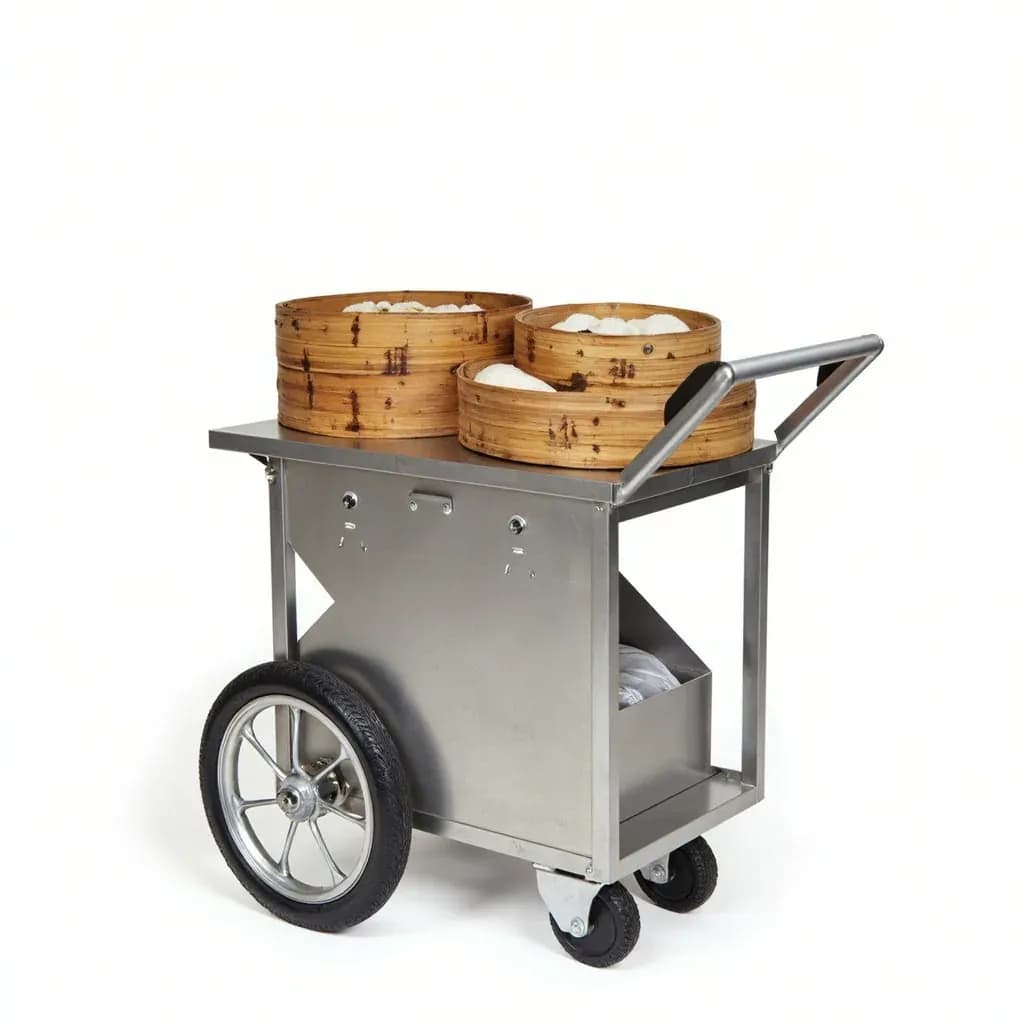
A heated rolling cart for serving dim sum tableside from stacked steamer baskets.
A dim sum push cart is a wheeled service trolley, often heated or holding steaming water, that carries trays and bamboo steamer baskets of dumplings and small dishes through a dining room. Servers roll it between tables so guests can choose plates on sight, the traditional way of serving yum cha. The heated base keeps the dim sum hot during the rounds.
The dim sum push cart (點心車, dian xin che) is a mobile, heated serving station that anchors the traditional Cantonese yum cha service. Built as two or three tiers of stacked bamboo steamers set over a rolling steel frame, it carries steaming baskets directly to the table so diners can see, smell, and choose dishes on sight rather than order from a printed sheet. A heat source at the base — historically a charcoal brazier, more commonly a gas flame, electric element, or simmering water bath in modern carts — keeps the contents of the lower baskets at full serving temperature while upper tiers hold a gentler warmth suitable for delicate dumplings and buns. The cart's value lies less in the equipment itself than in the system it enables: visible selection, constant heat, and the personality of the server pushing it.
In the hands of a veteran server — often called a "dim sum auntie" (點心阿姐) — the cart becomes a small performance. She wheels between closely packed tables, chants abbreviated dish names and prices in rapid Cantonese, lifts lids to display the food, and marks each selection with a chop or stamp on the customer's tally card. Steam venting from between the basket rims and lids signals freshness, and the rattle of casters and hiss of steam create the acoustic texture of a busy Hong Kong tea house. That combination of visual, thermal, and human cues is hard to replicate with a paper order form.
Since the 1980s most dim sum restaurants have replaced cart service with tick-sheet ordering for speed and portion control, but a handful of heritage venues and revivalist kitchens still run carts because the format signals authenticity and lets chefs showcase daily specials that never make it onto the printed menu. Where local fire codes prohibit open flame, modern carts use electric heating elements or hot-water reservoirs that perform the same job without the drama of a glowing brazier.
Alternatives
Types & varieties
Traditional design with a charcoal brazier in the lower compartment; imparts a faint smoky note to bamboo steamers and provides fierce radiant heat.
Mid-20th-century modernization using an LPG burner beneath a water tray; steady, controllable, and suited to long service periods.
Common in newer or renovated restaurants; silent, fume-free, easy to regulate, and meets modern ventilation codes, but lacks the visual drama of open flame.
Lower section holds a large bath of simmering water that surrounds the steamers, gently reheating without drying out bao or dumpling skins.
Has separate heated and ambient or chilled zones, allowing steamed items alongside cold dishes such as century egg or jellyfish.
Smaller, lighter cart used in some Hong Kong spots for congee, cheung fun, or fried items that don't need stacking.
Heat and the Loading Sequence
A working dim sum cart is loaded in a deliberate sequence so every basket reaches the table at the right temperature and texture. Long-cooking, dense items — sticky rice in lotus leaf (lo mai gai), daikon cake, pork ribs — go at the bottom, where heat is fiercest. Quick-steamed dumplings such as har gow, siu mai, and chive dumplings sit on top, where steam is gentler and they finish cooking without toughening the wrappers. Char siu bao and custard buns typically occupy the middle tier. This is also why a customer who wants piping-hot lo mai gai should ask the server to lift from the bottom of the stack, while delicate steamed egg custards are best pulled from the very top, where warmth is mildest.
- Bottom tier: high heat for long-cooking, dense items (lo mai gai, daikon cake, steamed pork ribs).
- Middle tier: medium heat for filled buns (char siu bao, custard bao) and cheung fun.
- Top tier: gentle warmth for delicate items (har gow, steamed egg custard, spinach dumplings).
- A properly working cart shows visible steam venting from the basket rims; dry lids mean the contents have been sitting.
The Tally Card System
Every table receives a small paper card that doubles as menu, order pad, and bill. As the server pushes the cart past, diners call out their choices and the server marks each dish with a rubber stamp (in older houses, a quick inked chop pressed onto the card). Each stamp represents one steamer basket or one portion, and stamps are counted at the end of the meal against a posted price list to produce the bill. The system is fast and tactile but error-prone in busy service: a double stamp or a misread mark is common, so diners should recount their card before paying.
- Stamps correspond to dish type, not quantity — one stamp usually equals one steamer basket or one portion.
- Each restaurant uses a unique stamp set so dishes can be identified unambiguously at the till.
- Stamps are usually made of carved rubber, often with Chinese characters, Cantonese abbreviations, or small icons so the till staff can match each mark to a dish quickly.
- Always recount the card before paying; busy carts lead to occasional double-stamping.
Common uses
Tips & pitfalls
- Stop the cart quickly when something catches your eye — popular items like har gow, siu mai, and char siu bao sell out within a single pass on busy mornings.
- Order early in the meal; steamers near the bottom of the stack are hottest, while baskets on top are gently warm and better suited to delicate items like steamed egg custards.
- Listen for the server's chant — experienced aunties call out abbreviated dish names (e.g., "lo mai gai" for sticky rice) and prices in Cantonese at a rapid clip.
- Don't reshuffle baskets on the cart yourself; the server arranges them so the hottest items are ready to lift directly onto your table.
- Confirm the stamp count on your tally card before paying — it's common for items to be double-marked in a busy, fast-moving service.
- If you want a specific temperature, ask the server to lift from a particular tier: bottom for piping hot, top for gently warmed.
- Don't mistake a passive holding cart for an active steamer — a properly working cart has visible steam venting from the basket rims; if there is none, the contents have been sitting too long.
- When the cart pauses at your table, use the moment to ask the auntie what's fresh or unusual that day — veterans often steer you toward the best batches.
Good to know
- Origin
- Cantonese dim sum tradition, especially the traditional tea houses (cha lou, 茶樓) of Hong Kong and Guangdong
- Also called
- Dian xin che (點心車), yum cha cart, dim sum trolley
- Typical structure
- Two or three tiers; a heated lower compartment beneath stacked bamboo or stainless steel steamer baskets
- Heat source
- Traditionally charcoal or kerosene; modern carts use LPG burners, electric elements, or hot water reservoirs
- Material
- Steel or iron frame with brass or chrome fittings; bamboo steamers stacked on top
- Mobility
- Four swivel casters, typically 3–5 in (8–13 cm), for navigating between closely spaced tables
- Service method
- Server pushes the cart between tables, calls out dishes, and lifts lids so diners can select visually
- Order tracking
- Stamps on a tally card (originally chop marks, later branded stamps) record each dish for the final bill
- Status today
- Largely replaced by paper order sheets since the 1980s–90s, but preserved in traditional Hong Kong houses and some revivalist venues
Also called
dim sum cart · dim sum trolley · yum cha cart
Related

Peeler
Swift blade for stripping skin off fruit and vegetables

Grater
Sharp-toothed surface for shredding cheese and vegetables

Microplane
Ultra-fine rasp for citrus zest, garlic, and hard cheese

Mixing Bowl
All-purpose bowl for combining, whisking, and tossing

Whisk
Looped wires that beat air into eggs, cream, and sauces

Spatula
Flat blade for flipping, lifting, and scraping

Slotted Spoon
Pierced spoon that lifts solids and drains the liquid behind

Wooden Spoon
Gentle, heat-friendly spoon for stirring anything