Prep Tools
Dish Drying Rack
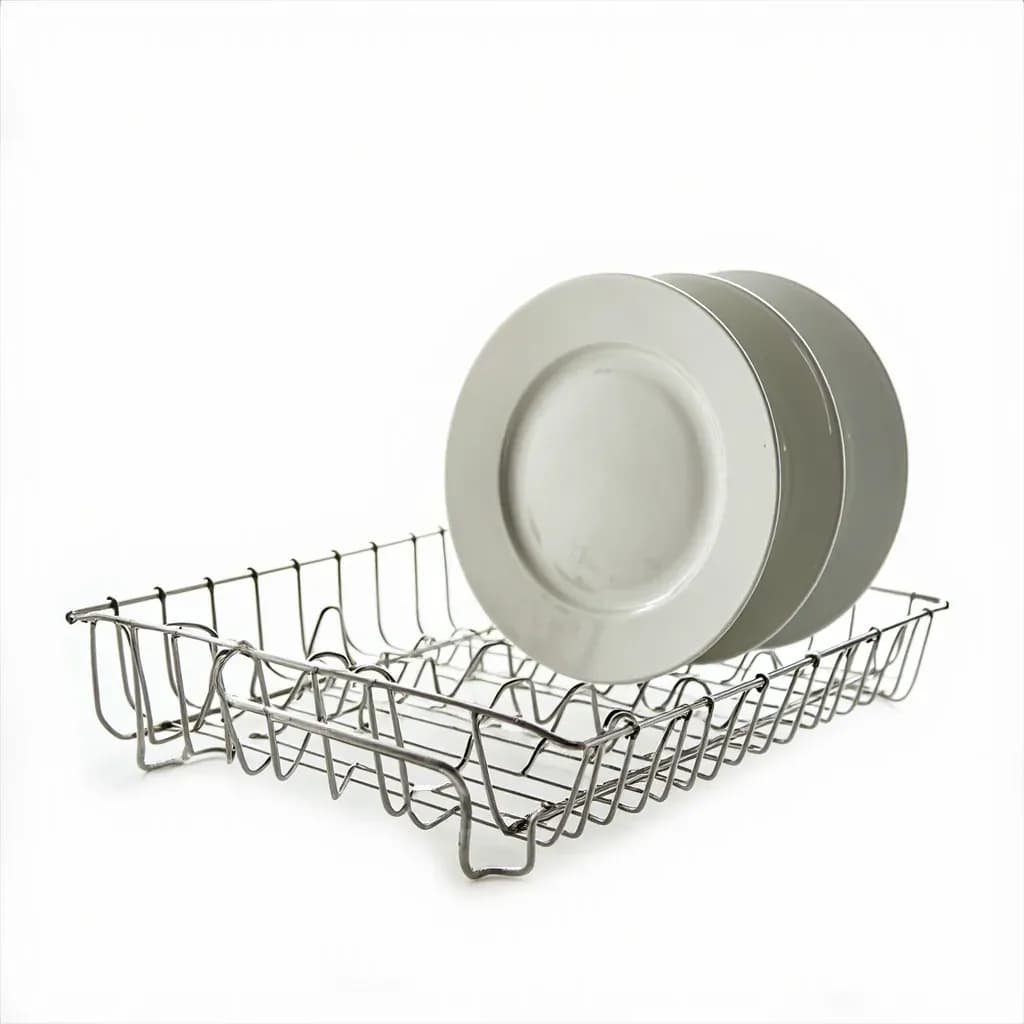
A slotted rack that holds washed dishes upright to air-dry and drain.
A dish drying rack is a frame with slots and tines that hold plates, bowls, glasses, and utensils on edge so water drains off and air circulates around them. It usually sits beside the sink, often over a drip tray or sloped board that channels water back into the basin. It lets dishes air-dry hygienically without a stack of damp towels.
A dish drying rack is a passive but essential piece of kitchen furniture: a slotted frame that holds freshly washed dishes upright so gravity can pull water off their surfaces and ambient air can finish the job. Unlike a towel, which smears moisture around and can redeposit lint, a good rack keeps each plate, glass, and pot separated, angled for drainage, and exposed on both sides — turning a damp stack into dry, ready-to-put-away items in a matter of hours. The rack itself does no work; it merely sets the geometry that lets water and air do theirs.
In practical terms, a rack is judged on three things: airflow, drainage, and footprint. Open wire or rod designs in stainless or chromed steel dry fastest because air circulates freely, but water droplets can drip and splash back onto lower dishes, which tends to leave more spots on glassware. Most counter-top racks solve the drip problem with a removable tray that should be emptied daily — standing water in the tray is the single biggest source of mildew, smell, and the gray slime that builds up around a sink. Material choice matters more than most cooks realize: stainless steel is the longest-lasting and most sanitary, chromed wire is cheaper but chips and rusts at the welds, plastic is light and inexpensive but scratches and yellows, and bamboo or beech looks handsome but must never sit in pooled water.
For most home kitchens, a roughly 16-inch-wide stainless counter-top model with a sloped drip tray, a dedicated mug or glass rail, and a small cutlery caddy covers nearly every day's needs. Tight kitchens do better with an over-the-sink or roll-up rack that lets water fall straight into the drain; bigger households benefit from two-tier designs. The right rack quietly disappears into the workflow, which is exactly the point.
Alternatives
Types & varieties
The standard free-standing model with a drip tray, plate slots, a cup or mug rail, and a cutlery holder.
Spans the sink basin so water drips directly into the drain; saves counter space in small kitchens.
Silicone-wrapped stainless rods that flex into a cylinder; lays flat for drawer storage or rolls out over the sink.
Stacked design that roughly doubles capacity for larger households; usually has a sloped drip tray.
Fixed above the sink or under a cabinet, common in European kitchens with built-in draining boards.
An absorbent diatomite or microfiber mat in a shallow drawer; dishes dry out of sight, ideal for tiny kitchens.
Collapsible wooden rack, light on counter space; needs occasional oiling and must never be left sitting in water.
Enclosed cabinet with a low-watt heater and fan that speeds drying; trades counter space and electricity for speed.
Detachable side basket, often built in or sold separately, for spoons, knives, and small tools.
Choosing the right rack for your kitchen
Start with the sink, not the rack. Measure the counter to one side of the sink — that flat stretch is where a rack will live, and it should sit close enough that you can pivot from washing to racking without dripping across the room. As a rule, leave at least two inches behind the rack so the drip tray can be slid out and lifted without scraping the wall or backsplash. If that stretch is shorter than about 14 inches, an over-the-sink or roll-up rack will serve you better than a counter-top model.
- For one or two people: a single-tier 14–16 in stainless rack with a sloped, removable drip tray is plenty.
- For a family of three or more: consider a two-tier rack or a wider 18–20 in model; vertical capacity matters more than slots per inch.
- For hard-water regions: open wire racks tend to leave more spots on glassware than enclosed plastic trays, since falling droplets can splash back up; a quick microfiber hand-polish after drying helps either way.
- For small or rental kitchens: a roll-up rack or in-drawer diatomite mat keeps the counter clear and the rack out of sight when guests arrive.
- For serious cooks: look for a rack with a separate, detachable cutlery caddy and a dedicated section for lids, since lids are what usually end up drying flat on the counter and breeding mildew.
Materials compared
Stainless steel is the gold standard: it doesn't rust if the grade is decent, it tolerates hot soapy water, and it can go in the dishwasher for a deep clean. Chrome-plated wire looks similar at a glance but chips at the welds and the underlying steel will eventually rust, especially in humid kitchens. Plastic is light, cheap, and quiet, but it scratches easily, and those scratches harbor bacteria and stains; it also yellows over time. Bamboo and beech look beautiful and feel warm, but they need food-grade mineral oil a few times a year and must be tipped upright to drain — never left sitting in a puddle or they will swell and split.
- Stainless: most durable, dishwasher-safe, slightly pricier.
- Chrome-plated wire: lightest, but prone to rust at joints.
- Plastic: cheapest and quietest, but scratches and yellows.
- Bamboo or beech: handsome and renewable, but high-maintenance and never dishwasher-safe.
Common uses
Tips & pitfalls
- Empty and dry the drip tray every day; standing water is the number-one source of mildew, smell, and gray slime around a dish rack.
- Give dishes space — slots should not be packed tight, since airflow is what does the drying, not the rack itself.
- Angle plates slightly toward the back of the rack so pooled water at the rim drains instead of running down the face and spotting the glaze.
- Hand-wash the rack itself weekly with hot soapy water and a small brush to clear gunk from the slots and welds.
- Never put bamboo or chromed wire racks in the dishwasher — both will swell, peel, or rust at the joints.
- In hard-water areas, hand-polish glasses with a microfiber cloth right after drying to prevent the white spots that no rack can prevent.
- Place the rack on the side of the sink closest to the dishwasher or stove to shorten the carry path during cooking and cleanup.
- Don't lean on a tightly packed rack as a time-saver — pre-rinsing dishes before they go in is what actually saves time, not cramming more in.
Good to know
- Also called
- Dish rack, plate rack, draining rack
- Primary function
- Holds washed dishes upright so gravity drains water and airflow finishes drying
- Common materials
- Stainless steel, chrome-plated steel, plastic, bamboo, beech wood, silicone-coated wire
- Typical counter-top size
- 14–20 in wide × 11–14 in deep × 5–7 in tall
- Capacity
- Roughly 8–15 plates, plus slots or rails for bowls, mugs, lids, and a caddy for cutlery
- Drip tray
- Most counter-top models include a removable tray; should be emptied daily to prevent mildew
- Notable makers
- OXO, Joseph Joseph, Simplehuman, Brabantia, Yamazaki, Spectrum, KitchenAid
- Cost range
- About $10–$30 for basic plastic; $25–$80 for stainless; $40–$150+ for premium or over-the-sink models
Also called
dish rack · drying rack · drainer rack
Related

Peeler
Swift blade for stripping skin off fruit and vegetables

Grater
Sharp-toothed surface for shredding cheese and vegetables

Microplane
Ultra-fine rasp for citrus zest, garlic, and hard cheese

Mixing Bowl
All-purpose bowl for combining, whisking, and tossing

Whisk
Looped wires that beat air into eggs, cream, and sauces

Spatula
Flat blade for flipping, lifting, and scraping

Slotted Spoon
Pierced spoon that lifts solids and drains the liquid behind

Wooden Spoon
Gentle, heat-friendly spoon for stirring anything