Prep Tools
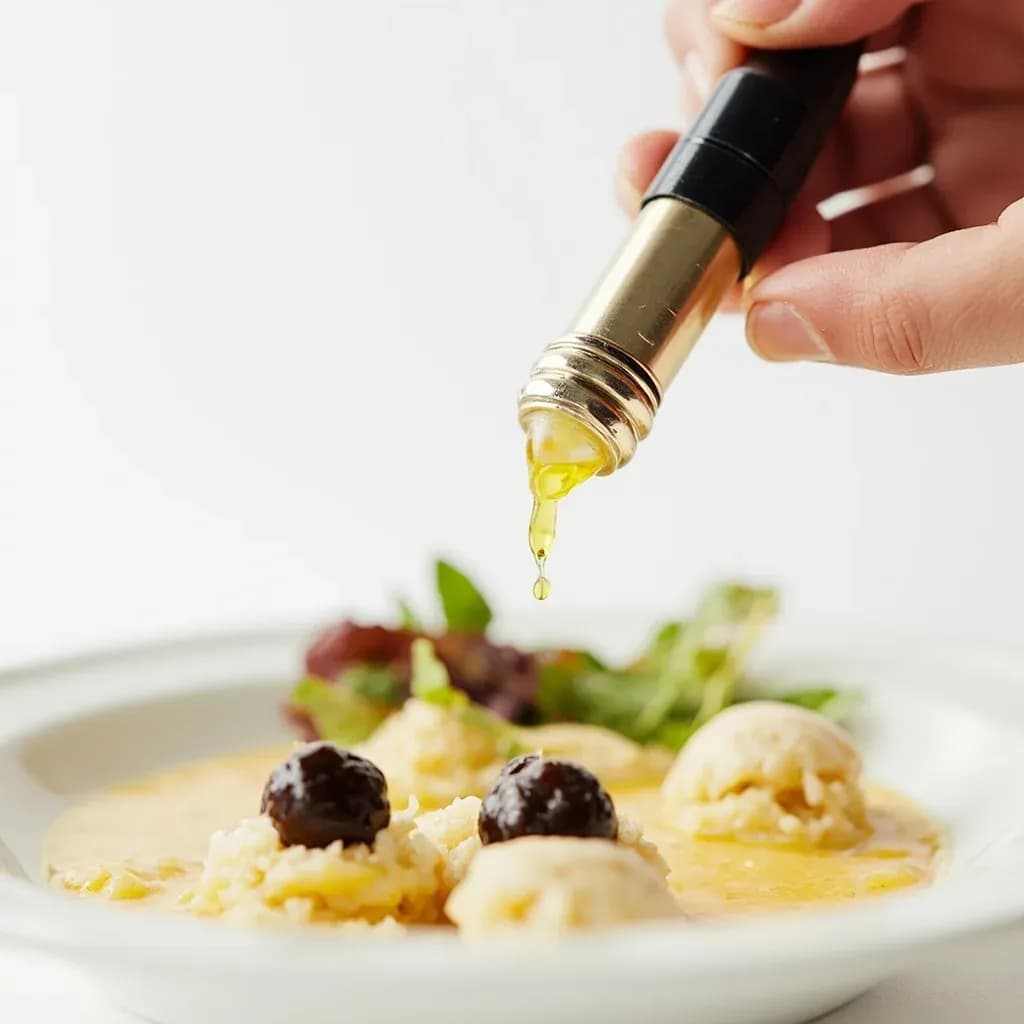
Dosing Pipette / Caviar Maker
A dropper or syringe that drips flavored liquid into a setting bath to form spherified 'caviar' pearls.
A dosing pipette or caviar maker is a precise dropper, syringe, or multi-nozzle tool used to release uniform drops of a sodium-alginate liquid into a calcium bath, where they set into gel pearls. Modernist and pastry cooks use it for spherification, making juice, vinegar, or liqueur 'caviar' that bursts in the mouth. Multi-hole droppers speed production by forming many pearls at once.
The dosing pipette — sometimes sold as a caviar syringe or caviar maker — is the simple, hand-operated instrument behind one of molecular gastronomy's most photographed tricks: turning flavored liquid into uniform spheres that burst on the tongue. Physically, it is a narrow, graduated barrel (typically 1 mL for caviar-size work) with a plunger or squeeze bulb at one end and a small tip at the other. The tip meters individual drops of a sodium-alginate liquid into a calcium-salt bath, where each drop skins over almost instantly into a gel membrane, then rounds up into a bead as it sinks.
What makes the tool matter is precision. Spherification chemistry depends on a tight ratio of alginate to calcium — measured in tenths of a percent — and on the size of the drop hitting the bath. A heavier squeeze flattens the pearl, splashes the bath, and drags tails of unset gel; a steady, gravity-fed release from a few centimeters above the surface produces clean, marble-round spheres. The pipette gives the cook that control by hand, without pumps or syringes.
Although it became famous through Ferran Adrià's lab at El Bulli in the early 2000s, the dosing pipette has no high-tech origin: it is an adaptation of lab pipettes and oral syringes, and home cooks now use inexpensive plastic versions for everything from olive-oil pearls to mango caviar. Once the bath concentrations are dialed in, the tool itself is forgiving — what it demands is steady hands, rested (de-gassed) liquid, and a clean tip.
Alternatives
Types & varieties
The workhorse for 3–4 mm caviar pearls; graduated barrel, drop-by-drop release
Used for larger spheres, ravioli-style drops, or higher-volume prep
Cheaper lab-style option; less precise volume control but functional for casual use
Plunger syringe with a narrow tip; favored by some chefs for steadier, more controlled drops
The originals sold with the Texturas line, in 1 mL and 5 mL sizes
Bundled with alginate, calcium salts, and recipes for the home cook
Heavy-duty versions built for restaurant service; metal tips resist wear
Basic vs. Reverse Spherification
The pipette is the same in both techniques; what changes is which side of the chemistry sits in the bath and which sits in the drop. In basic spherification, the flavored liquid is dosed — alginate in, calcium out — so each pearl gels all the way through and must be eaten within minutes. In reverse spherification, the pipette delivers a calcium-fortified liquid into an alginate bath, so a thin membrane forms around a liquid core that holds at room temperature for hours. Reserve reverse spherification for dairy, alcohol, and any liquid that already contains calcium; basic spherification will gel those liquids the moment alginate touches them.
- Basic: flavored liquid + alginate → calcium bath → eat immediately
- Reverse: flavored liquid + calcium → alginate bath → holds for hours
- Use basic for acidic fruit juices and wines with low calcium
- Use reverse for milk, cream, yogurt, and cocktails
Dialing In Pearl Size
Pearl diameter is a function of drop volume, drop height, and bath depth. A 1 mL pipette held 5–10 cm above a 5 cm-deep bath produces roughly 3–4 mm pearls; stepping up to a 5 mL pipette and a deeper bath produces larger marbles up to roughly 1 cm. The bath must be deep enough that the drop has time to round before hitting the bottom — a shallow dish produces pancakes. Conversely, too much height flattens impact and creates tails.
- 1 mL pipette + 5–10 cm drop height + 5 cm bath = classic caviar (3–4 mm)
- 5 mL pipette + ~10 cm drop height + ~8 cm bath = larger pearls (roughly 1 cm)
- Fill the bath in a wide, deep container so drops do not stack
- Stir or skim the surface between batches to keep drops from clumping
Care and Storage
Alginate residue dries into a hard film that seals the tip, so the single most important habit is flushing the pipette with clean water the moment dosing is finished. Disassemble the plunger and barrel; the O-ring seal tolerates hand-washing but can warp in a hot dishwasher. Store tips dry, and replace the seal if drops begin leaking past the plunger.
- Flush with plain water immediately after every use
- Disassemble for hand-washing; avoid high-heat cycles
- Keep spare O-rings and tips on hand — they are the parts that wear
- Store with the plunger removed so the seal does not take a permanent set
Common uses
Tips & pitfalls
- Hold the pipette 5–10 cm above the bath and let drops fall by gravity; squeezing splashes the bath and produces tails.
- Aim for 0.5–1% sodium alginate in the flavored liquid and 0.5–1% calcium chloride or lactate in the bath — outside this range pearls will not set or will set rubbery.
- Never add sodium alginate to a liquid that already contains calcium (milk, cream, dairy purées): it gels on contact and clogs the tip. Use reverse spherification instead.
- Rinse finished pearls briefly in clean water to strip residual calcium, which tastes bitter and metallic.
- Stir or skim the calcium bath between batches so the surface stays clear; a cloudy, gel-flecked bath yields uneven pearls.
- Let the flavored liquid rest 1–2 hours, or vacuum-degas it, before dosing — trapped air bubbles distort the spheres.
- Keep the calcium bath at least 4–5 cm deep so drops can round up before touching the bottom.
- Use room-temperature liquids; cold drops deform more easily and gel unevenly.
- If pearls flatten or trail tails, the alginate concentration is too low. If pearls are small, dense, and rubbery, the calcium bath is too strong.
Good to know
- Also called
- Dosing syringe, caviar syringe, dropper pipette
- Origin
- Popularized at El Bulli (Roses, Spain) under Ferran Adrià in the early-to-mid 2000s; spherification chemistry developed with food scientist Hervé This
- Standard capacity
- 1 mL for caviar-sized pearls; 2, 5, and 10 mL sizes exist for larger spheres or higher-volume work
- Yield
- A 1 mL pipette delivers roughly 30–40 caviar-size pearls (3–4 mm) per fill
- Working concentrations
- Flavored liquid at 0.5–1% sodium alginate; bath at 0.5–1% calcium chloride or calcium lactate
- Drop height
- Hold 5–10 cm (2–4 in) above the bath; gravity-fed drops round up better than squeezed ones
- Material
- Food-grade polypropylene or borosilicate glass, often with interchangeable tips
- Cost
- Basic plastic pipettes from a few dollars; restaurant-branded kits (Molecule-R, Texturas, Gastroback) run $15–$60
Also called
Syringe & Eyedropper · Caviar Maker · Spherification Dropper
Related

Peeler
Swift blade for stripping skin off fruit and vegetables

Grater
Sharp-toothed surface for shredding cheese and vegetables

Microplane
Ultra-fine rasp for citrus zest, garlic, and hard cheese

Mixing Bowl
All-purpose bowl for combining, whisking, and tossing

Whisk
Looped wires that beat air into eggs, cream, and sauces

Spatula
Flat blade for flipping, lifting, and scraping

Slotted Spoon
Pierced spoon that lifts solids and drains the liquid behind

Wooden Spoon
Gentle, heat-friendly spoon for stirring anything