Prep Tools
Double Honey Sieve
A two-tier strainer that filters wax and debris from freshly extracted honey.
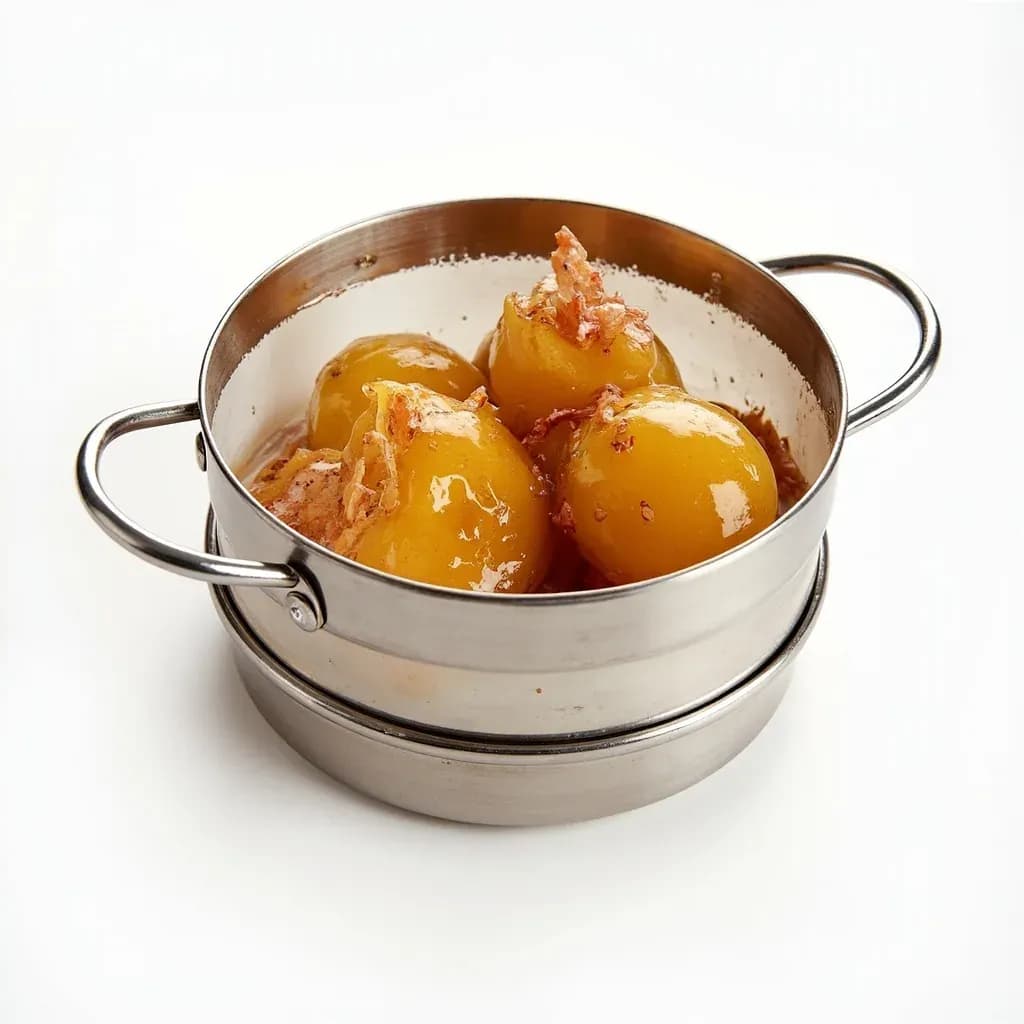
A double honey sieve is a stainless strainer with two stacked mesh layers, coarse over fine, that sits on a bucket to filter raw honey. As extracted honey pours through, the top screen catches wax cappings and bee parts while the lower fine mesh removes smaller particles. It is a beekeeping and home-honey tool that yields clear, clean honey ready for jarring.
The double honey sieve is a two-tier gravity strainer built specifically for cleaning freshly extracted honey. Physically it is two stacked meshes — a coarse upper screen, typically 8 to 10 meshes per inch, that catches wax cappings, comb fragments, and the occasional bee part, sitting above a finer lower screen of 18 to 30 meshes per inch that polishes out smaller bits of propolis, dust, and lint. Most are food-grade stainless steel in 8-, 10-, or 12-inch diameters, sized to span a 5-gallon food-grade pail or a bottling bucket fitted with a honey gate.
What makes the configuration worth its own tool, rather than just two colanders stacked, is the order: the coarse mesh takes the bulk of the debris so the fine mesh does not blind over in the first minute. Because filtration is entirely passive — honey falls through under its own weight, with no pump or press — the result is a noticeably clearer jar than a single layer of cheesecloth produces, while natural pollen and other flavor-bearing solids remain suspended in the liquid. For the hobbyist or small-batch beekeeper working in a domestic kitchen, that balance is the point: clean-looking honey, intact pollen profile, no heat or filter aid introduced.
A double sieve is not, however, a substitute for commercial filtration. It will not deliver the brilliant, long-shelf-life clarity of diatomaceous-earth or pressure filtration, and honey destined for retail shelves and long ambient storage usually still wants a final pass through a finer system or a settling tank. For the home producer, the farmers'-market jar, or the beekeeper rendering comb honey at the kitchen counter, the double honey sieve is the right first step — often the only step — and the one piece of equipment that turns a frame of sticky comb into something you would actually hand to a neighbor.
Alternatives
Types & varieties
The standard form: ~8–10 mesh over ~30 mesh, both stainless, sized 8–12 in.
Italian-style cone shape; fits a wide-mouth bottling bucket, often with an integrated stand or rim hooks.
Nylon cloth stretched between two hoops; gentler on honey but less durable and harder to sanitize than stainless.
Some makers sell three stacked meshes (coarse, medium, fine) for progressively clearer honey.
A double-mesh sieve with extended arms that hook over a 5-gallon (19 L) honey pail rim.
Mesh sizing, decoded
Beekeeping mesh is counted in openings per inch, and — counter to what most cooks expect — a higher number means smaller holes. The double honey sieve typically pairs an 8 to 10 mesh upper screen (openings roughly 2.5 to 3 mm across) with an 18 to 30 mesh lower screen (openings roughly 0.8 to 1.4 mm across). That ratio is what matters: the upper mesh is loose enough to let honey fall through quickly while stopping comb and bee parts, and the lower mesh is tight enough to catch the fine debris that would otherwise settle as sediment in the jar. When a product listing or recipe gives only one number, ask which mesh it refers to — and remember that a '30 mesh' sieve is finer than a '10 mesh' sieve, not coarser.
Cleaning and storage
The single most common complaint about any honey sieve is cleanup. Honey's sugars glue themselves to mesh fibers as soon as the temperature drops, and crystallized honey lodged in a 30-mesh screen is genuinely tedious to remove. The fix is preemptive: rinse the sieve under the hottest tap water you can run the moment you finish filtering, and let it soak briefly in water above ~40 °C / 104 °F if needed. Use only a mild dish soap if you must, and rinse until the water sheets off cleanly — even a faint residue will flavor the next batch of honey. Dry the sieve completely before putting it away, because trapped moisture will ferment any honey film left behind and can, over a long season of neglect, corrode or pit even stainless steel. Stored clean and dry, a stainless double sieve is essentially a lifetime tool.
Common uses
Tips & pitfalls
- Always stack coarse over fine — the coarse mesh catches the bulk so the fine mesh does not clog immediately.
- Warm honey (to around 32–38 °C / 90–100 °F) flows much faster through the sieve; cold honey stalls.
- Never press or stir honey through the mesh with a spoon — that forces wax particles and air into the filtrate and clouds the result.
- Work in two passes for retail-clarity: first pass through a coarse/fine double sieve, then a second pass through a finer single sieve or cheesecloth.
- Rinse the sieve in hot water (above ~40 °C / 104 °F) as soon as you finish; crystallized honey in the mesh is a chore to remove.
- Dry the sieve thoroughly before storing — trapped moisture can ferment residual honey and corrode even stainless steel.
- For honeycomb or chunk honey, sieve the liquid portion only and add comb pieces by hand after bottling.
Good to know
- Type
- Two-tier gravity strainer for liquid honey
- Typical Material
- Food-grade stainless steel (some models use nylon mesh)
- Configuration
- Stacked sieves; coarse mesh on top, fine mesh on bottom
- Common Mesh Sizes
- Upper sieve ~8–10 mesh per inch; lower sieve ~18–30 mesh per inch
- Typical Diameters
- 8, 10, or 12 inches to fit standard honey buckets and gates
- Filtration Method
- Gravity / passive (no pressure)
- Placement
- Sits across a food-grade pail or settling tank with a honey gate
- Primary Function
- Removes wax cappings, bee fragments, propolis, and other debris from raw extracted honey
Also called
honey strainer · double honey strainer
Related

Peeler
Swift blade for stripping skin off fruit and vegetables

Grater
Sharp-toothed surface for shredding cheese and vegetables

Microplane
Ultra-fine rasp for citrus zest, garlic, and hard cheese

Mixing Bowl
All-purpose bowl for combining, whisking, and tossing

Whisk
Looped wires that beat air into eggs, cream, and sauces

Spatula
Flat blade for flipping, lifting, and scraping

Slotted Spoon
Pierced spoon that lifts solids and drains the liquid behind

Wooden Spoon
Gentle, heat-friendly spoon for stirring anything