Baking & Pastry
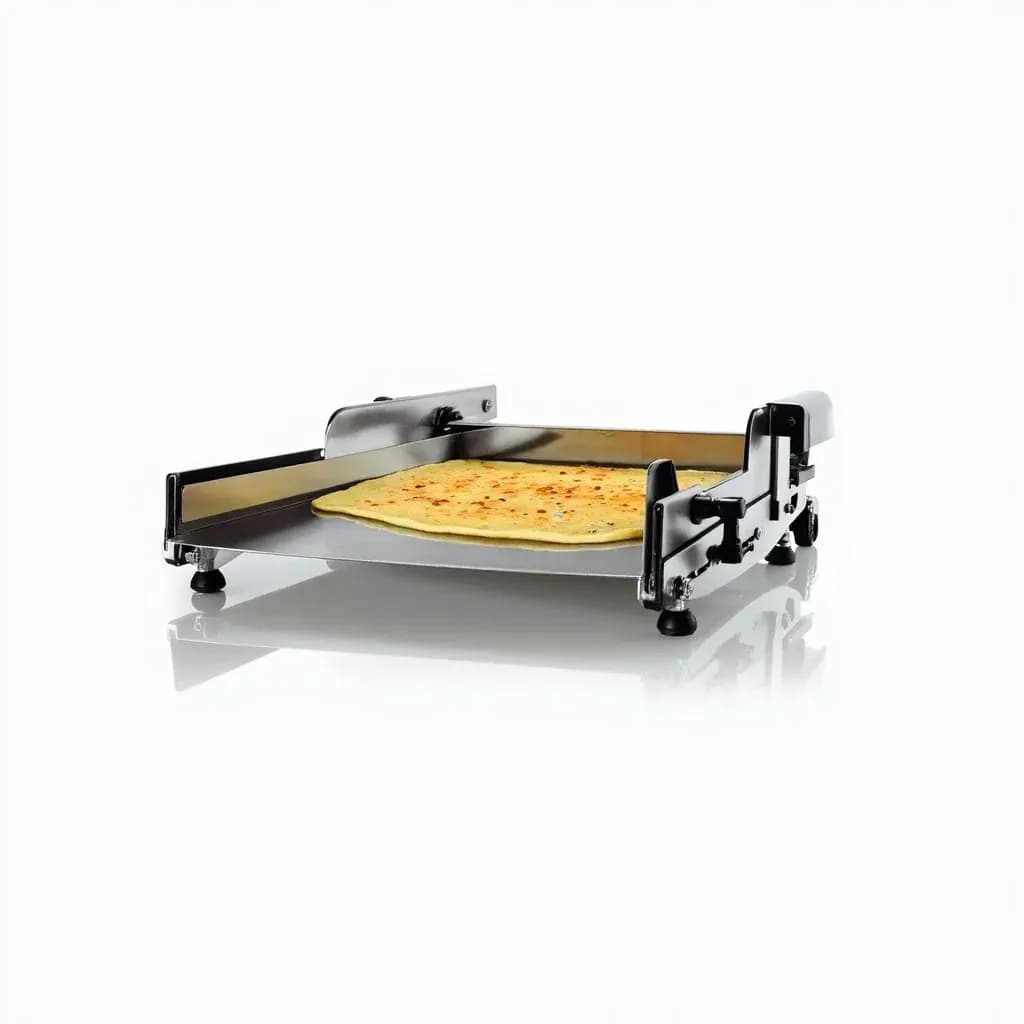
Dough Sheeter
A roller machine that flattens dough into thin, even sheets for pastry, pasta, and laminated doughs.
A dough sheeter passes dough between adjustable rollers to flatten it into uniformly thin sheets far faster and more evenly than a rolling pin. Bakeries use it for croissant and puff-pastry lamination, pie dough, and pasta, tightening the roller gap with each pass. Even thickness is critical for laminated dough so the butter layers and rise stay consistent across the whole batch.
A dough sheeter is a pair of parallel, adjustable rollers that flatten a slab of dough to a precise, repeatable thickness as it passes through the gap. The mechanism is the same whether the rollers are turned by a hand crank on a 6-inch pasta machine or by a motor on a 26-inch commercial unit, and it descends from the mechanized bakery equipment that replaced the rolling pin in commercial pastry kitchens in the early twentieth century. The gap between the rollers sets the thickness; the dough that emerges is typically a little thicker than the gap itself, because the dough springs back and because pressure across the sheet is even rather than concentrated where the pin bears down.
The machine matters because most pastry and pasta problems are really problems of uneven thickness: butter that smears instead of layering, pasta that rolls thick in the middle and thin at the edges, croissants that puff in some spots and stay flat in others. A sheeter solves all of these at once, and it does it faster than hand rolling once the dough is large enough to feed. It also gives a gentler, more uniform compression than a rolling pin, which is the single biggest reason laminated doughs and yeasted pasta behave better on a machine.
In use, a sheeter is not a smarter rolling pin; it is a different tool. It cannot create layers in croissants or puff pastry, only reduce the dough's thickness; the layers come from the folds made between passes. It cannot rescue under-rested or overworked dough, and it will punish rough handling by tearing, sticking, or locking up the gluten. Used well, with cold dough, light flour, and a stepped-down gap, it turns 5 kg of laminated dough into a long, even sheet of croissants in a few minutes and turns a fist of egg pasta into a translucent sheet that reads the grain of the bench beneath.
Alternatives
Types & varieties
Side-handle operation; common in small bakeries, R&D kitchens, and home use, and the format most Italian pasta machines take.
Compact motorized unit with two rollers and fold-up side tables; the workhorse of cafés, restaurants, and small-to-mid bakeries.
Larger motorized unit on legs with extended infeed/outfeed and return conveyor tables; built for high-volume croissants, puff pastry, and pizza.
Rolls in both directions without lifting or flipping the dough; significantly faster on long sheets and gentler on laminated dough.
Narrow (typically 6-in) hand-crank format with a stepped thickness dial and optional cutting attachments; doubles as a pastry sheeter for the home kitchen.
Free-standing unit or attachment that folds dough between roller passes for croissant and Danish; pairs with a sheeter rather than replacing it.
Press-style or hot-dog-roller design purpose-built to press pizza dough balls into rounds; many pizzerias use a sheeter instead.
Sheeter vs. rolling pin
A rolling pin flattens dough by localized downward force, which compresses the dough unevenly and pushes it outward from the point of contact. A sheeter flattens by passing the dough through a fixed gap, so the pressure is the same across the full width of the sheet. That uniformity is what gives a sheeter sheet its even thickness from edge to edge, and it is also why a sheeter is gentler on gluten: the dough is compressed in one clean pass rather than being pushed and stretched repeatedly. The trade-off is that a sheeter can only reduce thickness to the size of its smallest gap, and it cannot shape a sheet that is wider than its rollers. For rounds, tarts, and free-form galettes, a pin still does work a machine cannot.
- Sheeter gives uniform thickness; pin gives uneven thickness that varies with hand pressure.
- Sheeter compresses in one pass and stresses the gluten less, so yeasted and laminated doughs hold up better.
- Pin can shape any size and form (rounds, ovals, irregular); sheeter is limited to its roller width.
- Sheeter wins on speed once dough is large enough to feed; pin wins on small batches and shaped work.
Sheeting laminated dough
For croissants, Danish, and puff pastry, the sheeter has a strictly limited job: it reduces the dough to the right thickness. The layers, the flaky honeycomb, the visible spiral in a baked croissant — none of that comes from the rollers. It comes from the folds made between passes. The classic sequence is to encase a cold butter block in the dough, then reduce thickness by repeated single turns (fold in thirds, like a letter) or book turns (fold in quarters), resting 30–45 minutes in the refrigerator between each turn so the gluten relaxes and the butter re-firms. Warm dough, a gap that closes too fast, or a bench that is heavily floured will smear the butter into the flour, glue the layers together, and bake out as a flat, bready slab rather than a flaky one.
- The sheeter reduces thickness; the folds create the layers. Do not expect rollers alone to laminate.
- Keep dough and butter around 8–10°C (46–50°F); warm dough sticks, tears, and smears the butter.
- Rest 30–45 minutes in the fridge between every turn so gluten relaxes and butter re-chills.
- Dust very lightly, and brush off excess flour before each pass — over-flouring toughens pastry and streaks croissants white.
Common uses
Tips & pitfalls
- Pass the dough through the widest setting first to smooth, seat, and elongate it, then close the rollers in small steps. Jumping from wide to thin in a single pass tears the dough and locks up the gluten.
- Keep laminated and butter-rich doughs well chilled (around 8–10°C / 46–50°F) between passes. Warm dough sticks, tears, and the butter smears into the flour instead of staying in distinct layers.
- Dust very lightly with flour, or rely on a dry bench, and brush off excess before the next pass. Over-flouring toughens pastry and leaves white streaking in baked croissants.
- Feed dough into the rollers square and flat, never angled or curled. Folded edges catch on the roller nip, jam the machine, and produce uneven sheets.
- Keep fingers, dough scrapers, and brushes clear of the roller nip. A sheeter can crush a finger almost instantly; use the safety guard and a wooden pusher for the last inch.
- Clean rollers with a dry brush or plastic scraper only. Never use a metal blade or abrasive, and never direct water at bearings, chains, or the motor housing.
- For croissants, remember the sheeter only reduces thickness; the layers come from the folds (single, book, or wallet turns). Rest the dough in the fridge between turns to relax the gluten and re-chill the butter.
- If the dough shrinks back hard after a pass, it is under-rested or overworked. Let it relax 10–15 minutes under plastic before the next pass rather than forcing it thinner, which will tear the sheet and toughen the crumb.
Good to know
- Also called
- Dough roller, pastry sheeter, mechanical rolling pin, bench sheeter
- Roller widths
- 6 in (150 mm) on home pasta machines; 10–26 in (250–660 mm) on commercial units; 9- and 12-in home models also sold
- Thickness range
- Roughly 1–30 mm depending on model; precision units reach about 0.5 mm
- Roller material
- Hard-chrome-plated steel or stainless steel
- Drive type
- Manual hand-crank, or electric (110V/220V, 0.5–1.5 HP on countertop models)
- Throughput
- Roughly 20–50 kg of dough per hour on an electric countertop unit
- Weight
- Countertop 30–80 lb (14–36 kg); floor-standing 150–400 lb (70–180 kg)
- Price range
- Manual home $50–$250; electric countertop $1,000–$4,500; floor-standing $4,000–$15,000+
- Origin
- Mechanized bakery sheeters (e.g., Atlas Biscuit Sheeter Co., 1904); home hand-crank pasta machines popularized in Italy in the 1930s by Imperia (1932) and Marcato (1930)
Also called
Pastry Sheeter · Pasta Sheeter
Related

Muffin Pan
Multi-cup pan for muffins, cupcakes, and egg bites

Bundt Pan
Fluted ring mold for showstopping cakes with a center hole

Springform Pan
Latch-release pan that frees delicate cakes without flipping

Pie Dish
Sloped round dish for crisp-bottomed pies and quiches

Tart Pan
Fluted pan with a pop-out base for clean-edged tarts

Rolling Pin
Rolls dough into even sheets for pastry and bread

Pastry Brush
Brushes on egg wash, glaze, butter, and marinades

Bench Scraper
Flat blade that divides dough and clears your work surface