Prep Tools
Pasta Rolling Machine
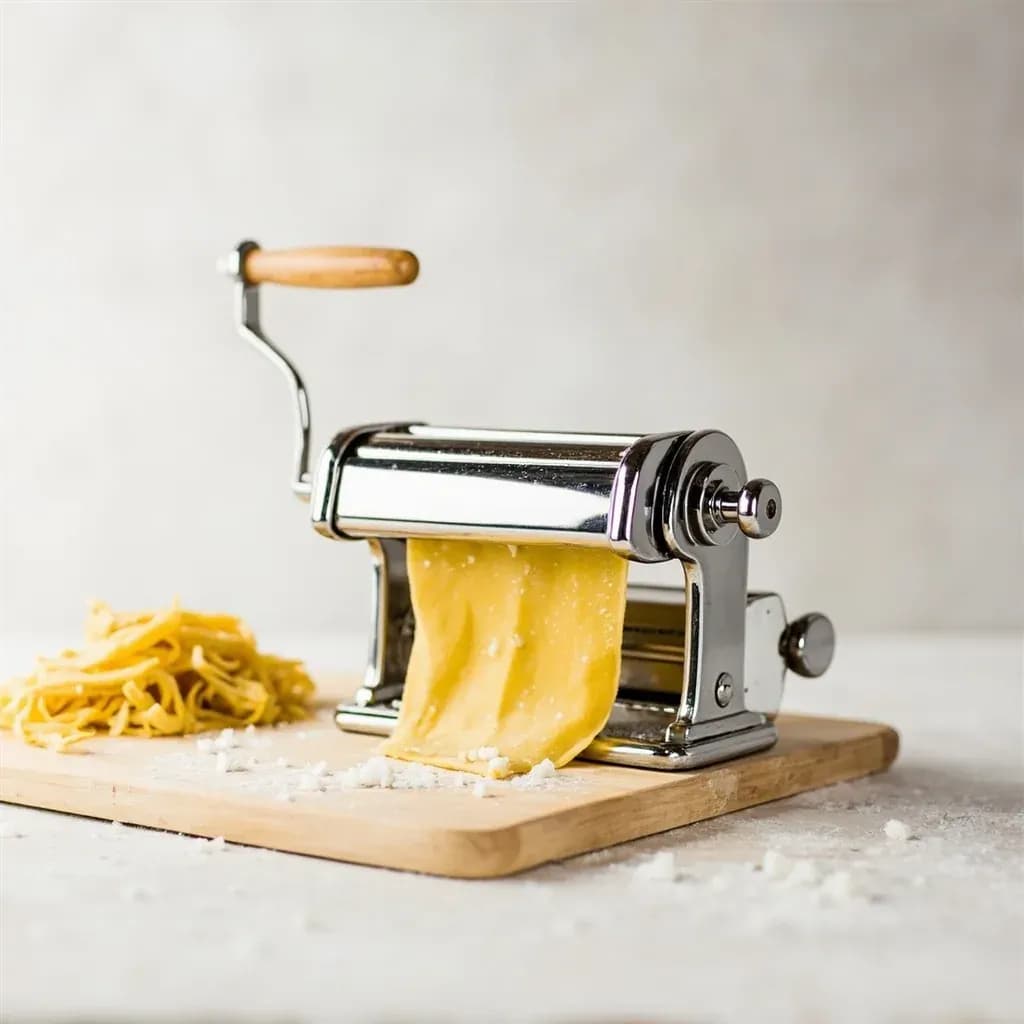
A hand-cranked roller that flattens pasta dough into even sheets and cuts noodles.
A pasta rolling machine is a clamp-on, hand-cranked device with adjustable rollers that progressively flatten pasta dough into thin, even sheets. Attachments cut the sheets into noodles like tagliatelle or spaghetti. Brands like Imperia and Marcato are workhorses for fresh egg pasta at home and in restaurants.
A pasta rolling machine is the small benchtop tool that turned home pasta-making from a rolling-pin marathon into a routine you can finish before the water boils. In its classic form it pairs smooth chrome-steel rollers geared to a hand crank with one or two cutting rollers slotting into the same frame: one pass thins a rested slab of dough to a precise sheet, another shaves that sheet into ribbons of consistent width. The design has been an Italian kitchen fixture since the early twentieth century, with Marcato (founded 1930 in Campodarsego, Veneto) and Imperia setting the template nearly every other maker still copies.
What the machine really contributes is uniformity, not speed. When every square centimeter of sheet is the same thickness, a tagliatelle cooks in the same time as its neighbor, a raviolo has the same bite as the one beside it, and a lasagna noodle lays flat instead of buckling in the pan. Numbered dials — 0 through 9 on a Marcato, 0 through 7 on an Imperia — step the rollers closer by fractions of a millimeter, letting the dough thin gradually as the gluten relaxes rather than tearing under force. A well-rolled sheet feels almost silk-like: no rips, no thick spots, and no drag on the crank.
The machine also doubles as a dough developer. Folding a sheet in thirds and passing it back through the thickest setting a few times — laminating — aligns the gluten strands and evens out hydration, the same principle a baker uses to layer butter in croissants. It is a quiet step most beginners skip, and the difference between a sheet that drapes and one that tears almost always comes down to whether the dough was laminated before it was thinned.
Alternatives
Types & varieties
The benchmark home machine: 150 mm chrome-steel rollers, settings 0–9, integrated tagliatelle and fettuccine cutters, clamp base.
Same rollers as the Atlas 150 but with a non-stick coating on the cutting rollers, useful for egg-rich doughs that would otherwise cling to bare chrome.
Wider 180 mm rollers for larger sheets — lasagna, cannelloni, oversized ravioli — without splicing two narrower sheets together.
Italian competitor with a different geared handle and 0–7 settings; widely sold alongside Marcato and interchangeable in role, if not in parts.
Budget machines in the same form factor; adequate for casual use, generally with less durable gearing than the Atlas line.
Three-piece set (roller plus tagliatelle and spaghetti cutters) that mounts to the stand-mixer power hub; not a separate hand-cranked machine.
Aftermarket motors such as the Marcato Pastamotor clamp onto the hand crank and turn a manual machine into an electric one.
Press dough through bronze or Teflon dies to make shapes like penne, rigatoni, and macaroni — a different category from sheet-rolling machines, though often sold by the same brands.
Laminating: the step that decides the sheet
Every pasta rolling machine can thin dough, but only the cook who laminates first gets a sheet that drapes, cuts cleanly, and holds its shape in boiling water. Lamination is the simple, repeatable move of folding the dough, running it back through the thickest setting, and repeating — the same principle a baker uses to build the layers in croissants, applied here to align gluten and even out hydration. It is also what transforms a slightly dry lump into a supple, cooperative sheet.
- Start with a slab about the width of the rollers and roughly finger-thick.
- Pass it through setting 0 (rollers touching) once to flatten it into a rough rectangle.
- Fold the sheet in thirds like a business letter, keeping the open ends aligned so the shape stays rectangular.
- Pass the folded dough back through setting 0, keeping the same orientation so the sheet does not drift.
- Repeat the fold-and-pass three to four times total — the dough will visibly smooth out, become more elastic, and lose tackiness.
- Only then begin stepping the dial down, one notch at a time, never skipping a setting.
Common uses
Tips & pitfalls
- Rest the dough 30 to 60 minutes wrapped in plastic at room temperature before rolling — cold or under-relaxed dough snaps and cracks in the rollers.
- Anchor the machine firmly with the bench clamp; a loose machine will skate toward you as you crank and can score the countertop.
- Pass the dough through setting 0, fold it in thirds like a letter, and run it through two or three times at the thickest setting first to laminate and smooth it.
- Work down one setting at a time, dusting the sheet very lightly with flour or fine semolina only if it sticks — never use flour to compensate for poorly hydrated dough.
- Let the rollers pull the dough through; do not force it or crank fast, which stretches the gluten unevenly and tears the sheet.
- Crank with your dominant hand and guide the sheet with your other hand so it exits straight, not curling sideways into a spiral.
- Hang finished sheets over a pasta drying rack or lay them on lightly floured tea towels for 10 to 15 minutes before cutting or filling so the gluten relaxes and the sheets hold their shape.
- Clean with a dry pastry brush and a wooden toothpick for the cutter teeth, and a barely damp cloth for the rollers — water inside the gear housing rusts the internals.
- Occasionally wipe the chrome rollers with a cloth barely moistened with food-grade mineral oil; do not use cooking oil, which can go rancid and flavor the dough.
- Do not roll chocolate, nut, or oily doughs through the standard rollers; they leave residue that transfers to plain pasta. Designate or thoroughly clean the machine between very different doughs.
Good to know
- Origin
- Italy; hand-cranked domestic machines became widespread in the early-to-mid 20th century. Marcato, founded in 1930 in Campodarsego, Veneto, is the most iconic manufacturer.
- Roller Material
- Chrome-plated steel rollers in housings of painted steel, anodized aluminum, or ABS plastic.
- Standard Width
- 150 mm (about 6 in) on the common Atlas-class machines; 180 mm (about 7 in) on the wider Atlas 180.
- Roller Settings
- Numbered 0 to 9 on Marcato or 0 to 7 on Imperia. Setting 0 is the thickest (rollers touching); higher numbers thin the sheet progressively, down to roughly 0.5–0.6 mm at the top end.
- Built-in Cutters
- Most machines integrate two cutting rollers: tagliatelle (about 6 mm) and fettuccine (about 2 mm). Additional dies (spaghetti, capellini, lasagnette, pappardelle, ravioli) are sold as attachments.
- Mounting
- Most units use a bench clamp that grips countertops up to about 6 cm (≈2.4 in) thick.
- Capacity
- Best suited to sheets up to about 150 mm wide and dough pieces roughly the size of a small fist per pass; commercial tabletop extruders handle far more.
- Power Source
- Hand-cranked by default; aftermarket motors such as the Marcato Pastamotor, or stand-mixer-driven attachments, are available for those who want electric drive.
- Cleaning
- Wipe with a dry cloth or brush; never submerge, and avoid water reaching the gearing unless the manufacturer explicitly allows it.
Also called
pasta machine · Imperia · Marcato · pasta roller
Related

Peeler
Swift blade for stripping skin off fruit and vegetables

Grater
Sharp-toothed surface for shredding cheese and vegetables

Microplane
Ultra-fine rasp for citrus zest, garlic, and hard cheese

Mixing Bowl
All-purpose bowl for combining, whisking, and tossing

Whisk
Looped wires that beat air into eggs, cream, and sauces

Spatula
Flat blade for flipping, lifting, and scraping

Slotted Spoon
Pierced spoon that lifts solids and drains the liquid behind

Wooden Spoon
Gentle, heat-friendly spoon for stirring anything