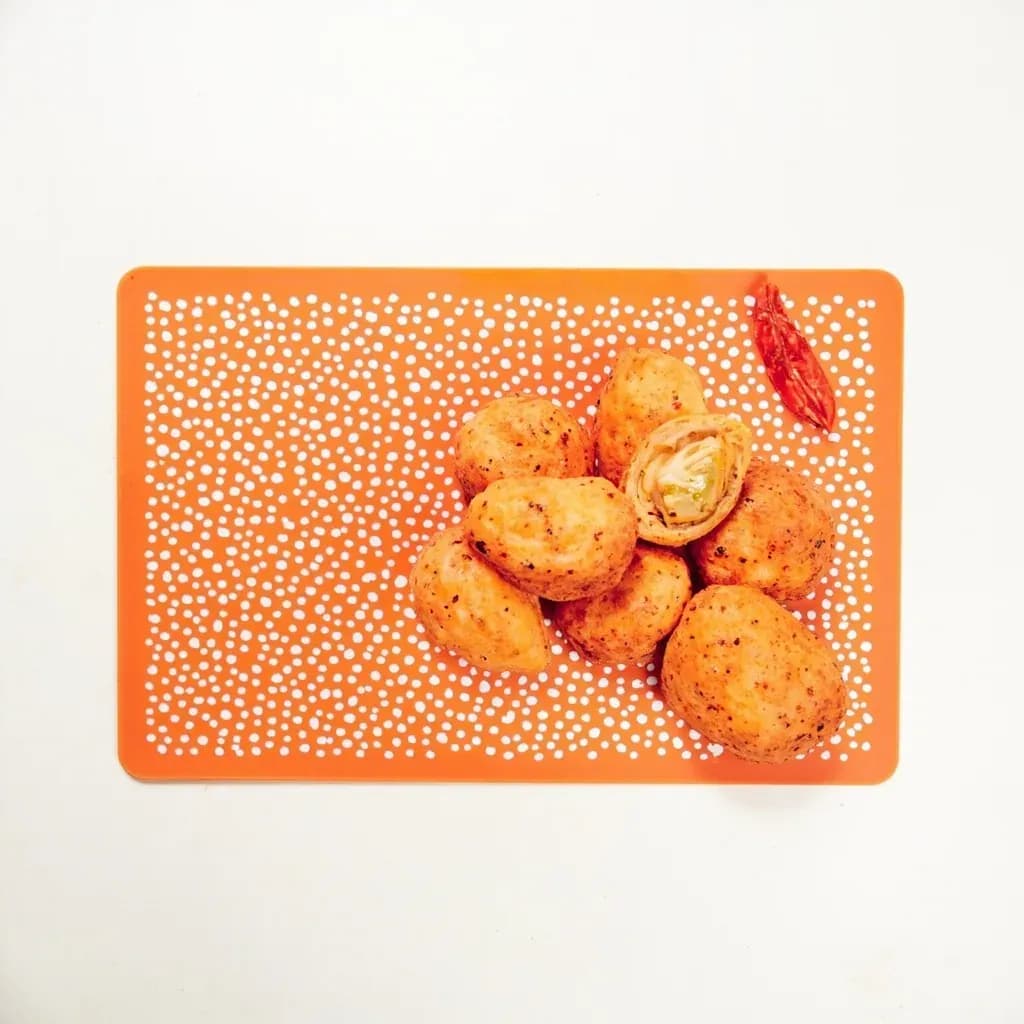
Prep Tools
Draining Mat
A perforated or ribbed mat that lets liquid drain away from washed produce, cheese, or fried foods.
A draining mat is a perforated, ribbed, or mesh sheet that raises food slightly so liquid can run off and collect below. It is used to drain washed vegetables, set draining cheese curd or tofu, and rest fried foods so they shed excess oil. Many sit over a tray or in a sink to catch the runoff.
A draining mat is a flat sheet of food-grade silicone molded with a pattern of raised ridges and shallow valleys. Food sits on the ridges while liquid runs off into the channels below and air circulates beneath — the same principle older cooks achieved by draping a clean kitchen towel over a wire cooling rack. The silicone version does that job more reliably: it does not absorb moisture, will not transfer lint or odors to food, tolerates heat, and rinses or dishwashes clean in seconds.
The mat matters because most foods that come out of water or fat are worse for sitting in either. A drop of water trapped under a berry dilutes its flavor and softens its skin. A batch of fries left on a flat plate loses crispness to its own steam. The ridges give water and oil somewhere to go, and the air gap keeps the underside of the food from stewing, which makes the mat useful well beyond produce — it doubles as a landing pad for fried foods, a draining surface for fresh cheese, a defrosting rack, and a heat-safe trivet.
The mat is often confused with two look-alikes. A microfiber dish-drying mat is made to soak up water from plates and glassware, the opposite of what you want for food. A flat silicone baking mat has no ridges and is meant to keep food from sticking. The ridges are the entire point of a draining mat.
Alternatives
Types & varieties
The classic form: a flat silicone sheet with molded ridges and valleys so liquid runs off and air circulates under the food
Slatted silicone that unrolls across a sink to drain washed produce or rinsed dishes directly over the drain
Sized to fit a standard half-sheet baking pan (18 × 13 in), doubling as a roasting or baking mat and a draining surface
Includes cut-out handles or a hanging hole for easier lifting from a pan and simpler storage
Thicker, more rigid mat used in professional kitchens that holds its shape under heavy roasts and sheet pans
Why a Ridged Mat Beats a Flat One
A flat silicone surface or a sheet of parchment keeps food from sticking, but it traps liquid underneath. A ridged mat creates channels for runoff and an air gap under the food, so the surface touching the food stays drier. It does the work of a wire rack without the wobble, the wire marks on soft cheese, or the need to launder a kitchen towel underneath.
What to Look For
- Food-grade, BPA-free silicone so nothing leaches into produce or cheese.
- Heat resistance to at least 425°F if you plan to use it as a trivet or for landing hot pans.
- A fiberglass core if you want the mat to hold its shape under heavy roasts or stacked sheet pans.
- An over-the-sink version if you wash a lot of greens, berries, or herbs.
- Cut-out handles or a hanging hole for easier lifting and storage.
Care and Storage
- Rinse or run through the dishwasher soon after use with greasy or starchy foods; silicone is non-absorbent but oil films hold dust.
- Top-rack dishwasher or a brief scald with boiling water is enough to sanitize.
- Roll loosely for storage rather than folding sharply — sharp creases weaken silicone over time.
- Keep knives away; silicone is soft enough to cut, and a nicked surface is harder to clean.
- Stay within the manufacturer's heat limit when using the mat as a trivet.
Common uses
Tips & pitfalls
- Spread food in a single, uncrowded layer — bunching turns the ridges into a flat tray and defeats the drainage
- Place the mat on a rimmed sheet pan or plate to catch drips rather than directly on the counter
- Do not cut on a silicone draining mat; use a separate board to prevent nicks that trap residue
- For fried foods, leave them uncovered on the mat — covering with towels traps steam and softens the crust
- Rinse or run through the dishwasher soon after use with oily or starchy foods so the surface does not hold a film
- To sanitize, run through a hot dishwasher cycle or pour boiling water across the surface
- Roll loosely for storage; sharp folds crease the mat and shorten its life
- Gently shake greens on the mat after washing — the ridges channel water off the leaves faster than flat towels
Good to know
- Material
- Food-grade silicone, typically BPA-free; some versions include a fiberglass core for rigidity
- Heat resistance
- Generally oven-safe to about 425–450°F (220–232°C), depending on manufacturer
- Typical dimensions
- Common sizes range from roughly 12 × 16 in (30 × 40 cm) to 16 × 24 in (40 × 60 cm); also sold in half-sheet and over-the-sink formats
- Shape
- Rectangular is most common; also available as over-the-sink rolls, half-sheet pan liners, and round versions
- Cleaning
- Dishwasher safe (top rack usually recommended); non-absorbent, so it resists staining and odor
- Storage
- Flexible silicone rolls or folds for drawer storage; rigid fiberglass-core styles store flat
- Cost range
- Typically $10–$30 USD for consumer versions; commercial-grade mats run higher
- Relationship to other tools
- A flat, non-absorbent alternative to wire cooling racks layered with paper towels or clean kitchen towels
Also called
Perforated Draining Tray · drainage mat · draining board
Related

Peeler
Swift blade for stripping skin off fruit and vegetables

Grater
Sharp-toothed surface for shredding cheese and vegetables

Microplane
Ultra-fine rasp for citrus zest, garlic, and hard cheese

Mixing Bowl
All-purpose bowl for combining, whisking, and tossing

Whisk
Looped wires that beat air into eggs, cream, and sauces

Spatula
Flat blade for flipping, lifting, and scraping

Slotted Spoon
Pierced spoon that lifts solids and drains the liquid behind

Wooden Spoon
Gentle, heat-friendly spoon for stirring anything