Prep Tools
Draining Table
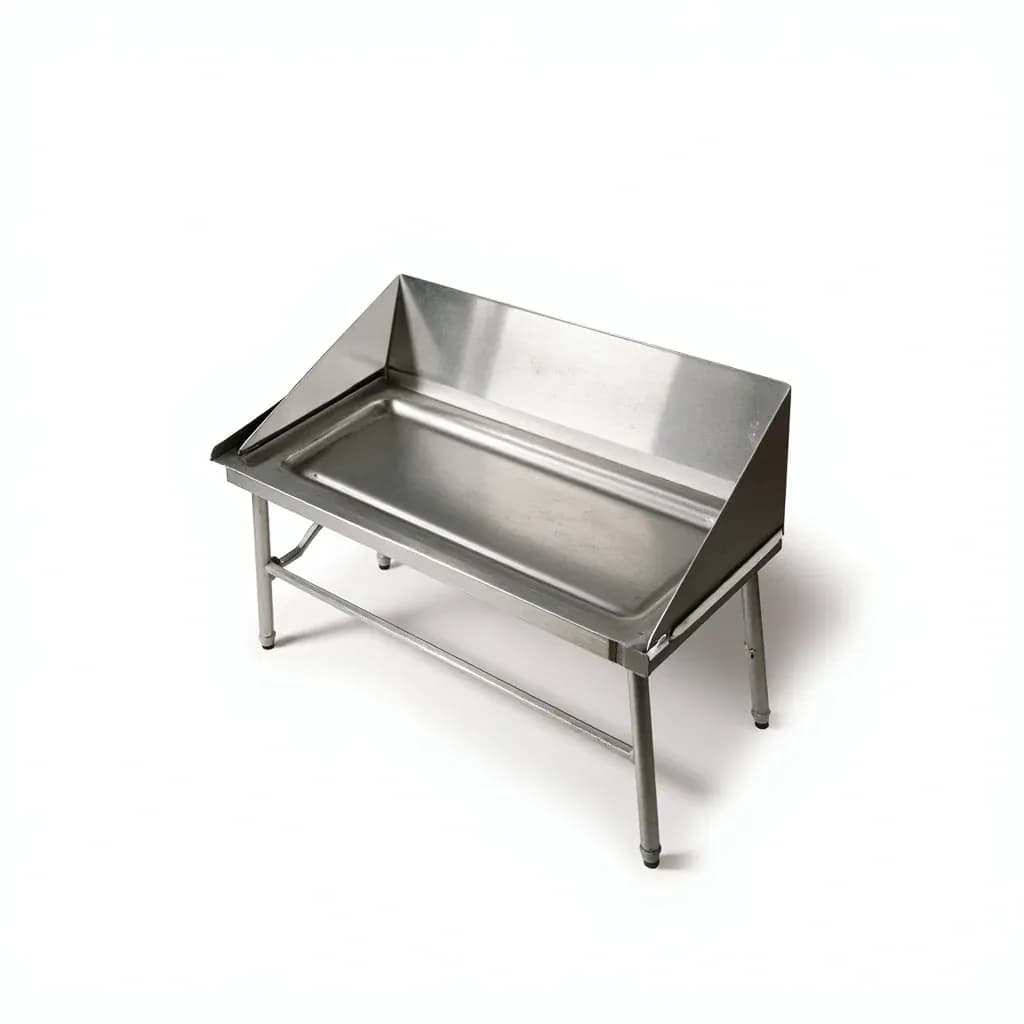
A sloped, channeled worktable that drains liquid away from washed produce, dishes, or cheese.
A draining table is a stainless or perforated work surface pitched toward a drain channel so liquid runs off rather than pooling. It is used for rinsing produce, holding washed cookware, and especially in cheesemaking where whey must drain from curd. The sloped, easy-clean top keeps the workspace dry and hygienic.
A draining table is the unglamorous workhorse behind any operation that processes wet food at volume — a flat stainless surface engineered so that water, whey, brine, or fish rinse doesn't pool on it but flows, by gravity, to a drain. The principle is older than stainless steel: European market stalls and dairies used sloped stone or butcher-block slabs for the same reason. A modern draining table adds precise slope (about 1/4 inch per foot), a channeled or rimmed surface that catches runoff, and a hard-plumbed drain that keeps the work zone dry and sanitary. In a busy fish prep area, cheesemaking room, or produce line, it is the difference between a clean workflow and a constantly mopped floor.
It earns its place whenever the liquid leaving the food is continuous, hot, or potentially hazardous — fish blood and scales, brine from pickled vegetables, whey from draining curds, meltwater from thawing proteins. Smaller kitchens improvise with a rimmed sheet pan tipped over a sink, a perforated hotel pan nested over a full one, or a standard prep table with a removable drainboard; those substitutes work fine for a few heads of lettuce. The dedicated table becomes essential when volume rises, when health codes require liquids to leave the work zone, or when the same surface is reused across many batches in a single shift.
Mechanically there is not much to it: a 16-gauge stainless top, an understructure of galvanized or stainless legs and cross-bracing, and a drain outlet typically 1.5 to 2 inches in diameter tied into a floor drain, trough, or indirectly connected waste line. The skill is in the details — uniform slope without low spots, clean welds that won't harbor bacteria, a slope direction that doesn't force the cook to work uphill, and a drain screen that someone actually remembers to clear.
Alternatives
Types & varieties
The most common form: a flat work surface with a shallow rim channeling liquid to one or more drain outlets at the corners.
The surface itself is angled toward a single central or end drain; maximizes runoff but reduces usable flat area.
Parallel grooves or ridges run toward the drain, speeding drainage and giving better grip on wet items like whole fish or vegetables.
Often includes a removable polyethylene cutting board insert, a faucet, and a scrap chute; some have an integral sink basin at one end.
Wider format with a backsplash, pre-rinse spray valve, and often a removable perforated insert for blanched greens.
Used in dairies and cheesemaking: holds cheese molds or racks so whey drains freely; often perforated or fitted with a stainless grid over a collection tray.
Long sloped surface with ridges or pegs for stacking washed pots, sheet pans, and dish racks; common in sculleries.
Caster-mounted version for flexible prep lines; smaller capacity and may route runoff to a catch bucket rather than a hard drain.
The slope matters more than the steel
The drainage spec on a draining table is roughly 1/4 inch of fall per linear foot — about a 2 percent grade — toward the drain. That is steep enough to keep water moving and shallow enough that small items don't slide off and sheet pans sit reasonably flat. Anything less and the surface ponds; anything more and it becomes a slide. The slope should be uniform from corner to corner; even a shallow low spot will collect liquid that then sits, breeds bacteria, and dilutes anything you later pour over the surface. Inspect a used or newly installed table by flooding it with a hose and watching where the water stops moving. Pay special attention to the welds where the top meets the rim or gutter; if they are pitted, ground flush, or rough, replace the panel rather than living with a chronic sanitation problem.
Sanitation and cross-contamination
A draining table is food-contact equipment, not just furniture, and it should be treated like one. Designate tables by task — one for raw fish, another for washed produce, a third for cheese — rather than trying to clean and reuse the same surface across categories in a single shift. Scrub seams and welds daily with a non-abrasive pad and an alkaline or quaternary ammonium sanitizer; concentrated chlorine bleach is hard on stainless and corrosive over time. Keep the drain screen clear of solids, because a clogged gutter pushes water onto the floor and undermines the entire point of the table. In cold rooms, insulate or heat-trace the drain line so condensate does not freeze and back the surface up.
When a substitute will do
Few home cooks need a dedicated draining table. For a small amount of washed greens, set a rimmed half-sheet pan at an angle over the sink or perch it on a rolled kitchen towel so the lower edge drains into the basin. A perforated hotel pan nested inside a solid one makes a serviceable mini-draining station for berries, cherry tomatoes, or blanched herbs. A wooden slatted rack set over a sheet pan works for cheese draining at home. These improvised rigs share the same principle as the commercial table — slope plus a clear path for water to leave — but they hold a fraction of the volume and have to be emptied by hand. Once you are processing more than a few pounds of produce at a time, gutting whole fish, or making cheese in any quantity, the dedicated table stops being a luxury.
Common uses
Tips & pitfalls
- Confirm the slope is uniform before installation — even slight low spots create pools that breed bacteria and dilute brines or wash water that you might want to keep.
- Keep the drain screen clear of solids; a clogged gutter defeats the table's purpose and pushes water onto the floor.
- Wipe seams and welds daily; stainless is sanitary only when the surface is intact and clean, not scratched, pitted, or left to scale up.
- Sanitize after raw fish, poultry, or meat contact before moving to produce, or designate a separate table for each task to prevent cross-contamination.
- Avoid harsh chlorine bleach on stainless; use alkaline or quat-based sanitizers and a non-abrasive pad to preserve the finish.
- For cheesemaking, choose a table that is food-grade and free of crevices; many makers line the surface with cheesecloth for clean whey separation.
- Orient the table so the drain side is away from your dominant hand — otherwise you spend the shift working uphill into runoff.
- Do not store sealed containers or boxes on the sloped surface — they migrate toward the drain and may fall.
- In cold rooms, account for condensate: insulate or heat-trace the drain line so it does not freeze and back up onto the work surface.
Good to know
- Primary material
- Stainless steel (typically 304 grade on food-contact surfaces, 430 on non-contact framing)
- Standard working height
- 34–36 in (86–91 cm) for commercial standing work
- Typical slope
- Approximately 1/4 in per foot (~2%) toward the drain to prevent pooling
- Drain outlet
- Usually 1.5–2 in (38–51 mm) NPS, plumbed to a floor drain, trough, or grease trap
- Length range
- Common 3–8 ft (0.9–2.4 m); custom units can run 10+ ft
- Typical load capacity
- 600–1,500 lb (270–680 kg) static load, depending on gauge and understructure
- Common certifications
- NSF/ANSI 2 (food equipment) and NSF/ANSI 8 (commercial cooking) where applicable
- Origin
- Evolved from sloped stone and butcher-block tables in European markets and dairies; stainless versions standardized in mid-20th-century commercial kitchens
Also called
drain table · draining bench
Related

Peeler
Swift blade for stripping skin off fruit and vegetables

Grater
Sharp-toothed surface for shredding cheese and vegetables

Microplane
Ultra-fine rasp for citrus zest, garlic, and hard cheese

Mixing Bowl
All-purpose bowl for combining, whisking, and tossing

Whisk
Looped wires that beat air into eggs, cream, and sauces

Spatula
Flat blade for flipping, lifting, and scraping

Slotted Spoon
Pierced spoon that lifts solids and drains the liquid behind

Wooden Spoon
Gentle, heat-friendly spoon for stirring anything