Prep Tools
Drip Collar
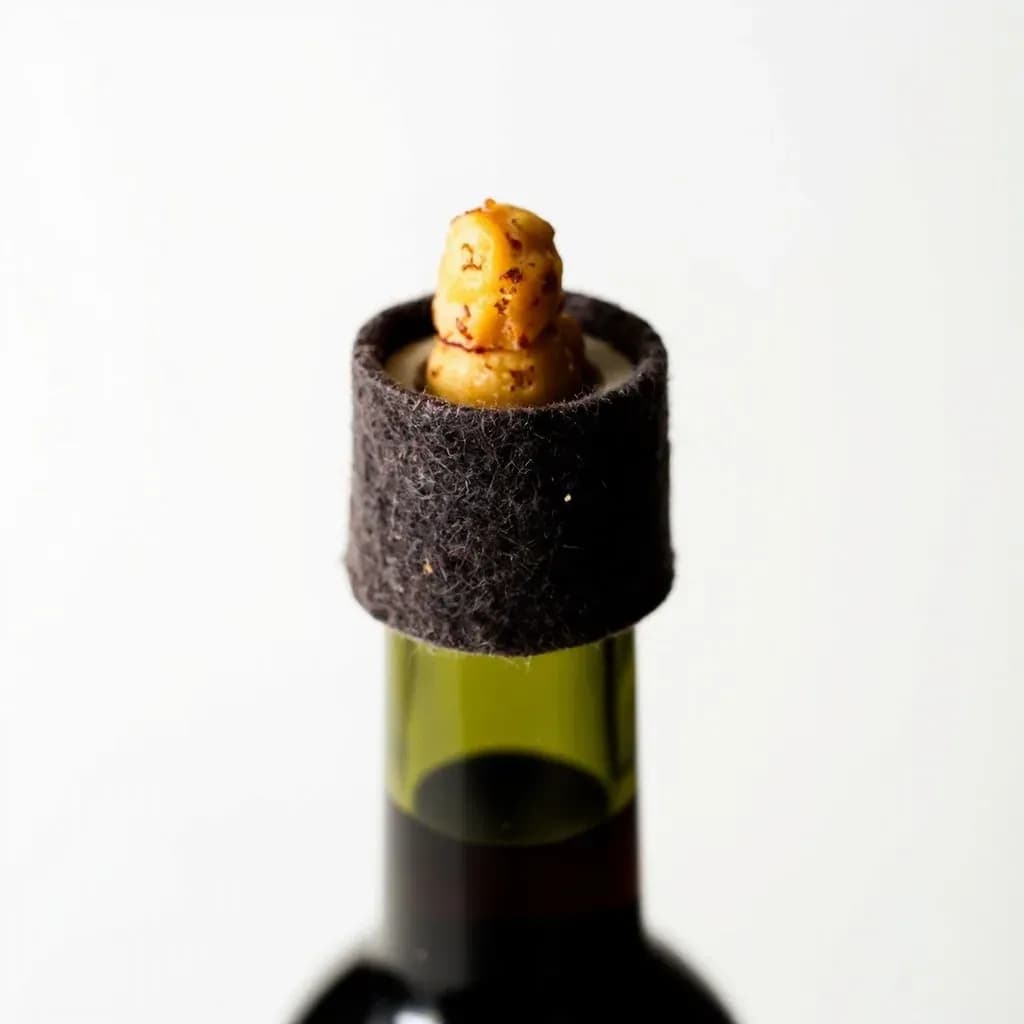
A small absorbent ring slipped over a bottle neck to catch wine drips after pouring.
A drip collar, or wine ring, is a felt-lined or absorbent band that fits around the neck of a wine bottle. As you tip the bottle back after pouring, the collar catches any errant drop before it runs down the label or onto the table. It keeps service tidy and protects linens during table-side pouring.
A drip collar — also called a wine drip ring or anti-drip collar — is a small soft or flexible ring that slides over the neck of a wine bottle to absorb or redirect the drops that escape after pouring. The accessory exists because wine bottles served below room temperature — most noticeably cold whites and young reds brought into a warm room — will inevitably shed a few beads of liquid down the outside of the neck. Those beads, sometimes called 'wine tears' (a term more often used for the streaks inside a glass), roll down toward the label and onto whatever sits below: a linen tablecloth, a starched napkin, a host's lap. Tannin-rich reds leave marks that ordinary laundering may not fully remove, and even a small spill in a restaurant can mean a linen charge.
The collar is a finishing tool, not a fix for sloppy pouring. A proper waiter-style pour — finishing with a slight twist and lift that breaks the stream before the bottle is raised — eliminates most drips on its own. The collar exists to catch what good technique leaves behind, and to give the pourer (or the guest) a clean visual handoff between bottle and glass. In tasting rooms and at trade events, where dozens of bottles are poured in succession, the collar is less about etiquette than about protecting the tasting surface from the cumulative effect of a hundred small drips.
Functionally, a drip collar behaves in one of two ways. Absorbent versions (felt, microfiber, terry) wick liquid into the fabric on contact and hold it there. Channeled versions (flexible silicone) gather the drop in a small trough or redirect it back down the neck. The first is the classic style; the second is easier to sanitize between wines but never actually 'soaks up' anything.
Alternatives
Types & varieties
The classic style; a soft ring of felt or microfiber that soaks up drips on contact. Often washable and reusable, and the most absorbent option available.
A stretchy, non-absorbent ring that channels drips in a small trough or guides them back down the neck. Dishwasher-safe and longer-lasting than fabric.
Cardboard or paper rings printed with the winery's branding, slipped on as part of the bottle's presentation; usually disposable.
Custom-printed drip rings used by wineries, importers, and event organizers as a low-cost marketing item handed out at tastings.
Lightweight paperboard rings used in volume at trade tastings and wine fairs, designed to be discarded after the event.
Absorbent vs. channeled: how the two main styles behave
The two functional categories of drip collar solve the same problem in opposite ways. Absorbent collars — felt, microfiber, and terry — pull liquid into the fibers on contact. A single drop is held in the weave rather than continuing its path down the bottle. This is the most forgiving style for protecting tablecloths, and the most forgiving for the pourer, because it forgives imperfect pour technique. The trade-off is hygiene: a fabric collar used through a flight of strong-flavored reds can hold residual color and aroma, and should be laundered or replaced between sessions.
Channeled silicone collars gather the drop in a small molded trough or redirect it back down the neck of the bottle. They never actually 'soak up' liquid, so they are easier to rinse and sanitize between wines — a real advantage at varietal tastings where cross-flavor transfer would be a problem. They are also more durable, often dishwasher-safe, and quieter on the bottle. The disadvantage is that a saturated silicone ring will eventually let the drop go; rinse it between pours when switching wines, and never assume the trough has unlimited capacity.
Working with a collar: habits that matter
A drip collar is at its best when paired with decent pour technique, and at its worst when treated as a replacement for it. The classic waiter finish — a slight twist as the bottle is lifted to break the stream before the bottle clears the glass — eliminates most drips on its own; the collar catches what good technique leaves behind.
Collar placement matters more than people expect. A collar pushed too high on the neck can slip down during pouring and land in the glass; one set too low sits below the drip line and catches nothing. Aim for just below the lip of the bottle, on the smooth section above the bottle's shoulder. On older bottles with sediment, the collar earns its keep as a final catch-point when the bottle is set down after a slow, tilted pour.
At multi-bottle tastings, collars become a hygiene concern as much as a stain concern. A fabric collar used through a flight of strong-flavored reds will hold residual color and aroma, and a silicone one will hold a small pool of liquid that can transfer between wines. Treat each bottle — or at minimum each flight of similar style — as a fresh collar. For home use, one well-kept fabric collar will last for years if rinsed and air-dried between sessions.
Common uses
Tips & pitfalls
- Slip the collar on just after the first pour, not before service — a dry collar looks tidy; a wet one looks like a mistake.
- Pair proper pour technique with the collar: twist the bottle slightly as you finish the pour to break the drip before lifting away.
- For older reds with sediment, pour slowly with the bottle tilted and let the collar catch the trailing drops after the bottle is set down.
- Wash fabric collars in mild soap without fabric softener — softener coats the fibers and reduces absorbency over time.
- Silicone collars channel drips back toward the bottle rather than absorbing them; rinse between wines to avoid cross-flavor transfer when switching varietals.
- Don't expect a collar to fix an aggressive pour — fast pouring aerates the wine and almost always overwhelms the ring.
- Replace disposable collars at multi-bottle tastings every six to eight bottles; a saturated paper ring will leak onto the table.
- Store fabric collars dry between uses; a damp collar left in a bag can develop a musty smell that transfers to the next bottle.
Good to know
- Also called
- Wine drip ring, anti-drip collar, wine drip catcher
- Function
- Slips over the neck of a wine bottle to absorb drips and 'wine tears' that run down the side after pouring
- Bottle opening diameter
- Approximately 18–19 mm (cork finish) to 21 mm (screw cap); collars are designed to stretch over this dimension
- Typical collar dimensions
- Roughly 3–4 cm outer ring with an inner hole of about 18–20 mm
- Common materials
- Felt, microfiber, terry cloth, silicone, or paperboard
- Reusability
- Available as washable/reusable (fabric, silicone) or single-use disposable (paperboard)
- Best paired with
- Red wines, which stain more visibly than whites and benefit most from a catch ring
- Typical setting
- Wine tastings, formal table service, restaurants, and home dining with tablecloths at risk
- Origin note
- A modern wine-service accessory; commercially common from the late 20th century onward as wine culture expanded into homes and restaurants
Also called
Drip Collar (Wine Ring) · wine ring · drip stopper ring
Related

Peeler
Swift blade for stripping skin off fruit and vegetables

Grater
Sharp-toothed surface for shredding cheese and vegetables

Microplane
Ultra-fine rasp for citrus zest, garlic, and hard cheese

Mixing Bowl
All-purpose bowl for combining, whisking, and tossing

Whisk
Looped wires that beat air into eggs, cream, and sauces

Spatula
Flat blade for flipping, lifting, and scraping

Slotted Spoon
Pierced spoon that lifts solids and drains the liquid behind

Wooden Spoon
Gentle, heat-friendly spoon for stirring anything