Prep Tools
Drop Lid (Otoshibuta)
A lid that rests directly on simmering food to circulate liquid and braise evenly.
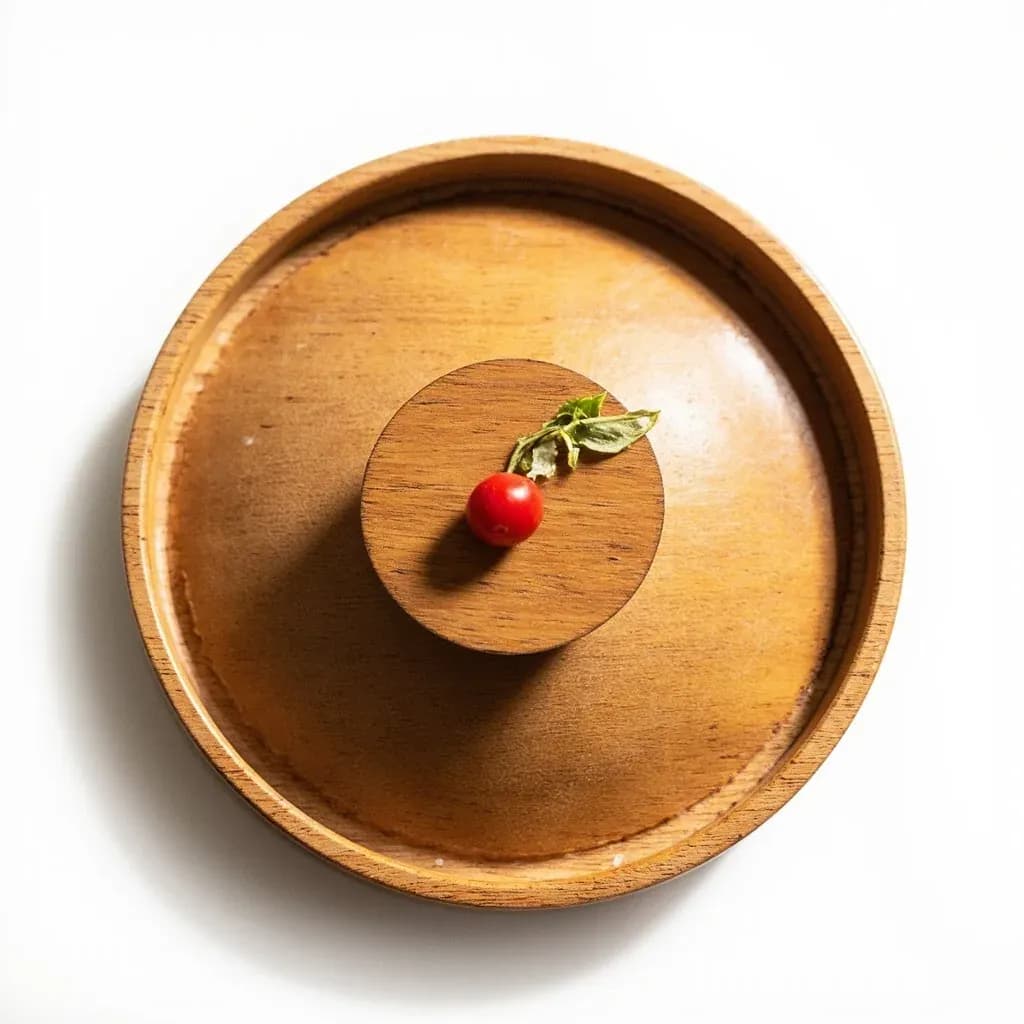
An otoshibuta is a wooden, metal or silicone lid smaller than the pot that floats directly on top of simmering food. It pushes the cooking liquid up and over the ingredients so they braise evenly with less liquid and gentle pressure. Common in Japanese simmered dishes, it keeps delicate items submerged without vigorous stirring that would break them apart.
A drop lid — otoshibuta in Japanese — is a flat disc or square that drops into a pot and rests directly on the surface of the food rather than sealing the rim. This single change in geometry reshapes how heat and moisture behave: steam rises, condenses on the underside of the lid, and rains back down as a continuous bath of seasoned liquid across the top of the ingredients. Because vapor still escapes around the edges, the simmer stays gentle and the broth reduces slowly rather than building up pressure. The net effect is even cooking, submersion without over-stirring, and protection from the air that would otherwise dull the color of greens or dry the surface of fish.
The otoshibuta is most at home in nimono and dashi-based braises, but its usefulness is broader: anything that benefits from quiet, even heat and steady contact with liquid cooks better under one. Root vegetables, beans, leafy greens, rice porridge, and reheated leftovers all respond well. Traditional lids are turned from hinoki (Japanese cypress) or kiri (paulownia), chosen for being light, naturally moisture-resistant, and flavor-neutral; modern kitchens lean on perforated stainless steel or flexible silicone for the dishwasher and the speed of service.
The otoshibuta is the Japanese refinement of an idea that runs through most of the world's braising traditions: French cooks lay a cartouche — parchment with a central slit — on the same principle, and cooks in Spain and Italy weight a heatproof plate on top of a slow-cooked dish. The reusable wooden lid is simply the most enduring, hands-off expression of a low-tech universal tool.
Alternatives
Types & varieties
The most prized traditional material; light, faintly aromatic, naturally moisture-resistant. Pairs especially well with white-fleshed fish and root vegetables.
Even lighter than hinoki and completely neutral in scent and flavor; the everyday choice in Japanese home kitchens.
Pro-kitchen standard. Dishwasher-safe and durable; small holes keep liquid circulating across the surface and make the lid easy to lift with chopsticks.
Heavier and firmer in contact; useful when you want firmer contact with delicate ingredients like flaky fish, though it can crush silken tofu.
Flexible, dishwasher-safe, often sold in nested sets covering several pot diameters. Gentlest on fragile ingredients.
Round with a small knob, sized to drop into a donabe or stockpot.
Made for tamagoyaki pans, sukiyaki nabe, and shallow rectangular casseroles.
Woven or slatted; inexpensive and traditional for steaming, though less precise for nimono.
How It Changes the Simmer
Three things happen when an otoshibuta sits on the food instead of the pot rim, and together they account for almost every quality cooks associate with a well-made simmered dish. First, the lid forces steam to travel laterally across the surface of the ingredients before it condenses and drips back down, so every piece is continuously bathed in the seasoned cooking liquid rather than only the ones at the bottom. Second, because vapor still escapes around the edges, the pot never pressurizes the way it does under a fitted lid — the broth reduces slowly and the temperature holds at a steady, gentle simmer. Third, the food is shielded from direct contact with the air, which protects volatile aromatics and the pigments that give blanched greens and kabocha their color. The result is the clean flavor, intact texture, and bright color that define good nimono.
Material Choices
Wood, metal, and silicone each change the character of the tool, and the right one depends on what you cook and how you clean. The catalog above lists what each variant is; the notes below are the practical trade-offs.
- Reach for wood when flavor neutrality and quiet heat transfer matter most — kiri for purist nimono, hinoki when a faint resin note is welcome.
- Reach for perforated metal when the lid will be lifted repeatedly during service; the holes vent steam and give chopsticks something to grip.
- Reach for silicone when the ingredients are fragile (silken tofu, poached fish) or when one nested set needs to fit several pot sizes.
Improvising a Drop Lid
If you don't own an otoshibuta, the same effect can be reached with items already in a Western kitchen. These workarounds are not as elegant as a fitted wooden lid, but they are faithful to the principle of weighting the food directly.
- Cartouche: A round of parchment cut to the pot's diameter with a 1 cm slit (or small hole) in the center. Lay it directly on the food. The slit lets steam escape slowly, mimicking the rim gap of a real otoshibuta.
- Heatproof saucer or small plate: Upside-down in the pot, resting on the food. Skip plastic and anything not rated for simmering.
- Small lid from a smaller saucepan: Should drop in freely and rest on the food rather than the pot walls.
- Aluminum foil round: Pierce a few holes and lay it on top. A short-term fix when nothing else is available.
Common uses
Tips & pitfalls
- Pick a size that drops in freely without wedging — it should rest on the food, not float on the rim or scrape the pot walls.
- The fastest substitute is a parchment round with a small slit in the center, weighted lightly with a heatproof saucer; it mimics the way a real otoshibuta lets steam escape around the edges.
- For extremely delicate items (silken tofu, flaky white fish), reach for silicone or perforated metal rather than a heavy wooden lid that can crush or imprint the food.
- Wooden lids should never soak — wipe with a barely damp cloth, dry immediately, and stand upright to air. Prolonged water causes splitting and lifts the grain.
- Before first use, rinse a wooden otoshibuta in cool water and let it dry; oiling lightly with camellia (tsubaki) oil extends its life without tainting flavor.
- Don't crank to a rolling boil under the lid — a gentle simmer is what it's designed for. Violent bubbling will dislodge it and shred delicate ingredients.
- Resist the urge to use the pot's own fitted lid; a sealed lid traps steam and pressure and undoes the open-simmer balance the otoshibuta is engineered to maintain.
- If the liquid level falls too quickly during cooking, the lid is probably too small or too light — switch to a better-fitting or heavier piece rather than raising the heat.
- Lift a hot wooden lid by piercing it briefly with the tip of a chopstick and lifting from the pot's edge; perforated metal lids lift easily with chopsticks straight out of the liquid.
Good to know
- Japanese name
- Otoshibuta (落とし蓋) — literally "dropping lid"
- Origin
- Traditional Japanese (washoku) cookware, used for centuries in nimono and other simmered dishes
- Primary function
- Rests directly on the food to distribute heat, retain moisture, and keep ingredients submerged
- Traditional materials
- Hinoki (Japanese cypress) and kiri (paulownia); occasionally bamboo
- Modern materials
- Stainless steel (often perforated with 4–6 small holes), silicone, aluminum
- Sizing rule
- Diameter slightly smaller than the pot's inner rim so it rests on the food, not the edge
- Steam behavior
- Does not trap pressure — vapor escapes around the edges, so liquid reduces more slowly than under a sealed lid
- Care (wood)
- Hand wash only, wipe dry immediately, never soak; occasionally oil with camellia or food-grade mineral oil
- Care (metal/silicone)
- Dishwasher safe; check thin stainless versions for warping over time
- Common pot pairings
- Donabe, yukihira saucepan, saucier, shallow casserole, tamagoyaki pan
Also called
otoshibuta · drop lid · floating lid
Related

Peeler
Swift blade for stripping skin off fruit and vegetables

Grater
Sharp-toothed surface for shredding cheese and vegetables

Microplane
Ultra-fine rasp for citrus zest, garlic, and hard cheese

Mixing Bowl
All-purpose bowl for combining, whisking, and tossing

Whisk
Looped wires that beat air into eggs, cream, and sauces

Spatula
Flat blade for flipping, lifting, and scraping

Slotted Spoon
Pierced spoon that lifts solids and drains the liquid behind

Wooden Spoon
Gentle, heat-friendly spoon for stirring anything