Prep Tools
Drying Rack
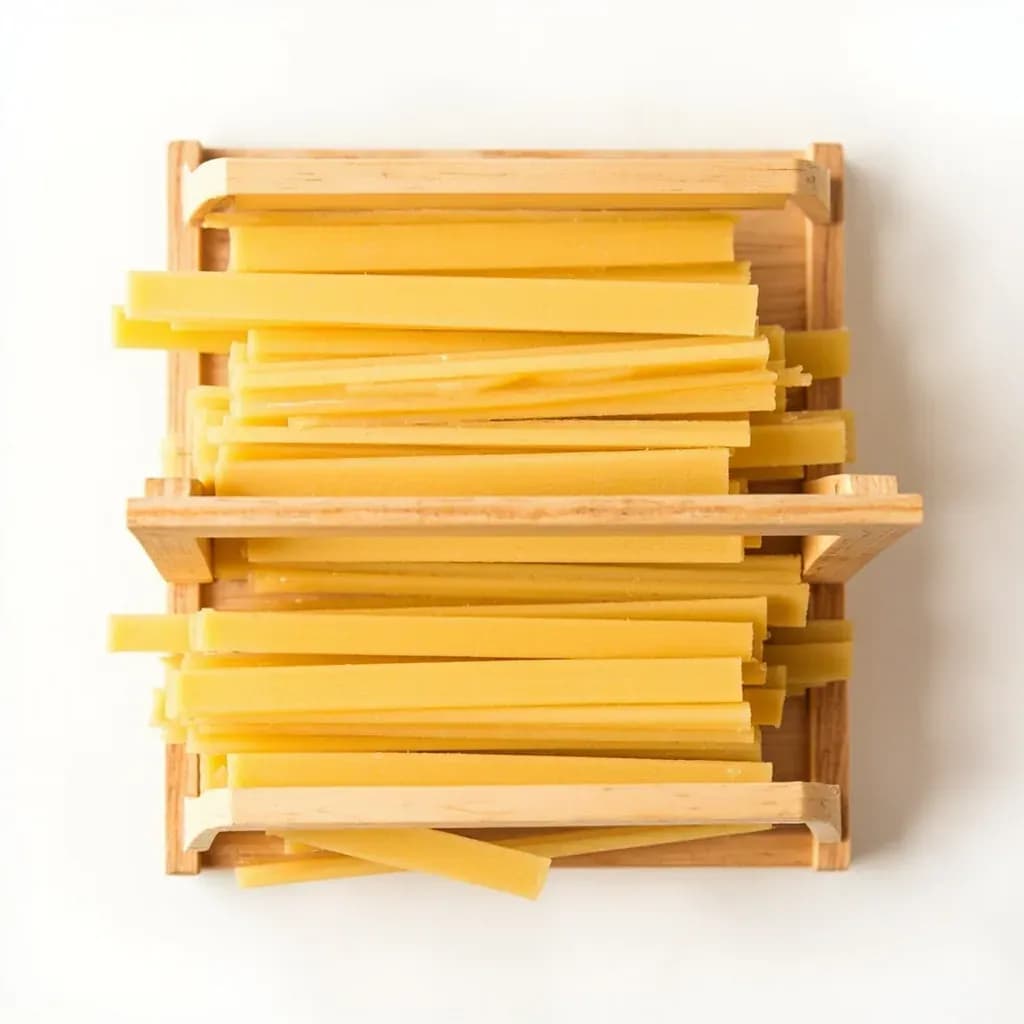
A rack with rods or mesh for air-drying fresh pasta, herbs, or rinsed produce.
A drying rack is a frame fitted with rods, dowels, or mesh that suspends food to air-dry. Cooks drape fresh-cut pasta over its arms to dry before cooking or storage, and similar racks dry herbs, sliced fruit, and washed greens. Good airflow around each piece is what prevents sticking and uneven drying.
A drying rack is any open-frame surface — dowels, mesh, or pegs — designed to hold food in the air so moisture leaves and the surface stays untainted. At its core it solves one problem: getting air to all sides of something wet or sticky without the food sitting in its own liquid or sticking to a flat surface. Wooden dowel racks are the classic form because rounded, food-safe wood gives pasta strands and herb stems a place to rest where they won't adhere or split, while mesh screens let small leaves and thin slices breathe without falling through. Stainless, nylon-coated wire, and food-safe plastic versions exist for cooks who want dishwasher-safe convenience.
The rack matters most when drying is part of the recipe itself, not just cleanup. Fresh egg pasta needs 12–24 hours of still, dry air to form a leathery skin so it can be stored or even cooked without clumping; the same physics applies to curing herbs, drying fruit leather, and giving fried foods somewhere to drip without steaming their undersides. A good rack also organizes the work — long strands stop snagging on the counter, herb bunches stay inverted, and rinsed greens lose their wash water before they hit a salad. It is a quiet tool, but it controls outcomes that no amount of heat or seasoning can rescue once the drying step is botched.
Choosing among the variants is mostly about what you dry most. Pasta makers want dowels long enough to drape tagliatelle or spaghetti without the strands touching the counter; herb growers want fine mesh that won't lose thyme or oregano leaves; produce cooks want a rack that lives near the sink and handles daily rinsing. Match the rack to the job and it disappears into the workflow; mismatch it and you'll fight stuck pasta and damp herbs every time.
Alternatives
Types & varieties
Free-standing frame with multiple parallel wooden dowels; the classic shape for draping strands of tagliatelle, spaghetti, and linguine.
Traditional curved Italian design with a single tall arm; pasta hangs in a U-shape — good for long strands in small kitchens.
Wood or stainless frame that folds flat for storage; popular for home cooks with limited counter space.
Small rod assembly that sits in a bowl or pot to lift pasta above liquid; used during cooling and tossing steps rather than true drying.
Flat rectangular frame with tight wire or nylon mesh for leaf herbs, edible flowers, and small fruit slices; can be stacked for volume.
Multi-tier suspended rack with hooks or mesh shelves for bunched herbs; uses rising warm air near the ceiling.
Collapsible stainless or silicone-edged frame that spans a sink; used for rinsing and air-drying greens, berries, and small produce.
Fixed or folding shelf and peg unit for permanent drying stations in pro or farmhouse kitchens.
Drying fresh pasta on a rack
A wooden dowel rack is the most forgiving tool for drying long, hand-cut pasta because the rounded surface lets strands drape in soft loops rather than lying flat against each other. The goal is a pasta surface that feels like soft leather — pliable but not tacky — so it can be portioned, bagged, or cooked directly. A few working principles make the difference between a successful batch and a stuck, cracked mess.
- Dust dowels lightly with semolina or rice flour before draping; semolina's coarse grain prevents sticking without flavoring the pasta.
- Form a U or figure-8 over the dowel instead of a single long drape — this shortens the hanging length so strands dry evenly from top to bottom.
- Don't crowd the dowels; leave at least a finger's width between adjacent strands so air moves freely.
- Flip long strands halfway through drying (about 6–8 hours in) so the side nearest the dowel doesn't stay damp.
- Keep the rack out of direct sun and away from exterior walls; drafts and heat both cause surface cracking while the interior stays gummy.
- Aim for ambient humidity below 60% — above that, the pasta skins over before moisture leaves the core.
- In humid kitchens, aim a small USB or clip fan across the room (not directly at the pasta) to cut drying time by roughly a third.
- Test doneness by touch and bend: a strand should bend without snapping and feel cool and dry to the fingertips, not cool and clammy.
Drying herbs, flowers, and thin slices
Mesh screens and hanging racks are built for things that need air on all sides without being held — leaf herbs, edible flowers, candied peel, fruit leather, and vegetable chips. The mesh size is the lever: too coarse and small leaves fall through; too tight and airflow chokes. Stacking screens with spacers is the simplest way to handle volume.
- Choose screens with 1/4–1/2 in (6–12 mm) openings for most culinary herbs; finer meshes work for chive blossoms and small flower petals.
- Lay herbs in a single layer, stems and leaves spaced — piling causes the bottom layer to brown and mold.
- Label screens by herb; thyme, oregano, and sage will leave flavor residue if reused without washing.
- For bunched herbs (parsley, rosemary, thyme stems), hang upside down on a rack with airflow above and below the bundle.
- Sanitize screens with a brief diluted-vinegar soak or a dishwasher run if stainless and labeled safe; wooden frames wipe only.
- Dehydrate fruit leather or thin vegetable chips on mesh in a low oven (60–75°C / 140–170°F) — only with heat-safe rack materials.
Rinsed produce and fried foods
The same airflow principle applies to wet greens, washed berries, and fried items that need to drain without steaming. Over-the-sink racks and vertical peg racks both serve here, and choosing between them comes down to volume and fragility.
- Spread washed greens, berries, or grapes in a single layer on a mesh rack — a salad spinner handles sturdy greens better but bruises delicate herbs and berries.
- For fried tempura, fritters, or herb fritters, stand them vertically on a peg or dowel rack so oil drips off and the bottoms stay crisp.
- Reserve produce-drying racks for produce; don't use a rack that has held raw meat drippings for fruit without thorough sanitizing.
Common uses
Tips & pitfalls
- Dust wooden dowels lightly with semolina or rice flour before draping fresh pasta — semolina's coarse grain prevents sticking without flavoring the dough.
- Don't crowd the dowels; strands should hang in loose loops with gaps between them so air circulates fully.
- For long pasta, form a nesting U or figure-8 over the dowel rather than a straight drape — this shortens hanging length and speeds even drying.
- Flip long strands halfway through drying so the side nearest the dowel isn't damp when you remove them.
- Position the rack away from windows and exterior walls; drafts cause uneven drying and surface cracking on pasta.
- Aim for ambient humidity below 60% — above that, pasta skins over while the interior stays gummy.
- Hand-wash wooden pasta racks in warm (not hot) water with mild soap, then stand them upright to air-dry completely before storing flat.
- Use a small USB or clip fan pointed at the rack (not directly on the food) to cut pasta drying time by roughly a third in humid kitchens.
- Wooden racks can warp if stored damp — keep them in a dry cabinet and rotate dowels occasionally.
Good to know
- Primary materials
- Beech, maple, or bamboo wood; stainless steel; food-safe plastic; nylon-coated wire
- Common pasta capacity
- Roughly 1–2 lb (450–900 g) of fresh pasta per load on a typical countertop rack
- Typical pasta dry time
- 12–24 hours at room temperature, depending on thickness, humidity, and airflow
- Ideal drying conditions
- Cool, dry room around 21–24°C (70–75°F) with good airflow; keep humidity below ~60% and avoid direct sunlight
- Dowel length
- Standard pasta racks use wooden dowels roughly 8–14 in (20–35 cm) long
- Traditional form
- The 'clog' or 'boot' rack (It. scarpetta) — a curved, arm-style wooden rack — comes from northern Italian pasta-making
- Maintenance
- Wooden racks are hand-wash only and must air-dry thoroughly; never put them in a dishwasher
- Mesh openings
- Herb-drying screens typically use 1/4–1/2 in (6–12 mm) openings to balance airflow and leaf retention
Also called
Pasta Drying Rack · Herb Drying Rack · Air-Drying Rack
Related

Peeler
Swift blade for stripping skin off fruit and vegetables

Grater
Sharp-toothed surface for shredding cheese and vegetables

Microplane
Ultra-fine rasp for citrus zest, garlic, and hard cheese

Mixing Bowl
All-purpose bowl for combining, whisking, and tossing

Whisk
Looped wires that beat air into eggs, cream, and sauces

Spatula
Flat blade for flipping, lifting, and scraping

Slotted Spoon
Pierced spoon that lifts solids and drains the liquid behind

Wooden Spoon
Gentle, heat-friendly spoon for stirring anything