Prep Tools
Egg Ring
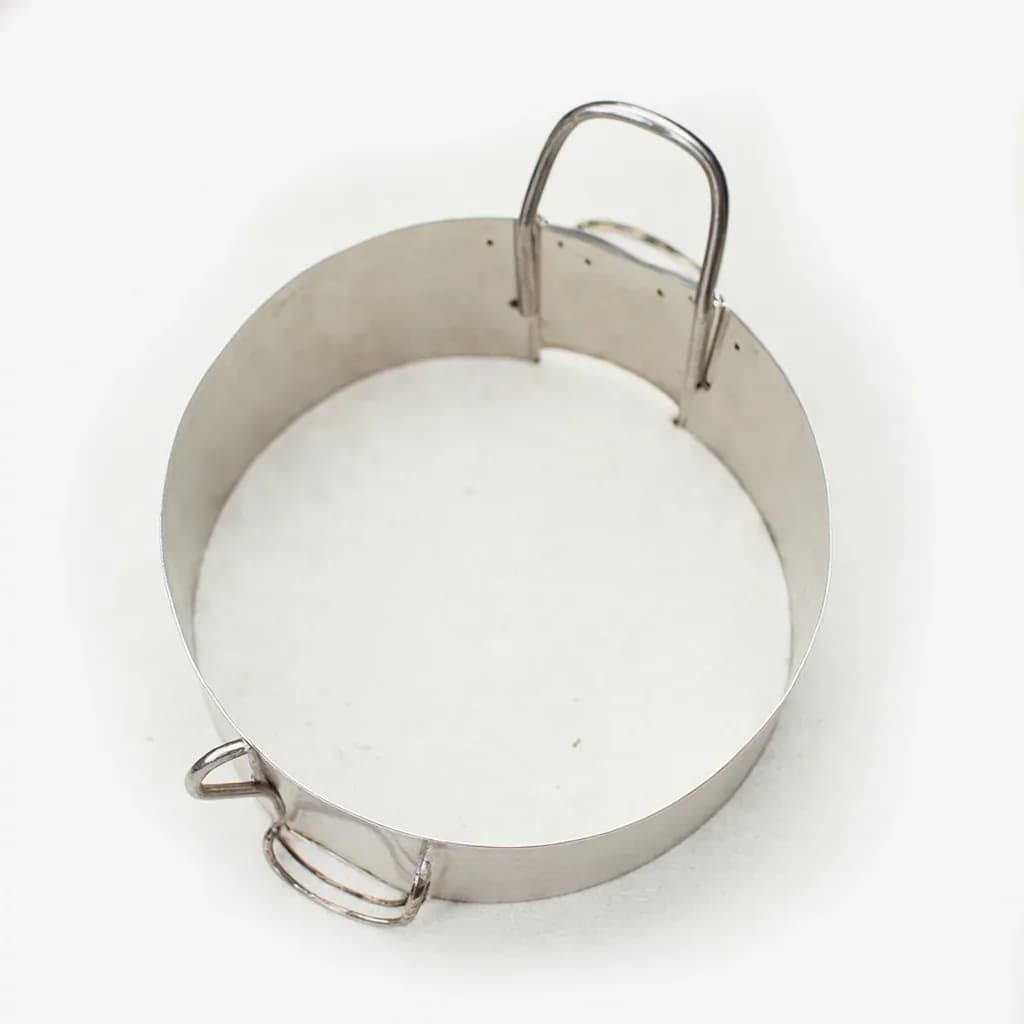
A small metal or silicone ring that shapes fried or poached eggs and pancakes into neat circles.
An egg ring is a short open-bottomed ring placed on a hot pan to contain a cracked egg or batter so it cooks into a uniform round. It is used to make round fried eggs for breakfast sandwiches and to shape crumpets or pancakes. Many have a handle and a non-stick or silicone coating so the cooked food releases cleanly.
An egg ring is a short, open-ended circular band — typically 3 to 4 inches across and about 1 to 1.5 inches tall — that sits on a cooking surface to confine a runny food (raw egg, pancake batter, a portion of hash browns) while it sets, producing a clean, uniform disk every time. The ring is doing two jobs at once: it acts as a mold that holds the food in shape, and, when made of metal, it conducts heat into the sides of whatever is inside, helping the edges of an egg white or a pancake set crisply and evenly. Without a ring, a cracked egg spreads into an amoeba and a ladle of batter pools into a lopsided blob.
Materials matter more than most buyers expect. Stainless steel and non-stick coated metal conduct heat well, so the white cooks up against a hot wall and releases cleanly with a thin film of oil; silicone is gentler and demolds beautifully but transfers almost no heat laterally, which means a softer, paler edge and a longer cook. The trade-off is convenience: silicone is virtually impossible to overcook onto and can be flexed off the food, while a metal ring rewards you with a better sear but punishes any lapse in oiling or preheating.
Used well, an egg ring is one of the highest-leverage tools in a short-order cook's kit. The whole technique rests on three variables — heat, fat, and patience — and the rest is just making sure the food stays put long enough to set. Once you've cooked a few rounds, the ring disappears from your attention and you stop thinking of eggs Benedict construction, slider patties, and perfectly round silver-dollar pancakes as separate problems.
Alternatives
Types & varieties
Rigid, durable, conducts heat evenly into the sides of the egg; needs a thin film of oil to release cleanly.
Easier release than bare stainless; the coating can scratch with metal utensils and eventually wear through.
Flexible for one-handed demolding, dishwasher-safe, and nearly impossible to burn food onto; lower heat conduction produces a softer, paler edge.
Produces a decorative wavy perimeter on the finished egg or pancake — purely aesthetic.
Used when plating calls for a geometric footprint rather than a circle.
A top tab or side handle keeps fingers away from the hot band and gives a clean place to grip when lifting.
A seam lets the ring open and slip off the cooked food without sliding a spatula underneath.
Detachable sides reconfigure to different diameters; a prosumer and commercial product.
Shorter and shallower than a typical egg ring; functionally interchangeable for most home uses.
Troubleshooting a stuck egg
A stuck egg is the single most common complaint, and it almost always traces to one of three causes: the pan wasn't hot enough, the ring wasn't oiled, or the egg was moved before the white had set. A cold or underheated pan lets the white weld itself to the metal before the bottom has firmed up; a dry ring does the same along the wall; and lifting or shaking the egg before the white turns opaque will tear the underside loose and bond it to the surface. If you find the egg cemented to the ring, set the whole thing — ring and all — back on a low burner for thirty seconds to melt the white, then slide a thin spatula under and lift the ring straight up. The other silent killer is too much heat: a screaming-hot pan scorches the bottom of the egg before the top has a chance to set, and no amount of oil will save it. Medium or medium-low heat, with the ring preheated on the oiled surface for fifteen or twenty seconds before you crack, solves nearly every release problem.
Common uses
Tips & pitfalls
- Always oil or butter the inside of the ring before each use, even on non-stick and silicone models — fat is what guarantees clean release.
- Place the ring on a preheated, lightly oiled surface for fifteen to twenty seconds before adding the egg; the warm wall helps the white set immediately on contact.
- Cook on medium or medium-low heat; high heat burns the bottom of the egg before the top sets and will scorch batter in seconds.
- When the whites are mostly opaque, slide a thin spatula under the egg and lift the ring straight up — don't drag the ring off the food.
- For poached eggs, set the ring in a shallow pan of barely simmering water, crack the egg in, and lift the ring once the white has turned opaque.
- Leave at least an inch of space between rings on the griddle so steam can escape and edges set properly; crowded rings turn out pale and rubbery.
- Soak metal rings in hot soapy water for ten minutes after use to loosen cooked-on white, and avoid steel wool on any non-stick coating.
- For pancakes and rice patties, let the food set fully around the rim before lifting the ring, or the edges will slump and you'll lose the shape.
- Silicone rings can float or tip in a pan of water — set them on a flat, stable base when poaching and don't overfill the pan.
Good to know
- Type
- Shaping ring / cooking mold
- Typical diameter
- 3 to 4 inches (7.5–10 cm); 3.5 in is the most common for eggs
- Height
- About 1 to 1.5 inches (2.5–4 cm)
- Common materials
- Stainless steel, non-stick coated aluminum, food-grade silicone
- Also known as
- Egg mold, egg cooking ring, egg shaper, crumpet ring
- Heat tolerance (silicone)
- Generally up to ~428°F / 220°C
- Care
- Metal rings are dishwasher-safe; silicone is dishwasher-safe; hand-washing extends life of non-stick coatings
- Cost range
- Roughly $5–$20 for a basic set; premium modular systems run higher
- Origin
- Modern commercial kitchen tool; descended from crumpet/hoop rings used in British baking
Also called
Egg Mold · Crumpet Ring
Related

Peeler
Swift blade for stripping skin off fruit and vegetables

Grater
Sharp-toothed surface for shredding cheese and vegetables

Microplane
Ultra-fine rasp for citrus zest, garlic, and hard cheese

Mixing Bowl
All-purpose bowl for combining, whisking, and tossing

Whisk
Looped wires that beat air into eggs, cream, and sauces

Spatula
Flat blade for flipping, lifting, and scraping

Slotted Spoon
Pierced spoon that lifts solids and drains the liquid behind

Wooden Spoon
Gentle, heat-friendly spoon for stirring anything