Prep Tools
Egg Slicer
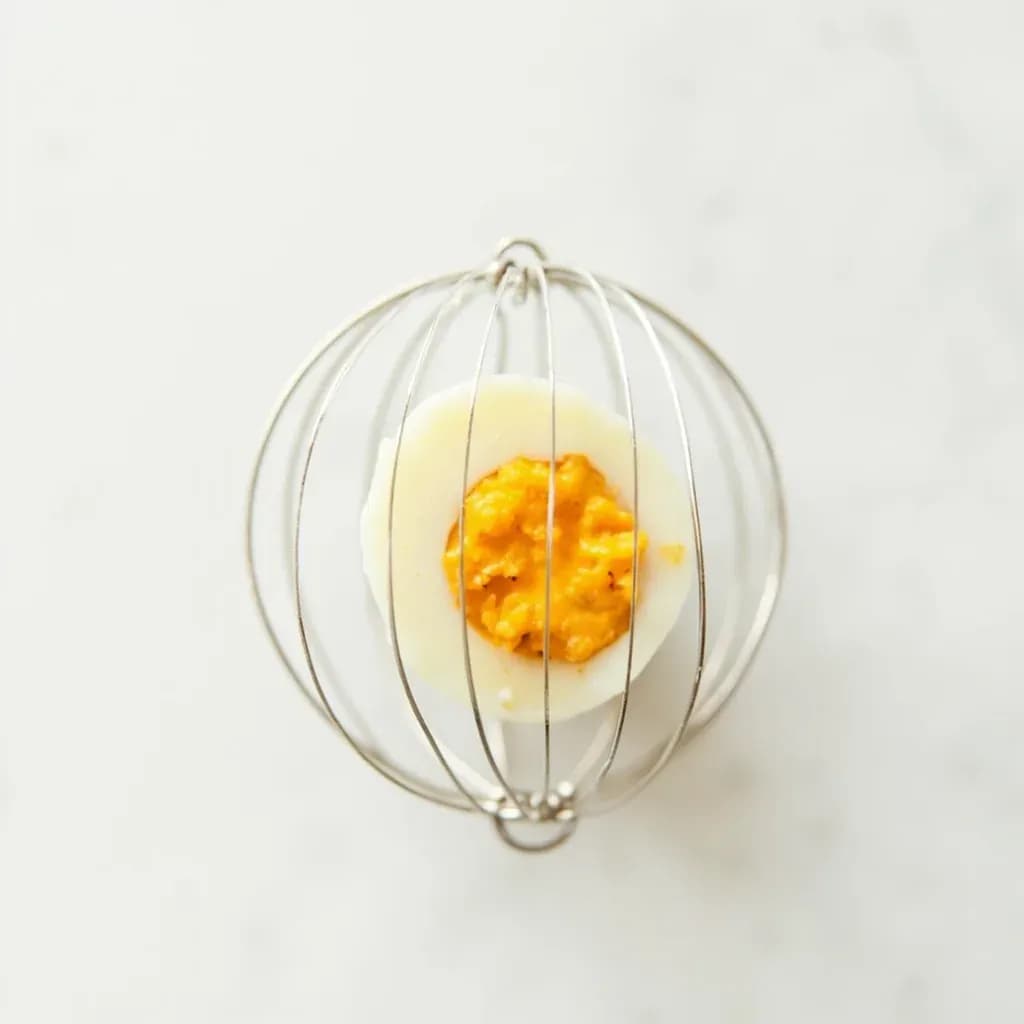
A hinged tool with taut wires that slices a peeled hard-boiled egg into even rounds in one press.
An egg slicer is a small device with a cupped base and a hinged frame of thin wires that cut a peeled hard-boiled egg into uniform slices in a single motion. Cooks use it for tidy egg slices on salads and sandwiches, and it also works for soft mushrooms, strawberries, and small mozzarella balls. Many models rotate the egg to switch between round slices and wedges.
The egg slicer is a hinged press tool with parallel taut wires that descends through a peeled hard-boiled egg to produce uniform coin-shaped rounds. The reason it works — and the reason it matters in practice — is that hard-cooked egg white and yolk are firm enough to be sheared by thin wire under pressure, but tender enough that a drawn knife blade tends to drag and crumble the protein network at the cut edges. A slicer's wires part the egg cleanly under tension, which is why it produces rounds with smooth, intact faces — and why it does so in a single motion rather than ten careful knife strokes.
The basic design has barely changed since Willy Abel's 1909 German patent. A spring-hinged frame holds the egg in a shallow cradle while a top plate carrying the wires drops down; the wires slice by tension rather than edge geometry, which is why they are deliberately thin and why the tool is never pried apart at the hinge. A standard model produces roughly 5 mm (about 1/4 in) rounds; wedger and dicer variants extend the same wire-shearing principle into wedges or small cubes for other preparations.
For cooks who prep eggs in any volume — chef's salads, Niçoise, deviled platters, ramen and bibimbap toppings — the slicer is less a gadget than a small but reliable labor-saver. The best results come from cold, fully hard-cooked eggs and a clean, vertical press.
Alternatives
Types & varieties
Hinged frame with a single row of parallel wires; produces even coin-shaped rounds. The original and most common form, ideal for salads and garnishes.
Wires arranged radially from a central point; produces 6 or 12 equal wedges, useful for deviled egg platters and garnishes.
Two perpendicular wire grids that chop the egg into small cubes; the fastest way to prep eggs for egg salad, ramen, or rice-bowl toppings.
A smaller, lighter hinged-wire tool sized for berries, button mushrooms, small mozzarella balls, or banana coins.
American cast-aluminum body with a domed hinge and short wires; an iconic 1920s–30s design now collected by enthusiasts.
Open stainless-steel frame with no closed bowl; wires stretched across an exposed rectangle, common in European kitchens.
Includes a raised cradle that holds the egg upright so the cook need not steady it by hand; other models are free-hand, requiring the cook to hold the egg on a board.
Why Wires Cut Cleaner Than a Knife
The egg slicer is technically a shear, not a knife. The wires are not sharp in the conventional sense; they are thin and held under tension so that, as the top plate descends, they slice through the egg like a cheese wire cuts through cheese. Hard-cooked egg white is a delicate gel of coagulated protein; a drawn knife blade compresses that gel ahead of the edge, dragging and tearing. Wires, by contrast, part the structure with almost no compression, which is why slicer rounds hold their shape while knife-cut slices often crumble at the edges. The practical takeaway: keep the wires taut (replace or restring the unit if they kink or stretch), press straight down (tilting bends the wires and tears the egg), and accept that this is a tool meant for fully firm eggs only — soft- or medium-cooked yolks will smear rather than cut.
Caring for Vintage and Everyday Models
Vintage cast-aluminum slicers from the 1920s–30s, including the American 'Brownie', routinely outlast their modern plastic counterparts, but they reward a little attention. Harsh dishwasher detergents and bleach pit aluminum and corrode older brass or German-silver wires; hand-washing in warm soapy water and towel-drying preserves both the body and the wire tension. If wires go slack, kink, or break, restring the unit rather than retire it — replacement wires and small spools of food-grade stainless steel are sold by cutlery and kitchen-tool specialists, and a properly restrung vintage slicer will perform like new.
Common uses
Tips & pitfalls
- Always peel the egg fully before slicing; shell fragments will lodge between the wires and tear every subsequent slice.
- Use only fully hard-boiled eggs — about 12 minutes at a rolling boil, then chilled in ice water. Soft- or medium-cooked yolks will squish and smear.
- Press straight down in one firm, even motion. Tilting the cutter tears the whites and bends the wires permanently.
- Chill eggs thoroughly before slicing; cold, firm whites cut cleanly, while warm eggs drag and crumble.
- Wipe the wires with a barely damp cloth between cuts to keep residue from smearing the next slice. A thin film of neutral oil on the wires also reduces sticking, especially with dicers.
- Never pry the slicer open with a fork or knife; always use the hinge. Forcing it bends the frame and loosens the wires.
- Hand-wash and towel-dry. Harsh dishwasher cycles and prolonged soaking pit aluminum and corrode older wires.
- Replace or restring the unit when wires go slack, kink, or break — loose wires tear rather than slice and the egg mashes instead of cutting.
Good to know
- Type
- Hinged press-style slicer with parallel taut wires
- Origin
- Patented in Germany in 1909 by Willy Abel; US patents followed in the 1910s, including Hugo W. Herberg's 1914 design
- Also Called
- Egg cutter, Eierschneider (German), egg wedger (for wedge-style models)
- Standard Capacity
- One peeled large hard-boiled egg per press
- Typical Dimensions
- About 4–5 in (10–13 cm) long, 2.5–3 in (6.5–7.5 cm) wide
- Cut Thickness
- Wire spacing on standard slicers yields roughly 5 mm (about 1/4 in) slices; wedgers cut 6 or 12 wedges
- Materials
- Cast aluminum, chrome-plated steel, stainless steel, or molded plastic body with food-grade stainless steel wires
- Cleaning
- Hand wash and towel-dry; most metal models are dishwasher-safe but air-drying preserves wire tension
- Lifespan
- Decades; vintage cast-aluminum slicers from the 1920s–30s (e.g., the 'Brownie') still work when wires are intact
Also called
Eierschneider · Egg Cutter
Related

Peeler
Swift blade for stripping skin off fruit and vegetables

Grater
Sharp-toothed surface for shredding cheese and vegetables

Microplane
Ultra-fine rasp for citrus zest, garlic, and hard cheese

Mixing Bowl
All-purpose bowl for combining, whisking, and tossing

Whisk
Looped wires that beat air into eggs, cream, and sauces

Spatula
Flat blade for flipping, lifting, and scraping

Slotted Spoon
Pierced spoon that lifts solids and drains the liquid behind

Wooden Spoon
Gentle, heat-friendly spoon for stirring anything