Prep Tools
Enamel Bowl
A steel bowl coated in glassy enamel for mixing, washing, and serving food.
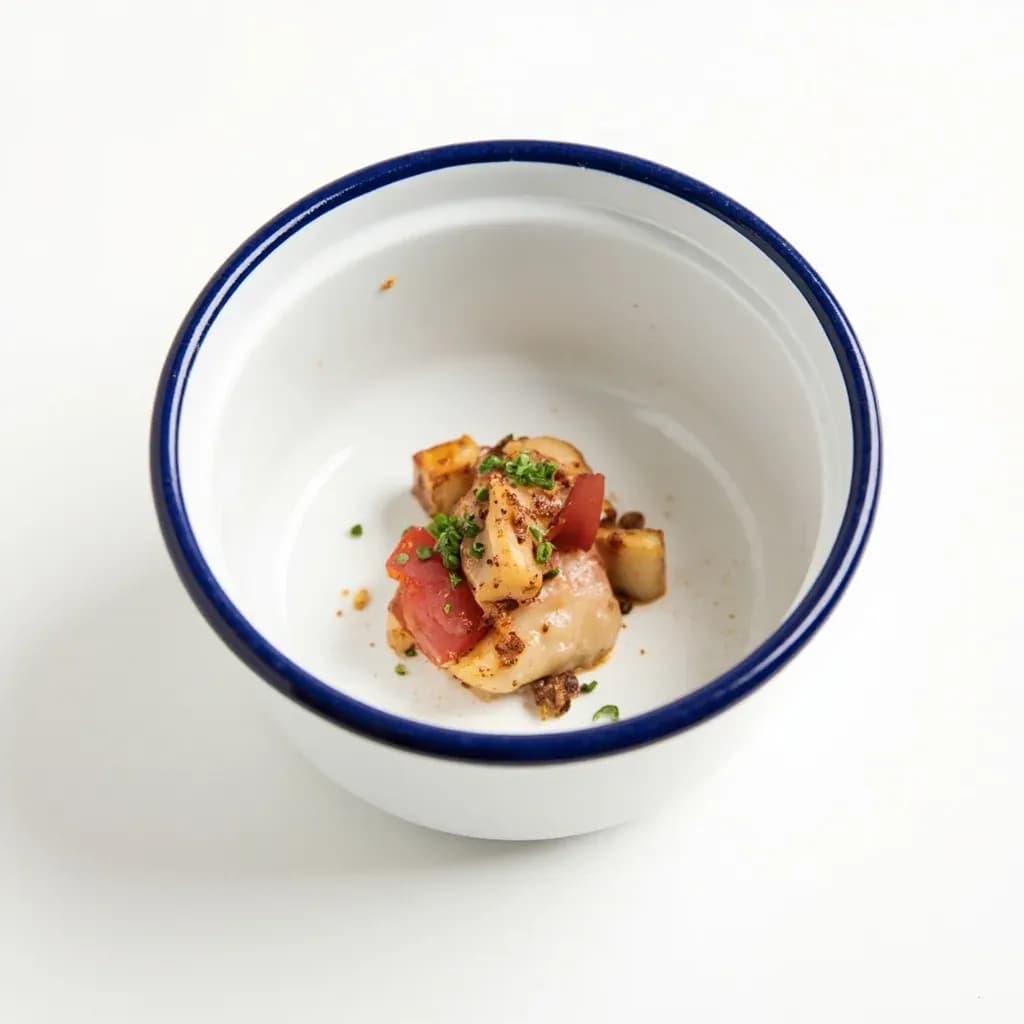
An enamel bowl is a metal bowl, usually steel, coated with a smooth, glassy vitreous enamel that resists rust and is easy to clean. Durable and lightweight, it is used across home and rustic kitchens for mixing, soaking, washing produce, and serving food and porridge. The enamel surface is nonreactive, so it safely holds acidic foods, though chips can expose the metal underneath.
An enamel bowl is a metal bowl — almost always a carbon or low-carbon steel shell — sheathed in a glassy coating called vitreous (or porcelain) enamel. That coating is made from a powdered glass frit fused to the steel at roughly 750–850 °C / 1380–1560 °F, which is what gives the bowl its smooth, glossy, ceramic-looking interior while keeping the lightness and toughness of metal underneath.
The combination matters in a working kitchen because it gives a cook something neither raw stainless steel nor ceramic can quite match. The glass surface is non-reactive, so a vinaigrette made with lemon, a tomato sauce, or a wine-based marinade picks up no metallic taint; it is non-porous, so the bowl holds no lingering smell from last night's garlic or smoked fish; and because most are white inside, you can read the colour and volume of a batter, the bloom of a dressing, or the rise of a dough at a glance. It weighs roughly half what a stoneware bowl of the same size does, and unlike glass or ceramic it will not shatter if a child knocks it off the counter or a cook drops it on a tile floor.
The weakness is impact. A hard knock can chip the glass coating, and once the steel underneath is exposed, that spot will rust if left wet — which is why an old café bowl is often the first thing in a kitchen to be retired. Used gently, though, an enamel bowl will outlast a stack of plastic ones, which is exactly the reason it became standard issue in European canteens, hospitals, and scout camps long before plastic took over, and why makers from Falcon to Riess have kept producing it for over a century.
Alternatives
Types & varieties
The iconic European café and cafeteria look; the institutional bistro bowl for over a century
Equally classic diner and canteen variant; often sold as a matched pair with the blue-rim version
Dark speckles over a cream or pale base; the visual shorthand for vintage graniteware and camping lines
Single-colour enamel throughout; favoured in modern Scandinavian and Japanese-style kitchens and in design-led brands
Hand-painted or transfer-printed blue-and-white florals and geometrics; the traditional look of Turkish, Russian, Polish, and Central European enamelware
Heavier cousin with the same glass-like surface but a cast iron core; built as oven-to-table serving bowls
How It Compares to Other Mixing Bowls
An enamel bowl sits in a useful middle ground between the other bowls most cooks already own, and knowing where it wins and loses helps you decide when to reach for it.
- Versus raw stainless steel: enamel wins on non-reactivity (no metallic taste in acidic mixtures) and on visibility (a white interior shows the colour of the food); stainless wins on durability if you routinely work with metal whisks and sharp tools.
- Versus ceramic or glass prep bowls: enamel wins on weight and on shatter resistance, which is why it has been the canteen, hospital, and camp standard for a century; ceramic wins on heat retention for tasks like proofing dough in a cold kitchen.
- Versus plastic: enamel wins on hygiene (no absorbed odours, no staining from turmeric or beetroot) and on longevity; plastic wins on price and on the ability to flex rather than chip if dropped.
- Versus enameled cast iron: the steel-cored bowl is far lighter and is built for everyday prep; cast iron bowls are heavier, hold heat, and double as oven-to-table serving dishes.
Common uses
Tips & pitfalls
- Use silicone, wood, or plastic utensils; metal whisks and sharp knives can scratch or chip the glass surface and expose the steel underneath
- Hand wash with a soft sponge and mild detergent — scouring pads wear down the gloss and can cut through to the core
- Dry the rim and any chipped spot immediately; exposed steel will rust quickly if left wet
- Lift stains from turmeric, beetroot, or berries with a paste of baking soda and water, or a short soak in diluted oxygen bleach
- Avoid thermal shock — do not move the bowl from the freezer to a hot oven, or pour boiling water into a cold bowl
- Never put it in the microwave; the metal core will arc
- Choose a pale interior (most have one) so you can judge the colour and rise of batters and doughs accurately
- Buy a nested set in graduated sizes — they are the most useful configuration for everyday prep and serving
Good to know
- Material
- Carbon or low-carbon steel core with a porcelain (vitreous) enamel coating
- Coating
- Glass-based frit fused to the metal at roughly 750–850 °C / 1380–1560 °F
- Weight
- Roughly half the weight of stoneware of the same volume; lighter than ceramic or glass bowls
- Typical sizes
- Small prep bowls from about 250 ml up to mixing bowls of 4–6 L; graduated nesting sets are common
- Heat tolerance
- Oven safe up to typical enamelware limits (around 250–270 °C / 480–520 °F); stovetop use is not recommended for thin steel-cored bowls as the base can warp and damage the enamel; not microwave safe because of the metal core
- Reactivity
- Non-reactive with acidic ingredients (citrus, tomato, vinegar, wine) when the enamel is intact
- Hygiene
- The glass surface does not absorb odours or flavours, making it a long-standing alternative to plastic prep bowls
- Notable makers
- Falcon Enamelware (Birmingham, England, founded 1920), Riess (Ybbsitz, Austria, enamelling since the 16th century), and the folkware traditions of Turkish, Polish, Russian, and Czech workshops
Also called
Enamel Basin · Enamel Dish · Enamelware Bowl
Related

Peeler
Swift blade for stripping skin off fruit and vegetables

Grater
Sharp-toothed surface for shredding cheese and vegetables

Microplane
Ultra-fine rasp for citrus zest, garlic, and hard cheese

Mixing Bowl
All-purpose bowl for combining, whisking, and tossing

Whisk
Looped wires that beat air into eggs, cream, and sauces

Spatula
Flat blade for flipping, lifting, and scraping

Slotted Spoon
Pierced spoon that lifts solids and drains the liquid behind

Wooden Spoon
Gentle, heat-friendly spoon for stirring anything