Prep Tools
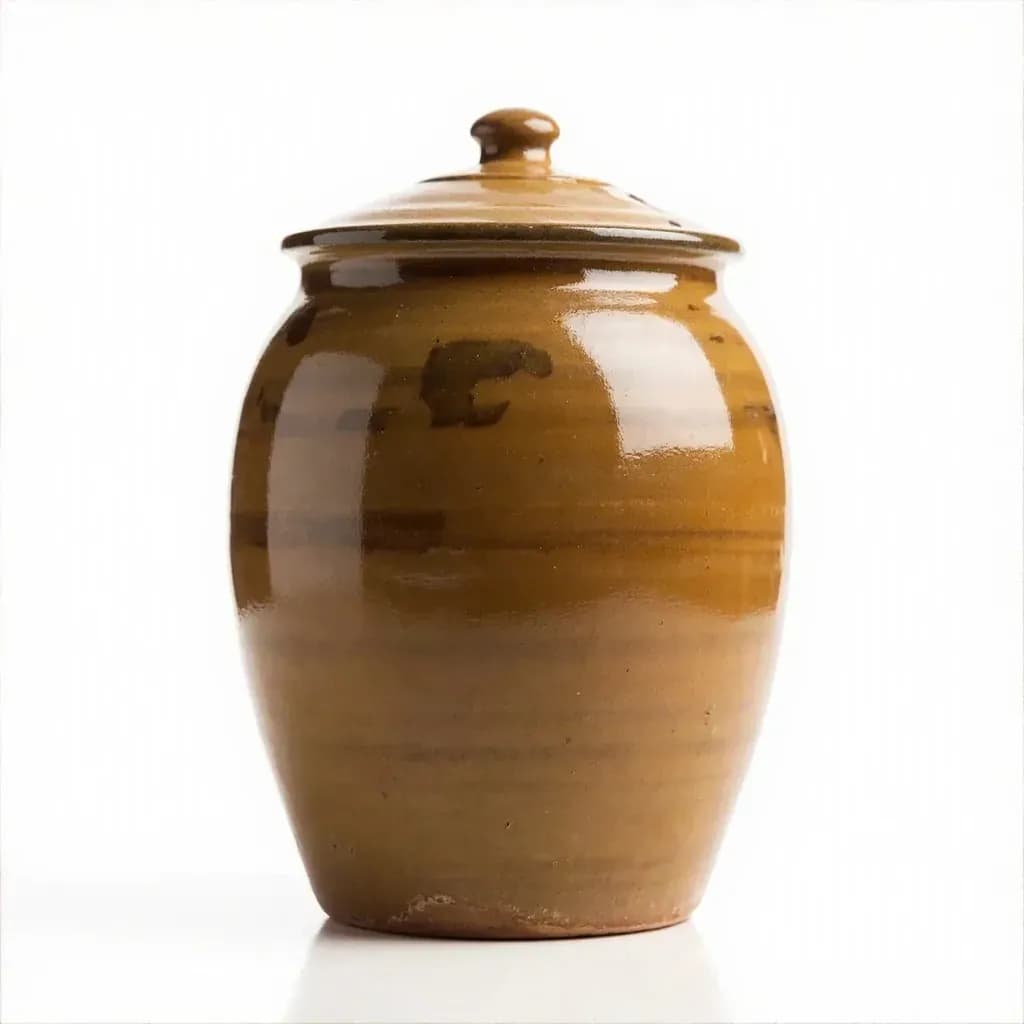
Fermentation Crock
A heavy vessel for fermenting vegetables and batters, keeping food submerged and air out.
A fermentation crock is a sturdy ceramic, clay, or plastic container used to ferment sauerkraut, kimchi, pickles, and batters like idli and dosa. Weights keep the food under its brine while a water-seal moat lets fermentation gases escape without letting fresh air or mold in. The thick walls and stable shape help hold a steady temperature through the days-long souring process.
A fermentation crock is a heavy ceramic or stoneware vessel engineered specifically for anaerobic vegetable fermentation — the slow, lactic-acid transformation that turns fresh cabbage into sauerkraut or kimchi, and cucumbers into full-sour pickles. What separates it from any other large food-safe container is a pair of design features working in concert: an inner lid and weight that keep the food pressed down under its own brine, and a water-filled channel around the rim that lets carbon dioxide escape while sealing oxygen out. That combination creates the stable, oxygen-free environment lactobacilli need to dominate the fermentation, while suppressing the molds and yeasts that cause surface scum and off-flavors.
The vessel matters because fermentation is as much an engineering problem as a culinary one. Vegetables give off CO2 as they ferment, and if that gas has nowhere to go, pressure builds; if oxygen gets in, surface molds colonize the food and the batch is lost. The water-seal crock solves both problems passively — you never need to "burp" it the way you would a sealed jar, and you do not have to babysit a plate-and-weight setup. For anyone making sauerkraut, kimchi, or fermented pickles in batches larger than a quart, a proper crock is the most forgiving tool available.
In practice, a 2- to 5-liter crock is the sweet spot for most home cooks: large enough for a meaningful batch of kraut or kimchi, small enough to keep on a counter or in a cool pantry, and manageable in weight when full. The crock is not the food — it is the chamber in which the food transforms — and a well-made one will outlast decades of use if handled with a little care.
Alternatives
Types & varieties
German stoneware with a U-shaped water channel around the rim, a domed inner lid, and matching ceramic weights; the benchmark design
Tall, straight-sided stoneware jar without a water seal; relies on a heavy plate and weight to keep food submerged; older, simpler form
Porous, unglazed Korean or Balkan clay vessel that breathes; traditionally buried or kept cool and represents a fundamentally different fermentation environment
Clear glass versions exist (typically 2–5 L) for visibility; less thermally stable than stoneware but useful for beginners who want to watch the process
Modern American-made (Ohio Stoneware and others) one- or two-piece ceramic crocks with a domed lid that nests into the pot, no water channel
Salt-glazed or alkaline-glazed 1–10 gallon crocks from the late 1800s to early 1900s, often repurposed for fermentation today and prized for their thick walls and weight
How the water seal works
The U-shaped channel around the rim of a Harsch-style crock is the heart of the design. You pour clean water into that channel before seating the outer lid, and the lid's lower edge sits down into the water. Gases produced inside — mostly CO2 from active fermentation — push outward and bubble up through the water, venting safely. Oxygen from the room air, however, cannot pass back through that water barrier into the vessel. The result is a one-way valve that requires no attention: the crock regulates its own atmosphere as long as the channel stays full. This is why a properly used water-seal crock rarely develops surface mold and never needs to be 'burped' the way a sealed mason jar does.
- The water channel needs to be refilled as it evaporates, especially in dry or warm kitchens
- The outer lid is not airtight — it is the water, not the lid, that creates the seal
- A faint bubbling or fizzing at the rim during peak fermentation is normal and a sign the seal is working
Choosing a size
Match the crock to what you actually eat. A 2-liter crock holds roughly 1.5 to 2 kilograms of shredded cabbage and produces about a quart and a half of finished sauerkraut — enough for a single person or a couple to work through in a few weeks. A 5-liter crock is the most versatile home size, holding enough for a batch of kraut, a round of kimchi, or a generous run of fermented pickles. Anything larger (10 L and up) is worth considering only if you process bushel baskets of produce at peak season, because once a crock is opened, the contents begin to oxidize and the batch is on a clock.
- 1–2 L: starter size, good for experimentation and small households
- 3–5 L: the everyday home size, roomy enough for a head of cabbage plus trimmings
- 10–15 L: serious preserving scale, heavier and harder to move when full
Care and longevity
A fermentation crock is one of the few kitchen tools that genuinely improves with age, provided the glaze stays intact and the stoneware is not thermally shocked. The simplest care routine — hot water rinse after each batch, air-dry with the lid off and the channel empty, store in a dry cupboard — is enough. Mild soap is acceptable on well-glazed crocks, but skip it on vintage or crazed pieces where residue can lodge in the ceramic and flavor the next batch. Inspect the glaze before each use: hairline cracks (called crazing) can harbor bacteria and are a reason to retire a vintage crock to decorative duty.
- Hand-wash with hot water only; skip the dishwasher
- Avoid moving a cold crock into a hot oven or pouring hot liquid into a cold crock
- Store with the lid off and the water channel empty so the stoneware can breathe
- Replace a crock with visible crazing, chips at the rim, or any crack that runs through the wall
Common uses
Tips & pitfalls
- Keep the water channel filled throughout fermentation; top it up if it evaporates, especially in a dry kitchen
- Use a salt concentration around 2% of vegetable weight — too little invites mold, too much stalls the lactobacilli
- Pack vegetables tightly and keep them fully submerged under the brine to prevent surface mold and oxidation
- Open the crock only to check, taste, or press the food down — every opening lets oxygen in and slows the process
- Clean stoneware with hot water only; skip the soap on vintage or crazed crocks, where it can lodge in the ceramic
- Ferment at 18–22 °C (65–72 °F) for predictable results; warmer ferments go fast and risk off-flavors, cooler ferments stall or crawl
- Inspect the glaze for crazing or cracks before each batch; hairline cracks in old crocks can harbor unwanted microbes
- Move the crock out of direct sunlight — UV raises temperature unevenly and can degrade the glaze over time
- When finished, transfer to sealed jars and refrigerate to slow the fermentation; a well-cared-for crock can be reused for years
Good to know
- Material
- Glazed stoneware (traditional); also available in unglazed earthenware and clear glass
- Key feature
- A water-filled rim or 'moat' that creates an anaerobic seal, letting CO2 vent while blocking oxygen
- Inner lid
- A floating or fitted inner lid that sits directly on the food surface
- Weight
- Usually supplied with ceramic half-moons or a single stone weight to keep food submerged under brine
- Typical sizes
- 1 L, 2 L, 3 L, 5 L, 10 L, and 15 L (roughly 1–4 U.S. gallons) for home use
- Working temperature
- Best at 18–22 °C (65–72 °F); fermentation slows or stalls below 15 °C (60 °F)
- Fermentation time
- 1–4 weeks for most vegetable ferments; can run longer for shelf-stable krauts
- Salt guideline
- Roughly 2% of vegetable weight by mass is the standard starting point
- Origin
- European stoneware tradition (German, Polish, Bohemian) for sauerkraut; Korean onggi and Balkan amphorae are parallel traditions
- Notable maker
- Harsch (Bürgersbach, Germany), the long-standing reference brand, founded 1793
- Care
- Hand-wash, air-dry with lid off; avoid sudden temperature changes to prevent stoneware cracking
Also called
Fermentation Batter Bowl · Batter Bowl · Plastic Batter Container · Fermenting Crock
Related

Peeler
Swift blade for stripping skin off fruit and vegetables

Grater
Sharp-toothed surface for shredding cheese and vegetables

Microplane
Ultra-fine rasp for citrus zest, garlic, and hard cheese

Mixing Bowl
All-purpose bowl for combining, whisking, and tossing

Whisk
Looped wires that beat air into eggs, cream, and sauces

Spatula
Flat blade for flipping, lifting, and scraping

Slotted Spoon
Pierced spoon that lifts solids and drains the liquid behind

Wooden Spoon
Gentle, heat-friendly spoon for stirring anything