Prep Tools
Fermentation Vessel (Demijohn)
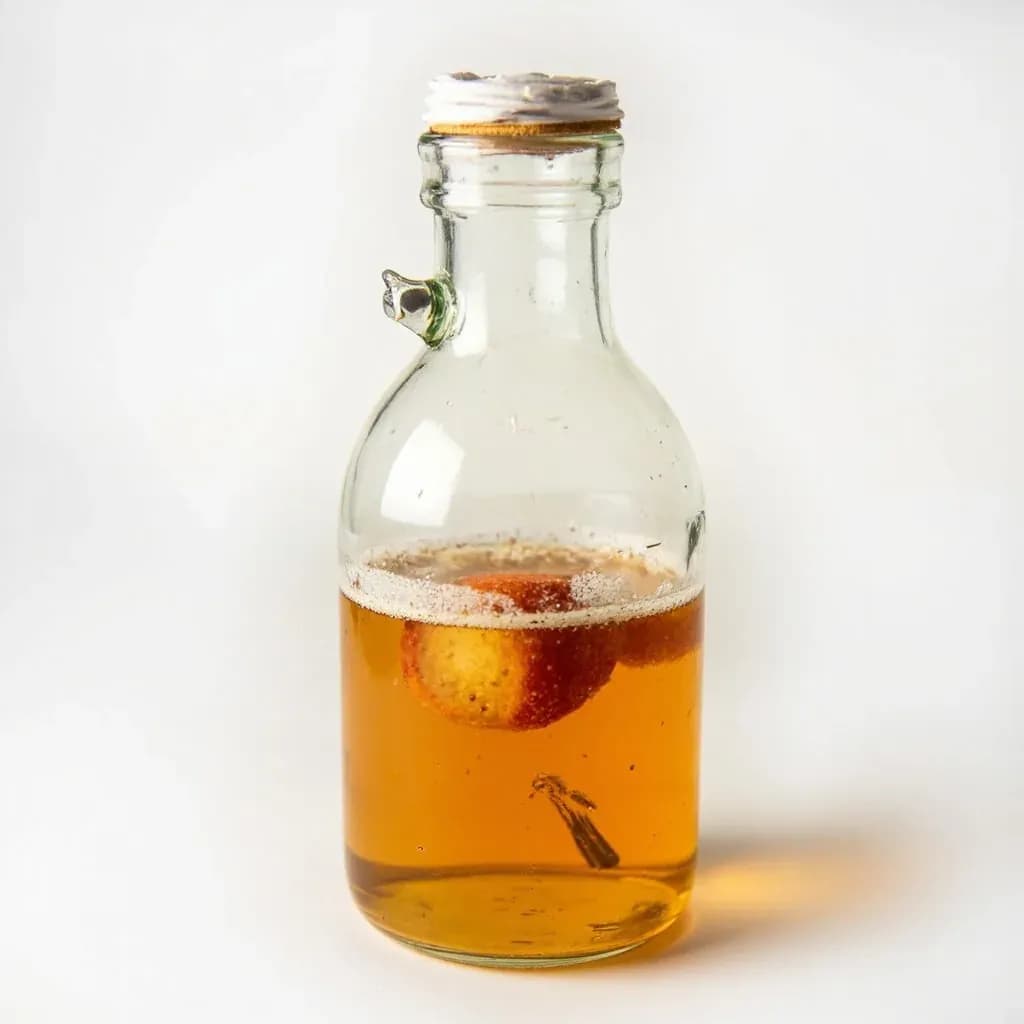
A large glass jug for fermenting wine, cider, vinegar, and other brews under airlock.
A fermentation vessel such as a demijohn or carboy is a large narrow-necked glass jug used to ferment and age liquids like wine, cider, mead, and vinegar. The narrow neck takes an airlock that lets carbon dioxide escape while keeping oxygen and contaminants out, and the glass lets the maker watch the brew clear over time. Its size suits batch fermentations that need weeks or months.
The demijohn is a large, narrow-necked glass bottle purpose-built for fermentation and bulk aging. Its defining features—the slender 25–30 mm neck that takes a rubber bung and airlock, and the bulbous body that holds from 1 L to 54 L of liquid—make it a self-contained, oxygen-controlled environment for wine, cider, vinegar, and mead. The traditional woven wicker or palm-leaf wrapping is not decorative: it cushions minor impacts, blocks UV light that can skunk aromatics in cider and hoppy ferments, and lets the vessel breathe slightly—useful for older-style oxidative ferments like sherry-style ciders and balsamic-tradition vinegars.
For batches in the 2–25 L range, demijohns occupy a useful middle ground between a kitchen crock and a winery tank. They are cheap, transparent enough (or translucent through wicker) to watch fermentation tick through its stages, and narrow enough at the neck to limit oxygen ingress and evaporation during months of aging. The trade-offs are real: a full 4.5 L vessel weighs around 6–6.5 kg and is awkward to move, the narrow mouth demands a long-handled bottle brush, and the glass is not pressure-rated—if the airlock dries out under an active ferment, pressure builds and the vessel can crack.
New cidermakers, home vintners, and mead-makers typically graduate to a wide-mouth carboy or PET fermenter once past the experimental stage, but the demijohn remains the iconic teaching tool. A 4.5 L wicker-wrapped bottle produces roughly six standard wine bottles per batch—manageable to bottle, drink, and learn from in a single season.
Alternatives
Types & varieties
The classic 4.5–25 L form: glass bottle encased in woven willow or palm for impact protection and UV shielding. Still imported from Italy, Spain, and Portugal for traditional winemaking.
Unwrapped, easier to inspect for clarity, sediment, or infection. Best stored in a cupboard or box if the ferment will sit in a lit room.
Lightweight food-grade polyethylene terephthalate; widely used by home cidermakers and small vineyards. Safer to handle when full, but scratches more easily and admits a little oxygen over long storage.
Traditional in some German (Bembel) and Mediterranean regional winemaking. Opaque, good thermal mass, but heavier, harder to sanitise, and you cannot see the ferment.
Lower-bored versions fitted with a plastic or glass spigot for racking finished wine or vinegar off the lees without siphoning.
Useful for laboratory-style ferments, vinegar mother cultivation, and small experimental batches where you want to test a recipe before scaling up.
Sizing and headspace
Choosing the right size comes down to your batch volume, your handling comfort, and how much krausen the ferment produces. A demijohn that is too full can foam out through the airlock; one that is too large leaves too much oxygen in the headspace, risking oxidation and, in vinegar work, surface mould.
- For wine, cider, and mead, fill to 80–85% of capacity (15–20% headspace) to absorb the foam and CO₂ of active fermentation.
- For vinegar, fill to 90% or higher: a smaller headspace reduces the oxygen-exposed surface and slows over-acetification.
- A 4.5 L demijohn yields roughly six 75 cL bottles—ideal for a first batch.
- Anything above 25 L is hard to move safely and clean effectively; consider a glass carboy or food-grade bucket instead.
Cleaning the narrow neck
The narrow neck is the demijohn's biggest ergonomic weakness. A standard bottle brush will not reach the shoulders, and any sediment left behind becomes a reservoir for infection on the next batch.
- Use a long-handled demijohn brush (40–50 cm shaft) with stiff polypropylene bristles.
- Wash with hot PBW or soda-ash solution, then rinse and follow with a no-rinse acid sanitiser such as star-san.
- For stubborn rings, fill the demijohn with hot water and a teaspoon of citric acid overnight, then brush and rinse.
- Always sanitise the bung and airlock separately—they harbour microbes in their crevices and must be treated as part of the same workflow.
Common uses
Tips & pitfalls
- Sanitise every piece that touches the brew—demijohn, bung, airlock, siphon, and funnel—with a no-rinse acid sanitiser; soap residue ruins head retention and leaves off-flavours.
- Never lift a full demijohn by the neck; cradle the body with both hands or use a brew-belt and a second person—a 25 L vessel can weigh 30 kg.
- Keep the airlock topped up with sanitiser solution or cheap vodka (no off-flavours, no mould) so it never dries out during long ferments.
- Ferment cool whites and ciders at 10–15 °C, reds and meads at 18–24 °C; wide temperature swings stall yeast and strip fruit aromatics.
- Rack off the gross lees 2–3 weeks after fermentation visibly stops—leaving wine on its lees for months produces hydrogen sulphide and rubbery off-notes.
- Wrap clear demijohns in a tea towel or store them in a box if the ferment must live in a lit room; UV skunking is real for cider and hoppy ferments.
- Drill a 6–8 mm hole through the wicker of an old wrapped demijohn to fit a standard airlock—a solid cork alone vents far too slowly under an active ferment.
- Replace rubber bungs every few years; old bungs harden, leak, and harbour microbes in the micro-cracks.
- To free a stuck bung, run warm water around the neck; the thermal expansion usually releases it without prying and risking a crack in the glass.
Good to know
- Material
- Borosilicate or soda-lime glass; traditional versions are cased in woven wicker or palm leaves for impact and UV protection.
- Neck diameter
- Approximately 25–30 mm—narrow enough to seal with a tapered rubber bung (#6–#8) and airlock, too narrow to admit a hand.
- Common capacities
- 1 L, 2 L, 4.5 L (1 imperial gallon), 5 L, 10 L, 15 L, 25 L, and 54 L (15 imperial gallons) for commercial cellars.
- Weight when full
- A 4.5 L demijohn of liquid weighs roughly 6–6.5 kg (13–14 lb); a 25 L vessel can reach 30 kg when full.
- Working fill
- Leave 15–20% headspace to absorb krausen, CO₂ foam, and any fruit cap during active fermentation.
- Closure
- Cork or tapered rubber bung fitted with a water- or silicone-bubble airlock; never seal solid—glass is not pressure-rated.
- Light sensitivity
- Clear glass transmits UV, which can damage hop compounds and oxidise delicate aromatics; wicker or a cloth sleeve shields the brew.
- Sanitisation
- Wash with hot PBW or soda-ash solution, then rinse and sanitise with a no-rinse acid sanitiser such as star-san before each use.
- Name origin
- From French dame-jeanne (Lady Jane), attested from the 17th–18th centuries, likely a folk rendering of an Arabic or Persian root for a large bottle.
Also called
Demijohn · Glass Carboy · Glass Fermentation Jar · Carboy
Related

Peeler
Swift blade for stripping skin off fruit and vegetables

Grater
Sharp-toothed surface for shredding cheese and vegetables

Microplane
Ultra-fine rasp for citrus zest, garlic, and hard cheese

Mixing Bowl
All-purpose bowl for combining, whisking, and tossing

Whisk
Looped wires that beat air into eggs, cream, and sauces

Spatula
Flat blade for flipping, lifting, and scraping

Slotted Spoon
Pierced spoon that lifts solids and drains the liquid behind

Wooden Spoon
Gentle, heat-friendly spoon for stirring anything